Families planning everyday half-term snacks
Compare flavours, portion sizes and nutrition labels without assuming that popcorn marketed around protein meets the condition for a ‘high protein’ claim.


Choose ordinary popcorn for its flavour and portion format, not as a high-protein snack. Myprotein’s checked Sweet and Salty Protein Popcorn provides about 17% of its energy from protein, below the 20% condition for a ‘high protein’ claim set out in the annex published on legislation.gov.uk. If a child needs a higher-protein snack for an individual dietary reason, follow their clinician’s or dietitian’s advice rather than relying on popcorn.
The reason for buying popcorn changes which label details matter most.
Compare flavours, portion sizes and nutrition labels without assuming that popcorn marketed around protein meets the condition for a ‘high protein’ claim.
If a child has been advised to increase protein because of poor appetite or another clinical concern, use the advice from the clinician or dietitian managing their care. Popcorn is not a substitute for that plan.
Read the exact pack for age restrictions, unpopped-kernel warnings and allergen declarations. Microwave popcorn also needs preparation according to its pack instructions.
Start with the reason for choosing popcorn, then compare the exact flavour and pack size rather than judging by the product name alone.
| Priority | What to check | Your needs |
|---|---|---|
| Protein claim | Read protein and energy per 100 g on the exact variant. The annex published on legislation.gov.uk sets a 20% energy-from-protein condition for a ‘high protein’ claim; protein grams alone do not show whether it is met. | I want to know whether ‘protein’ in the name means this popcorn meets the high-protein condition, or simply contains some protein. |
| Portion and flavour | Compare the per-serving and per-100-g figures for sugars, salt, fat and energy. Check the number of servings in a sharing bag and look at the ingredients for sugar or sweeteners. | For a half-term snack, I may want a small individual pack or a bowl to share. I also want to compare sweet and savoury flavours on the same serving basis. |
| Age and allergens | Check the current pack’s age limit and unpopped-kernel warning. Read both the ingredients and precautionary allergen statements, particularly when considering a protein-enriched product. | A child’s age or a milk or soya allergy could rule out a particular pack, regardless of its protein figure. |
| Preparation | Distinguish ready-to-eat bags from microwave popcorn. For a microwave product, follow its appliance and hot-bag instructions and check the amount prepared by each bag. | When we need a snack without cooking, a ready-to-eat pack is simpler to serve; microwave popcorn needs time and attention during preparation. |
Myprotein’s checked Sweet and Salty variant lists 18 g protein and 1,798 kJ per 100 g. Those figures put about 17% of its energy from protein, below the 20% condition for a ‘high protein’ claim in the annex published on legislation.gov.uk.
When that distinction matters, compare protein and energy on the exact variant’s label. Using the per-100-g figures, multiply protein in grams by 17 kJ and divide by energy in kJ.
The checked ASDA 80 g salted popcorn bag suggests three servings, while Tesco’s 110 g Sweet & Salted popcorn listing states four. Whole-bag intake therefore differs from a single serving shown on a label.
Check the declared serving size and servings per pack alongside the per-100-g nutrition table before dividing a bag into snacks.
Tesco’s listing for Metcalfe’s Sweet ’N Salt popcorn states that it is not suitable for children under 4 and warns that unpopped kernels may be present. Other checked products also carry kernel warnings.
Read the warning on the pack being served and do not disregard its stated age limit. Follow the preparation and hot-bag instructions for microwave popcorn.
Sweet and savoury popcorn labels differ in sugars, salt and serving size. A protein figure does not describe those other parts of the choice.
Compare the nutrition table, ingredients and portion format for the flavour you are buying. The NHS also advises choosing fruit and vegetables as snacks and limiting packaged snacks to two a day.
These details refer to the named products, not every flavour or pack sold under each brand.
Its checked Sweet and Salty Protein Popcorn lists 3.8 g protein per 21 g bag, according to Myprotein’s product information.
The checked Fresh Salted product is a microwave popcorn multipack listed by ASDA.
The checked Sweet ’N Salt product is a ready-to-eat 80 g bag listed by Tesco.
Tesco’s checked listing is for a 23 g Sweet & Salt popcorn bag.
Its checked own-label Salted Popcorn is an 80 g sharing bag with three suggested servings.
These popcorn packs cover ready-to-eat individual portions and a microwave option for half-term snacking. Choose between them by flavour, pack size, preparation and the warnings on the current pack, rather than treating them as high-protein foods.
 No image available
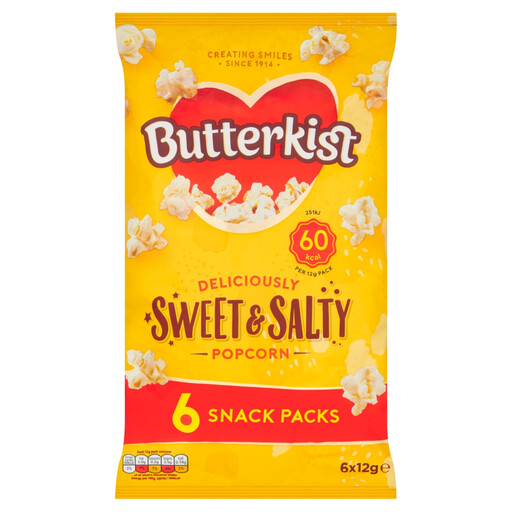
The six individual bags offer a stated portion size for a sweet-and-salty snack. Product information flags an under-4 restriction and possible hard pieces; check the current pack before serving.
 No image available
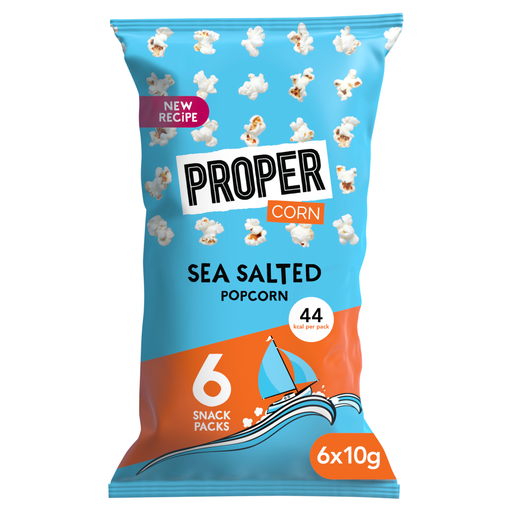
Six 10 g bags offer small savoury portions. The product information says it may contain milk; check the current pack for allergen, age and kernel warnings before serving.
 No image available
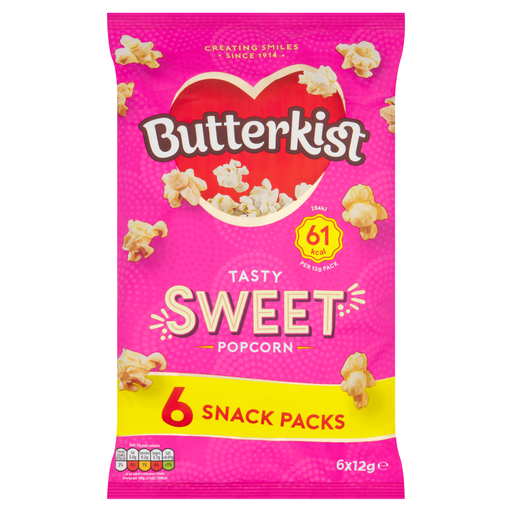
This sweet variant comes in six individual 12 g bags. Its product information states that it is unsuitable for children under 4 because of a choking hazard and that hard pieces may remain.
 No image available
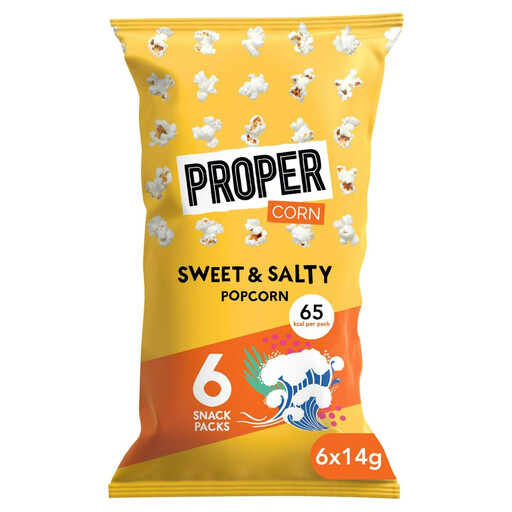
The six 14 g bags provide individual sweet-and-salty portions. Product information includes precautionary milk and soya statements; read the current pack’s allergen and child-safety information before buying.
 No image available
Three 60 g microwave bags suit a snack prepared at home rather than an immediately ready-to-eat portion. Product information calls for a microwave with a turntable, adult attention during preparation and care with the hot bag; follow the current pack’s instructions and kernel warnings.
Not simply because it contains protein or has ‘protein’ in its name. The annex published on legislation.gov.uk sets a 20% energy-from-protein condition for a ‘high protein’ claim. Myprotein’s checked Sweet and Salty Protein Popcorn provides about 17% when calculated from its stated protein and energy per 100 g; check the figures on the exact pack you are considering.
Myprotein lists 18 g protein per 100 g for its checked Sweet and Salty Protein Popcorn. ASDA lists 10 g per 100 g for PROPER Fresh Salted microwave popcorn and 8.2 g per 100 g for ASDA Salted Popcorn. Compare energy as well as protein if you need to assess a protein claim; compare the declared serving sizes if you want to know how much is in one snack.
Do not serve a product contrary to its age warning. Tesco’s listing for Metcalfe’s Sweet ’N Salt popcorn states that it is not suitable for children under 4 and warns of unpopped kernels. Check the warning on the exact pack, as other checked popcorn products also mention unpopped kernels.
Read the current ingredient and allergen declaration for the exact popcorn variant. Myprotein’s checked Sweet and Salty Protein Popcorn lists whey protein isolate containing milk and soya lecithin; ASDA’s listing for PROPER Fresh Salted microwave popcorn says it may contain milk. Do not assume that a different flavour or format has the same allergen statement.
Not when that snack is part of an individual plan for a child with poor appetite or increased nutritional requirements. Worcestershire Acute Hospitals NHS Trust discusses high-protein, high-energy diets in the context of children with specific needs. Ask the clinician or dietitian managing the child’s care what snack fits their plan.