Organisers planning self-service breaks
Sealed, ready-to-eat bags can be set out without cooking or dividing a sharing bag. Suppliers list 24-bag cases for catering and workplace settings, making the serving count straightforward to plan.


For a self-service conference break, choose ready-to-eat individual bags when you need sealed portions without venue preparation. A 24-bag case suits a larger planned serving count, while six-packs work for a small meeting or a top-up; microwave popcorn needs confirmed equipment, preparation time and a serving plan. Check the delivered packs’ ingredients and allergen statements before service.
Sealed, ready-to-eat bags can be set out without cooking or dividing a sharing bag. Suppliers list 24-bag cases for catering and workplace settings, making the serving count straightforward to plan.
A six-pack can cover a modest serving count or supplement an existing order. Tesco lists a 6 × 14 g pack and ASDA lists a Butterkist 6 × 12 g pack; count the bags needed across the whole break before ordering.
Check the exact delivered variant rather than relying on a flavour or brand name. For example, ASDA’s Propercorn 3 × 70 g listing carries a precautionary milk statement despite its vegan and gluten-free descriptions. Keep the applicable ingredient and allergen information accessible when serving attendees.
Start with the number of portions and how attendees will collect them, then check whether the venue can accommodate any preparation.
Choose when: You need a larger count of sealed bags for a self-service break.
Trade-off: A case commits you to one pack format, so confirm the serving count and delivered labels.
Choose when: The meeting is small or you need additional portions.
Trade-off: A larger conference may require several separate packs to be counted and transported.
Choose when: The venue confirms equipment, staff time and a way to serve the prepared popcorn.
Trade-off: It cannot go straight onto an unattended self-service table.
| Priority | What to check | Your needs |
|---|---|---|
| Individual portions | Count sealed bags against expected snack-takers. Check whether the product is ready to eat and whether its bags can be set out individually. | I need attendees to take a portion during a short break without someone dividing a larger bag. |
| Order quantity | Compare the number and weight of individual bags, not just the outer pack size. Work out how many complete packs meet the planned serving count. | For a small meeting, one or more six-packs may be enough; for a larger group, I want to know how many sealed servings a case provides. |
| Ingredients and allergens | Read the delivered variant’s ingredients, allergen declaration and precautionary statements. Keep the information available at service; do not apply one variant’s claims to another. | Attendees need to identify ingredients and declared allergens before selecting a snack, even when a pack is described as vegan or gluten free. |
| Venue preparation | For microwave popcorn, confirm equipment, staff time and a method of portioning it. For ready-to-eat bags, check the pack’s storage instructions before the event. | If there is no food-preparation plan, I want a snack that can be placed at the refreshment station ready to serve. |
A six-pack contains six individual portions, whereas the cited catering cases contain 24. The outer packaging alone does not tell you how many packs the full event requires.
Estimate the number of attendees likely to take popcorn, then total the sealed bags across your proposed order.
Using several retail multipacks also means more packs to count, store and carry.
Microwave popcorn needs preparation and portioning; individually bagged ready-to-eat popcorn does not. A short break may leave little time to prepare and distribute it.
Use sealed ready-to-eat bags when no preparation is planned. Otherwise, confirm the venue’s equipment, staffing and serving arrangements first.
Preparation adds staff time and clean-up to the break.
ASDA lists a Propercorn 3 × 70 g product as vegan and gluten free while also stating “May contain: Milk”. Those statements answer different questions about the product.
Inspect the delivered pack’s full ingredient and allergen wording, and make the relevant information available to attendees rather than relying on a front-of-pack claim.
A listed pack format is not a substitute for confirming that the intended quantity can be ordered and that the delivered packaging carries the information you plan to provide.
Confirm the order before finalising the refreshment plan, then inspect the packs received before service.
These references illustrate different pack formats; check the particular product and flavour you intend to serve.
Metcalfe’s offers popcorn flavours including sweet-and-salt and sea salt. J L Brooks lists a Sea Salt case containing 24 × 17 g bags.
Propercorn appears in small multipacks as well as larger case formats, with product-specific flavours and labels.
Butterkist offers a Sweet & Salty ready-to-eat six-pack listed by ASDA at 6 × 12 g.
Tesco’s own-label Sweet & Salted Popcorn is listed as a 6 × 14 g multipack for a smaller serving count.
Sainsbury’s lists an own-label Sweet & Salty Butterfly Popcorn 6 × 14 g pack alongside other popcorn formats.
Tesco lists a Tyrrells Sweet & Salty popcorn six-pack containing 6 × 12 g.
These ready-to-eat six-packs suit a small meeting or a top-up. For a larger conference, count how many packs you would need to provide the planned number of individual servings.
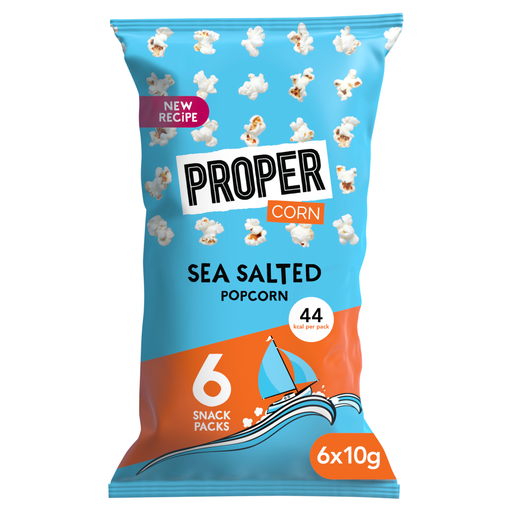 Image unavailable
Six ready-to-eat portions suit a small self-service break or a top-up without venue cooking. The product description warns of possible milk, gluten and soya traces; check the delivered label before providing allergen information.
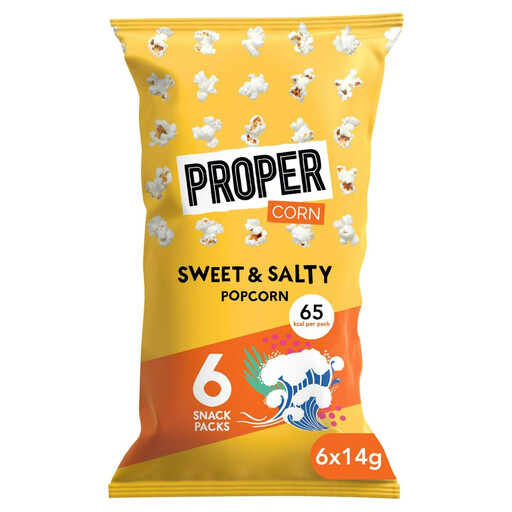 Image unavailable
This six-portion ready-to-eat pack can be set out for a small meeting without preparation. Its description warns of possible milk, gluten and soya traces; use the delivered pack’s wording when communicating allergens.
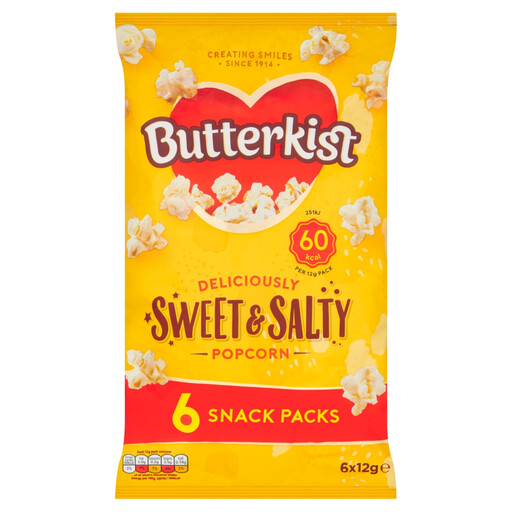 Image unavailable
Six ready-to-eat bags provide individual portions for a small group or top-up. The product information gives conflicting gluten statements, so check the delivered label before describing this pack’s dietary suitability.
Start with the number of attendees likely to take popcorn, then choose enough sealed bags to cover that planned serving count. A 24-bag case provides more individual portions per outer pack than a six-pack; allow for your attendance plan and any other refreshments rather than assuming every attendee will take a bag.
It suits a break only if the venue has suitable equipment, staff time and a way to prepare and serve it. For unattended self-service without food preparation, individually bagged ready-to-eat popcorn fits the serving plan more directly.
Yes, where a food business supplies the popcorn: Food Standards Agency guidance for England, Wales and Northern Ireland and Food Standards Scotland guidance for Scotland require allergen information for prepacked and non-prepacked food. Check the delivered product information and keep the applicable details available to attendees; how food is packed and served affects the labelling requirements.
No. Check the exact variant’s full label against the attendee’s requirements. ASDA’s Propercorn 3 × 70 g listing, for example, describes the product as vegan and gluten free but also states “May contain: Milk”.
You need an allergen-information process that matches how you supply it. Non-prepacked food still requires allergen information; if food meets the definition of prepacked for direct sale, Food Standards Agency guidance requires the food name and a full ingredients list with allergens emphasised on its packaging. Establish the applicable format before repacking or setting out the popcorn.