What matters when choosing?
For pork-joint batch cooking, decide whether you mainly need individual centre checks or monitoring throughout a longer cook. Then check whether the thermometer’s display, probe and cleaning instructions suit that job.
| Concern |
What to check |
Who this matters to |
| Repeatable centre checks |
Check for a °C display, a probe that reaches the thickest joint’s centre and cleaning instructions suitable for use between checks. |
When I cook several joints, I want to check each centre with a clean probe rather than rely on a surface reading. Around 50% of consumers put this repeatable check first. |
| Quick repeated readings |
Compare the stated response time and whether the display is easy to read at the point of use. |
With several portions to check, I want each reading to be easy to see without waiting longer than necessary. This is the primary need for around 30% of consumers. |
| Monitoring during a long cook |
Confirm probe capacity, charging and the connection or app needed for alerts. |
If I am preparing other dishes while a joint cooks, I want temperature updates without returning for every reading. Around 20% of consumers prioritise this hands-free approach. |
Joybuy product choices
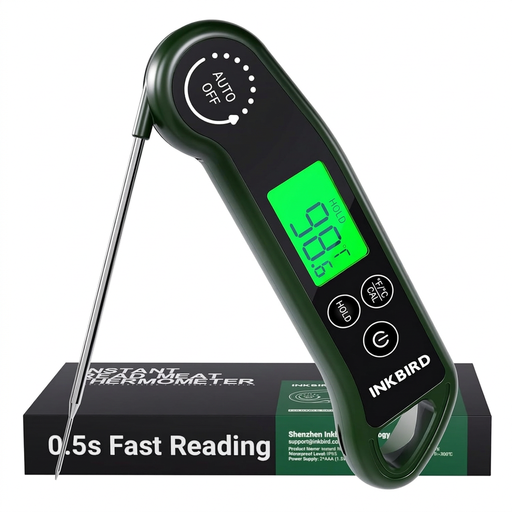
This instant-read meat thermometer is a choice to consider if you plan to check pork joints individually while roasting. Confirm that its probe and display meet your centre-checking needs before buying.
 No image available
INKBIRD RHT-11K K-Sensor Digital Meat Thermometer, Green
For individual checks while roasting, this model’s title states a 0.5-second reading and an LCD screen. Before using it for pork-joint batch cooking, check whether it displays °C, whether the probe reaches the centre of your thickest joint and how the probe should be cleaned.
View on Joybuy
Common questions
What temperature should I check for in a pork joint?
Check the applicable cooking instructions and account for both core temperature and holding time, rather than treating one instant reading as the complete target. GOV.UK food-business cooking guidance gives 70°C for 2 minutes as a standard core combination and says pork and rolled joints should be thoroughly cooked through.
Where should the probe go in a pork joint?
Put a clean probe into the thickest central section, not just the surface. GOV.UK advises inserting a clean thermometer probe into the centre of food when checking that it has been thoroughly cooked.
Should I clean the probe between checks?
Yes. GOV.UK home food-safety guidance advises fully cleaning a cooking thermometer after each use to avoid cross-contamination and support an accurate reading; take particular care before probing cooked food if the thermometer has touched raw pork.
Is a connected probe better for batch cooking?
A connected probe is useful if you want ongoing readings and alerts during a long cook, but it is not necessary for checking several joints individually at their centres. MEATER and Thermapen publish connected-monitoring features; a clean handheld instant-read probe remains a straightforward way to make separate centre checks.
Do home batch-cooked meals require food-business registration?
Cooking meals for your own household is different from starting or taking over a food business. Food Standards Agency registration guidance addresses food businesses; if you plan to sell or supply the food as a business, check the requirements with your local authority.


