Hosts serving one roast on schedule
If you will be near the oven before serving, a manual instant-read probe lets you check the joint without setting up phone monitoring.


For one oven-roasted pork joint that you can check shortly before serving, an instant-read thermometer with a clear Celsius display is a straightforward choice. A leave-in connected probe makes more sense if you need to follow the roast while greeting guests or preparing other dishes, but it adds charging, app and connection requirements. Whichever type you choose, follow the pork pack or recipe instructions and use a clean probe to check the centre of the joint.
If you will be near the oven before serving, a manual instant-read probe lets you check the joint without setting up phone monitoring.
A leave-in connected probe is worth considering if you want to follow the roast while preparing sides, answering the door or cooking outdoors. Check its app and connection requirements before choosing.
If you mainly want a Celsius reading near the end of cooking, a standalone digital thermometer avoids the charging and pairing involved in a connected system.
Decide whether you need one manual check before serving or temperature information throughout the cook; then check the display, measurement range and any equipment dependencies.
| Concern | What to check | Who this matters to |
|---|---|---|
| Final temperature check | Look for a readable Celsius display, a probe that can reach the joint’s centre and a measurement range covering the pack or recipe instruction. Check the stated response time if service is close. | If I am about to serve one roast, I want to check its centre promptly rather than keep the oven open. Roughly 50% of consumers would make that quick final check their primary concern. |
| Monitoring while hosting | Check that the probe can remain in your cooking setup, and confirm its temperature limits, charging needs, app compatibility and connection range. | While I prepare sides or spend time with guests, I would rather follow the roast without returning to the oven for every reading. Around 30% of consumers would put hands-off monitoring first. |
| Occasional, simple use | Confirm Celsius readings, a legible screen and cleaning instructions. If a battery is needed, check what comes with the thermometer. | For an occasional roast, I want a direct reading without setting up another connected device. About 20% of consumers would prioritise that simplicity. |
Weber says its separate meat-temperature probe must be used with an iGrill Mini, iGrill 2, iGrill 3 or Weber Connect device; it is not a standalone reading device.
Check whether the listing includes everything needed to display a reading before ordering a probe for your roast.
Choosing the separate Weber probe may also mean obtaining a compatible device.
A connected leave-in thermometer brings charging, app and connection considerations that may add little if you will be beside the oven shortly before serving.
Choose remote monitoring when being away from the roast is useful; otherwise compare standalone thermometers for display clarity and response time.
The Food Standards Agency’s guidance on GOV.UK says to clean a temperature probe fully after each use to avoid cross-contamination and obtain an accurate reading.
Clean the probe between checks and before storing it, following the care instructions for your model.
A target taken from another recipe may not reflect the instructions for the joint you are cooking. The Food Standards Agency advises following the recipe or packet temperature guidance.
Use the instructions for your pork joint, then check its centre with the thermometer.
Its Thermapen ONE is a standalone instant-read option for a manual check near serving time.
Its Pro smart probe is a connected leave-in route for hosts who want temperature information away from the oven.
Its Chef’s Precision Digital Instant Read Thermometer offers a standalone way to check an occasional roast.
Its connected thermometer equipment is relevant to cooks who already use, or intend to use, a compatible iGrill or Weber Connect setup.
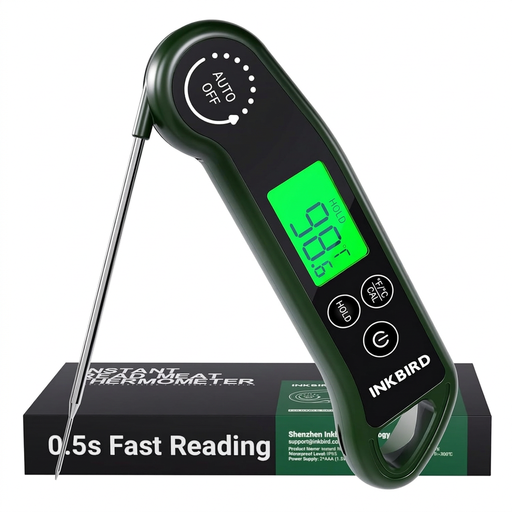
This digital meat thermometer is listed for roasting and may suit a check near serving time. Before choosing it for a pork joint, confirm that its sensor can measure the centre of the meat.
 No image available
For a roast check near serving, confirm that the sensor can be placed to measure the pork joint’s centre.
INKBIRD lists a 0.5-second reading and an LCD screen for this green RHT-11K K-Sensor model.
Check that it displays °C and that its measurement range covers the temperature in your pack or recipe instructions.
A thermometer lets you check the joint’s centre against its pack or recipe cooking instructions. The Food Standards Agency’s guidance on GOV.UK advises considering a food thermometer to verify the correct temperature.
Check the centre of the thickest edible part rather than relying on a surface reading. If the joint has bone or a large fat seam, follow the thermometer and recipe instructions on placement, and take another reading if the roast is uneven.
Follow the cooking time and temperature instructions for the specific pork pack or recipe, then use a thermometer to check the joint’s centre. This follows the Food Standards Agency’s cooking guidance on GOV.UK rather than assuming one target applies to every pork product.
Clean the temperature probe fully after each use. The Food Standards Agency says this helps avoid cross-contamination and supports an accurate reading; follow your model’s care instructions, particularly for any wiring or components that must not be immersed.
A wireless leave-in thermometer is useful when you want to follow the pork joint while tending to guests or other dishes; a standalone instant-read model is simpler for one check near serving. Before choosing wireless, confirm the app, charging, connection and cooking-setup requirements.