Who these oats may suit

Home biscuit bakers prioritising fibre

Choose a product with a clearly labelled fibre value per 100g if fibre density is your main consideration and a finer, bran-led texture works for the recipe. Mornflake and Waitrose product labels provide examples of bran-led and bran-added formats.

Bakers who want visible oat texture

Plain rolled oats can suit oat biscuits where recognisable flakes and a simple ingredient list matter more than maximising fibre per 100g. Quaker UK and Flahavan's describe their reviewed rolled-oat products as oat-based flake ingredients.

Gluten-free household bakers

Choose oats specifically labelled gluten-free when that is required. Coeliac UK notes that descriptions such as “100% oats”, “pure oats” and “organic” do not by themselves establish gluten-free status.

Buying priorities

Start with the texture your biscuit recipe needs, then compare fibre on the same per-100g basis and read the full ingredient and allergen information.

Priority What to check Your needs
Fibre per 100g Compare the nutrition panel on a per-100g basis. Check whether the fibre comes from oat bran, wheat bran or chicory inulin. Compare like-for-like dry ingredients. I want to compare fibre density without assuming every oat product has the same value. The reviewed labels range from 9.0g fibre per 100g for Quaker Traditional Rolled Oats to 25.6g per 100g for Mornflake Fibreful Oatbran.
Texture and recipe fit Choose fine oat bran for a bran-led ingredient, rolled oats for visible flakes, or oats with added wheat bran for a mixed format. Check the recipe before replacing one format with another. I want either a fine, less flake-defined biscuit or a recognisable oat texture. An oats-and-bran mix can keep flakes in the base while using a different ingredient profile from plain rolled oats.
Allergens and gluten-free use Read the current allergen statement and ingredient list. For gluten-free baking, look for a specific gluten-free label rather than relying on “organic”, “pure” or “100% oats”. If the biscuits are for a gluten-free diet, I need a specifically labelled product. Coeliac UK warns that standard oats can be contaminated when produced alongside wheat, barley or rye.
Nutrition claims in context Use fibre and beta-glucan wording to compare the dry ingredient and its stated conditions. Consider the complete recipe, quantities and serving size separately. I want to select an ingredient from its label, without treating a claim on oats as a claim about the finished biscuit. GOV.UK guidance states that voluntary nutrition and health claims must comply with the applicable rules.

Common buying pitfalls

  • Assuming every porridge oat product is equally high in fibre

    Labels for reviewed products vary substantially, so “oats” or “wholegrain” alone does not show how much fibre the product lists per 100g.

    Compare fibre per 100g, then check whether it comes from plain oat bran, added wheat bran or a blend containing chicory inulin.

  • Using an unsuitable oat product for gluten-free biscuits

    Standard oats may be contaminated with wheat, barley or rye, and wheat bran is itself a wheat-containing ingredient. “100% oats” and “organic” are not equivalent to a gluten-free label.

    For gluten-free baking, choose specifically labelled gluten-free oats, read the current pack and protect ingredients and preparation surfaces from cross-contamination.

  • Buying granola or muesli instead of a controlled baking ingredient

    Granola and muesli may include sweeteners, dried fruit, nuts, seeds or toasted flakes that alter a biscuit recipe's flavour, texture and allergen profile.

    For predictable results, start with a plain ingredient that matches the recipe: 100% rolled oats, 100% oat bran, or a deliberately chosen oats-and-bran blend.

  • Treating a product claim as a claim about the finished biscuit

    Fibre and beta-glucan information applies to the labelled product and stated serving conditions. The final biscuit depends on the amount used and the other recipe ingredients.

    Use the nutrition panel to compare dry ingredients, then assess the full recipe separately rather than extending a product claim to every biscuit made with it.

Relevant brand references

Mornflake

Relevant for bakers comparing plain oat bran with a fibre-enhanced oatbran blend.

  • Mornflake lists 19.4g fibre per 100g for Beta³ Oat Bran and 25.6g per 100g for Fibreful Oatbran.
  • Fibreful Oatbran contains chicory inulin, while oat bran is not a complete wholegrain according to Mornflake.

Flahavan's

Relevant for choosing between wholegrain rolled oats and a separate oat-bran baking ingredient.

  • Flahavan's Irish Porridge Oats are listed as 100% wholegrain rolled oats; Waitrose lists Flahavan's Oat Bran as 100% oat bran with 16g fibre per 100g.
  • Rolled oats and oat bran have different textures, so they are not like-for-like recipe substitutes.

Waitrose

Relevant for bakers wanting oat flakes with a measured addition of wheat bran.

  • Waitrose Porridge Oats with Wheatbran contains wholegrain oat flakes and 12% wheat bran, with 13.8g fibre per 100g listed on the label.
  • It contains wheat bran, so it is not suitable for gluten-free baking.

Quaker

Relevant as a straightforward rolled-oat option for biscuits with visible oat texture.

  • Quaker Traditional Rolled Oats are listed as 100% rolled oats with 9.0g fibre per 100g.
  • The label states that the product may contain wheat and barley, and its listed fibre is lower than the reviewed bran-led products.

Jordan's

A plain rolled-oat reference for buyers looking for organic wholegrain rolled oats.

  • Jordan's Organic Porridge lists organically produced wholegrain rolled oats and 8.1g fibre per 100g.
  • Its allergen statement says it may contain other gluten sources and nuts, so it should not be treated as specifically labelled gluten-free oats.

Dorset Cereals

Relevant mainly when a recipe deliberately calls for cereal blends rather than plain porridge oats or oat bran.

  • Dorset Cereals describes muesli and granola combinations containing wholegrain flakes, fruit, nuts, seeds and baked granola ingredients.
  • These combinations are not directly interchangeable with plain porridge oats in a controlled biscuit recipe.

Joybuy product options

Joybuy product options for fibre-focused biscuit baking, including an oat-bran route and a specifically labelled gluten-free oat-flake route.
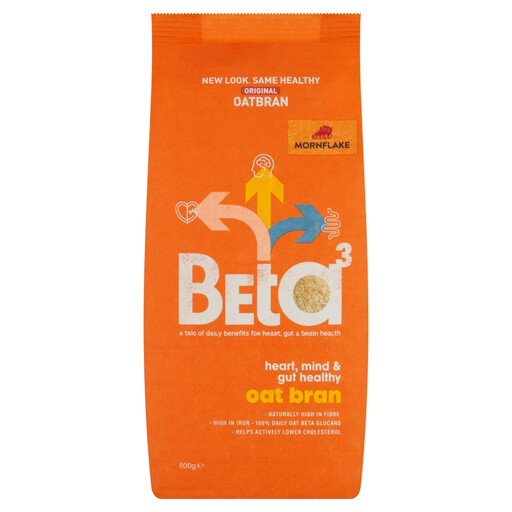
Mornflake Mighty Oats Original Heart Healthy Oatbran 800g

Mornflake Mighty Oats Original Oatbran 800g

A fibre-first option for biscuit recipes where a finer, bran-led texture is suitable.

100% oat bran; 19.4g fibre per 100g.

It is a bran ingredient rather than rolled oat flakes. The stated manufacturing information says it is unsuitable for wheat or barley allergy sufferers.

Joybuy

Morrisons Free From Gluten Free Oats 1kg

Morrisons Free From Gluten Free Oats 1kg

A plain oat-flake option for biscuit recipes needing a specifically labelled gluten-free oat base.

Gluten-free oats in a 1kg pack.

Contains oats; gluten-free suitability does not mean it is suitable for an oat allergy. Check that the flake format suits the recipe.

Joybuy

Frequently asked questions

Are oat bran and rolled porridge oats interchangeable in biscuit baking?

Not automatically. Oat bran is the bran portion of the oat seed, while rolled oats are whole rolled flakes; choose bran where a finer texture is acceptable and choose rolled oats where visible flakes matter. An oats-and-wheat-bran mix retains flakes but contains wheat.

Which reviewed option lists the most fibre for biscuit baking?

Among the reviewed products, Mornflake Fibreful Oatbran Porridge lists 25.6g fibre per 100g. Its ingredients are 87% oatbran and 13% chicory inulin, so check that this blend suits the recipe and household allergen needs before comparing it with plain oat bran.

Does “100% oats” mean that a product is gluten-free?

No. Coeliac UK says that “100% oats”, “pure oats” and “organic oats” do not establish that a product is gluten-free, because standard oats can be contaminated when produced alongside wheat, barley or rye. Choose oats specifically labelled gluten-free when required.

Can “high fibre” or beta-glucan wording tell me what my finished biscuits will be like?

No. Product wording applies to the labelled food and its stated conditions, while the finished biscuit depends on the recipe, the amount of oats used, other ingredients and serving size. GOV.UK states that voluntary nutrition and health claims must comply with the applicable rules.

How should oats or oat bran be stored after opening?

Keep dry oat ingredients in a cool, dry place in an airtight container. Mornflake advises storing its oat bran away from strong odours and using it within two months after opening and by the best-before date.