A plain pack containing only wholegrain oats gives you control over sweeteners in the dough, but it is not automatically a “reduced sugar” product: UK Government guidance treats that wording as a comparative nutrition claim. Use regular rolled oats for most recipes, choose jumbo oats for more distinct flakes, and use quick oats only where a smoother, faster-hydrating mixture is wanted. If gluten-free status matters, choose an explicitly labelled product and check the whole recipe.
Who these oats suit
Lower-added-sugar home bread bakers
Choose a simple oat ingredient so you can decide whether the dough contains sugar, syrup, fruit or sweet toppings. Product information from Flahavan’s and Joybuy shows examples with 100% wholegrain oats; check the exact pack rather than treating “reduced sugar” as a substitute for recipe-level sugar control.
Texture-led oat-bread bakers
Choose the flake format to match the loaf: regular rolled oats are a practical default, while jumbo and quick oats change flake size and hydration behaviour. Mornflake and Flahavan’s product information distinguishes smaller, faster-absorbing oats from larger flakes.
Gluten-free recipe followers
Choose oats specifically labelled gluten-free, then check every other bread ingredient and the preparation environment. The Food Standards Agency distinguishes foods labelled gluten-free from ordinary oat products, so the two should not be treated as interchangeable.
Buying priorities for oat bread
Start with the ingredient list, then match flake format to the recipe and check any gluten-free requirement before choosing a pack.
| Priority |
What to check |
Your needs |
| Control of added sugar |
Check for a plain ingredient list containing wholegrain oats only. Read the per-100g nutrition panel separately, and avoid sugar, syrup or flavouring in the ingredients when recipe-level control is the aim. |
I want the recipe, rather than the oat pack, to determine whether sweeteners are added to the loaf. |
| Flake format and texture |
Follow the recipe’s stated oat type where possible. Jumbo flakes are larger and thicker; quick or superfast flakes absorb liquid faster and can give a smoother mixture. |
I want the crumb and visible oat texture intended by the recipe, rather than assuming every porridge oat behaves the same way. |
| Gluten-free and allergen suitability |
Look for an explicit gluten-free label where required. Check the allergen statement, precautionary wording and all other recipe ingredients, including flour and raising agents. |
For a gluten-free loaf, I need the oat pack and the complete recipe to meet that requirement. |
Common buying pitfalls
-
Treating “reduced sugar”, “sugar free” and “no added sugar” as interchangeable
A plain oat product can have a 100% oat ingredient list while still showing naturally occurring sugars on its nutrition panel. A lower-added-sugar recipe is not automatically a product carrying a valid reduced-sugar claim.
Read both the ingredient list and the per-100g nutrition panel. For bread, choose plain oats without sugar or syrup ingredients, then adjust the recipe’s sweeteners separately.
-
Using sweetened instant sachets because they are labelled oats
Flavoured porridge sachets can add sugar before any bread ingredients are mixed in. Mornflake’s golden-syrup sachet, for example, lists wholegrain oatflakes alongside sugar.
For a lower-added-sugar loaf, choose a plain oat product with a short ingredient list rather than a flavoured sachet or pot.
-
Replacing regular rolled oats with quick or jumbo oats without adjusting expectations
Superfast oats use smaller flakes designed to absorb liquid faster, while jumbo oats are larger and thicker. That difference can alter hydration and texture in the finished loaf.
Use the oat type specified by the recipe. If you change format, make a small trial loaf and adjust liquid only according to the dough consistency the recipe calls for.
-
Assuming all oats are suitable for a gluten-free loaf
An explicitly gluten-free oat product is different from an ordinary oat pack, and wheat flour or cross-contact elsewhere in the recipe can still affect the finished loaf.
Where gluten-free status is necessary, choose explicitly labelled gluten-free oats and check every ingredient and preparation surface used for the bread.
Relevant oat brand references
Quaker
Relevant for plain oats and original sachets. Waitrose lists Quaker Rolled Porridge Oats, while a Joybuy original-sachet listing states 100% wholegrain oat flakes.
- The verified original sachet listing gives 100% wholegrain oats and 1g sugars per 100g.
- Check the exact pack’s ingredients and allergen statement; the verified sachet listing says it is made on equipment that also processes wheat.
Mornflake
Relevant when choosing between organic porridge oats, superfast oats and oatbran. Mornflake distinguishes standard organic oats from smaller, faster-absorbing superfast flakes.
- Superfast oats are cut and rolled for faster absorption, which can suit smoother mixtures.
- Golden-syrup sachets are sweetened, so check the precise plain product when controlling added sugar is important.
Flahavan's
Relevant for plain, organic, jumbo and quick oat formats. The brand’s product pages describe organic rolled oats, organic jumbo oats and quick oats made from wholegrain rolled oats.
- Choose organic standard oats for a simple rolled-oat ingredient, jumbo oats for larger flakes, or quick oats where rapid hydration is intended.
- Match the format to the recipe rather than treating the different oat types as quality rankings.
Waitrose
Relevant for own-label plain rolled oats, oat-and-wheat-bran blends and explicitly gluten-free rolled jumbo oats.
- Waitrose Scottish Porridge Oats list wholegrain oat flakes only and 0.9g sugars per 100g.
- Its oat-and-wheat-bran product contains 12% wheat bran, so it is not appropriate for a gluten-free loaf. Check the pack label because recipes can change.
Jordans
Relevant as an organic jumbo-oat option in UK retail. Waitrose lists Jordans Organic Jumbo Porridge Oats Breakfast Cereal 750g.
- The available listing identifies an organic jumbo-oat format.
- Check the individual pack before relying on it for an allergen-sensitive or lower-added-sugar recipe.
Joybuy oat options for bread baking
These Joybuy options cover plain, jumbo and explicitly gluten-free oat routes for bread baking, with the ingredient and flake format details shown in each listing.
 No image available
Morrisons Free From Gluten Free Oats 1kg
Consider this route when explicitly gluten-free oats are required for the bread recipe.
The listing states 100% gluten-free oat flakes and 1.1g sugars per 100g.
Check whether the flake format matches the recipe. A gluten-free oat product does not make the finished loaf gluten-free if other ingredients or preparation surfaces introduce gluten.
Joybuy
 No image available
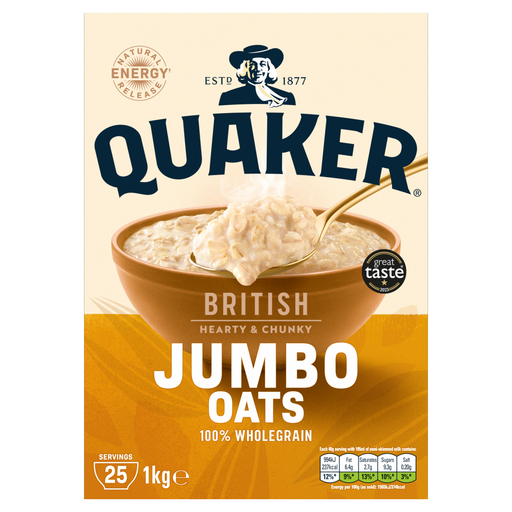
Quaker Jumbo Rolled Oats 1kg
Choose this option when the recipe calls for larger flakes or a more distinct oat texture.
The listing identifies jumbo rolled oats, 100% wholegrain oat flakes and 1.0g sugars per 100g.
It may contain traces of wheat, so it is not the choice where explicitly gluten-free oats are required.
Joybuy
 No image available
Flahavan's Organic Porridge Oats 2kg (2 x 1kg)
This is a plain-oat option for recipes where sweeteners are controlled separately in the dough.
The listing states 100% organic wholegrain oat flakes, 0.9g sugars per 100g and two 1kg packs.
The listing states oats containing gluten; check the flake format if a recipe specifically calls for jumbo or quick oats.
Joybuy
 No image available
Scotts Porage Old Fashioned Porridge Oats 1kg
Consider these oats when a heartier, more noticeable oat presence is wanted in the loaf.
The listing states thicker rolled oats, 100% rolled oats and 1.1g sugars per 100g.
It may contain wheat and barley. Check the recipe before changing to thicker flakes, particularly for a quick-oat or smooth-crumb formula.
Joybuy
 No image available
Quaker Oat So Simple Big Bowl Original 6 Pack 231g
This pre-portioned option may suit a small trial loaf or a recipe requiring measured oat quantities.
The listing states Quaker wholegrain rolled oats as the only ingredient, with 1.0g sugars per 100g. Each sachet is 38.5g.
Check the required oat texture before buying; the listing does not establish a jumbo or quick-oat format, and it does not state gluten-free certification.
Joybuy
Questions about oats in bread
Are plain porridge oats automatically “reduced sugar” oats?
No. Plain oats can help you control added sugar in a recipe because they do not add sweetening ingredients, but “reduced sugar” is a comparative nutrition claim rather than another term for unsweetened. Check the exact ingredient list and per-100g nutrition panel; Waitrose and Joybuy examples of plain oats list around 0.9g to 1g sugars per 100g.
Should I use regular, jumbo or quick oats in porridge bread?
Use the oat type specified by the recipe where possible. Regular porridge oats are a practical default for standard oat bread; choose jumbo oats for larger, thicker flakes and quick or superfast oats where faster liquid absorption and a smoother result are wanted.
Can I make gluten-free oat bread with ordinary porridge oats?
Do not assume so. Choose an oat product expressly labelled gluten-free where that condition matters, then check the flour, raising agents, seeds, dairy alternatives and preparation surfaces. The Food Standards Agency states that foods labelled gluten-free contain no more than 20mg/kg gluten as sold.
Do I need to add sugar to oat bread?
That depends on the bread formula rather than the oat product. Choose plain oats first, then follow the recipe’s approach to sweeteners: verified oat-bread recipes vary, with examples using Demerara sugar or maple syrup alongside the oats.


