People managing breakfast-time glucose
Whole jumbo or coarse oats are useful formats to compare when you want a slower-release carbohydrate option. Diabetes UK and Leeds Teaching Hospitals NHS Trust also stress that the portion remains important.


Choose plain wholegrain oats first, then select the format that suits your routine: whole jumbo or coarse oats are the more relevant options when a lower-GI route is important, while plain rolled oats remain a flexible everyday base. Diabetes UK and Leeds Teaching Hospitals NHS Trust note that portion size and total carbohydrate still matter, so compare the stated serving, carbohydrate and fibre before treating any oat product as suitable for your own plan.
Whole jumbo or coarse oats are useful formats to compare when you want a slower-release carbohydrate option. Diabetes UK and Leeds Teaching Hospitals NHS Trust also stress that the portion remains important.
Plain quick oats can offer a fast cupboard breakfast without automatically moving to sweetened sachets or flavoured cereal. Compare the exact ingredients, carbohydrate per serving and fibre.
Check the current pack’s allergen statement and any explicit gluten-free claim. Oats alone do not establish gluten-free suitability, and product warnings can differ between brands and formats.
Start with the oat format, then compare nutrition on the same basis and check the ingredient and allergen information for the exact pack.
| Priority | What to check | Your needs |
|---|---|---|
| Carbohydrate and portion | Compare carbohydrate on the same dry-weight or prepared-serving basis. Check whether milk, water or toppings are included. Use the stated serving as a starting point. | I want to know the carbohydrate in the bowl I will actually prepare, rather than comparing oat-only figures with a bowl made using milk. |
| Oat format | Check whether oats are coarse, jumbo, standard rolled, quick or instant. Diabetes UK lists coarse oatmeal such as steel-cut oats as low GI, while Leeds Teaching Hospitals NHS Trust highlights whole rolled jumbo oats. | I am willing to accept a thicker texture or longer cooking time if a coarse or jumbo format better fits my breakfast routine. |
| Fibre and wholegrain | Compare fibre per equivalent serving and read the ingredients. Check whether extra fibre comes from added wheat bran rather than oats alone. | I want a plain wholegrain base, but I will still account for carbohydrate rather than treating fibre as a substitute for portion planning. |
| Sweetened additions | Read the ingredient list for sugars, syrups, dried fruit and flavourings. Compare sugars and fibre for the exact variant, not just the brand. | I prefer a plain oat base so I can decide what, if anything, to add for flavour and sweetness. |
| Allergens and gluten claims | Read the current allergen statement and any may-contain wording. If gluten-free suitability is required, choose a product carrying an explicit gluten-free label. | I need the pack to fit my gluten, wheat, barley or nut-allergy requirements rather than relying on oats as the main ingredient. |
Glycaemic index is only one part of the decision. Diabetes UK explains that the type and amount of carbohydrate can affect blood glucose, and that portion size can have a larger effect than GI.
Compare the exact serving, carbohydrate and ingredients, then fit the portion into your individual plan.
Some packs list dry oats while others show a prepared serving with water or milk. Milk and toppings change the carbohydrate, sugars and calorie totals of the finished bowl.
Compare products per 100g dry weight first, then compare equivalent prepared portions. Check what the manufacturer includes in its serving calculation.
Wheat-bran oats contain wheat, while plain oat products can carry wheat, barley, gluten-source or nut warnings. A fibre-added option may therefore conflict with an allergy or gluten-free requirement.
Read the live pack allergen statement whenever you buy, especially after a recipe or packaging change. Choose an explicitly gluten-free product only where that claim is needed.
Plain oats, flavoured sachets, granola and fruit-added cereals can have very different ingredients. Diabetes UK notes that some breakfast cereals can contain high amounts of free sugars and less fibre.
For a more controllable cupboard staple, begin with plain oats and add toppings deliberately. Check the nutrition panel for flavoured or fruit-containing products.
Relevant for shoppers choosing between jumbo oats, faster-cooking oats and oat-bran formats. Mornflake describes its Jumbo Oats as 100% whole jumbo rolled oats.
Relevant for plain rolled oats and convenience-led porridge formats. The cited Quaker Rolled Porridge Oats listing describes a 1kg pack of 100% wholegrain oats with no added sugar.
Relevant for standard rolled oats, organic oats, jumbo oats and quick oats. The cited Irish Porridge Oats and Organic Oats are 100% wholegrain oat products.
Relevant for shoppers seeking organic wholegrain rolled oats. Jordans describes its Organic Porridge product as organically produced wholegrain rolled oats.
Relevant as a retailer own-label option with plain rolled oats and a wheat-bran-added alternative. Essential Porridge Oats are listed as wholegrain oat flakes.
Joybuy product options covering whole-jumbo, standard rolled, quick and oat-bran formats for shoppers comparing plain oat-based cupboard staples.
 No image available
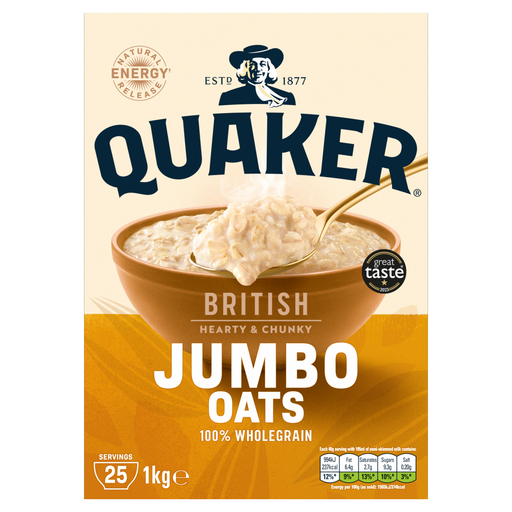
A plain whole-jumbo oat option for shoppers who want to prioritise this format.
The pack lists 100% wholegrain oat flakes, 60g carbohydrate, 9.0g fibre and 1.0g sugars per 100g.
Contains a wheat trace warning; check the current pack if gluten-free suitability is required. Use the stated carbohydrate amount with your own portion plan.
 No image available
A plain porridge-oat option for a measured everyday bowl with toppings chosen separately.
The listed dry 40g oat portion provides 24g carbohydrate and 3.6g fibre; the ingredient list states 100% oatmeal.
May contain wheat and barley. Compare the dry-oat figures rather than milk-prepared nutrition when assessing oats alone.
 No image available
A portion-defined plain quick-oat choice for microwave preparation when speed matters.
Each 38.5g sachet is listed as wholegrain rolled oats and provides 23g carbohydrate and 3.5g fibre before milk; preparation is stated as 2½ minutes.
The listed prepared-serving figures include 245ml semi-skimmed milk, so use the dry-sachet figures for an oat-only comparison.
 No image available
A plain wholegrain oat-flake option for shoppers who prefer an organic cupboard staple.
The pack lists 100% organic wholegrain oat flakes, with 26g carbohydrate, 3.3g fibre and 0.4g sugars per 40g serving.
Check the current pack if an explicit gluten-free claim is required, and account for the prepared portion and toppings in your plan.
 No image available
An oat-bran option for shoppers specifically comparing higher-fibre oat-based breakfast ingredients.
The pack lists 100% oatbran, with 48.2g carbohydrate, 19.4g fibre and 1.5g sugars per 100g.
This is oatbran rather than rolled or jumbo oats. Check preparation guidance and the amount used before relying on it for porridge; Mornflake states it is not suitable for wheat or barley allergy sufferers.
No. Oats are a carbohydrate food, so both the type and total amount eaten can affect blood glucose. Plain wholegrain oats can be a useful breakfast base, but the portion, preparation, toppings, medication and your individual plan still matter.
Whole jumbo or coarse oats are the stronger evidence-aligned route when choosing by GI. Diabetes UK lists coarse oatmeal such as steel-cut oats as low GI, while Leeds Teaching Hospitals NHS Trust identifies porridge made with whole rolled jumbo oats as a lower-GI choice; portion control and individual monitoring still apply.
Use the pack’s declared serving as a starting point, then adjust it with your diabetes team if you use carbohydrate counting, insulin or have individual weight or glucose goals. Diabetes UK notes that manufacturer serving sizes vary and that weighing food is the most accurate method when precise portions are needed.
They can be an option if wheat is suitable for you. The cited Waitrose Porridge Oats with Wheatbran list 5.5g fibre per 40g serving prepared with water, but they contain wheat bran and cereals containing gluten, so they do not meet a gluten-free or wheat-allergy requirement.
No. Buy a product explicitly labelled gluten-free if that is your requirement and check the current pack. The Food Standards Agency states that food labelled gluten-free must contain no more than 20mg/kg of gluten, and oats must still be emphasised as an allergen.