Families making porridge several times a week
For households deciding whether a 1 kg to 3 kg bag will be used reliably and stored well, while keeping plain oats as a flexible breakfast base.


Choose plain oats in a pack size your household can use and store well, then control the finished bowl through the liquid and toppings you choose. The Advertising Standards Authority and Committee of Advertising Practice state that a solid food needs no more than 3 g of fat per 100 g for a UK low-fat claim; the plain oat products covered here list higher dry values, so a water-prepared serving should not be mistaken for a low-fat claim for the oats themselves.
For households deciding whether a 1 kg to 3 kg bag will be used reliably and stored well, while keeping plain oats as a flexible breakfast base.
For shoppers who want to manage the fat content of the finished bowl through portions and preparation, rather than assuming plain oats qualify as a low-fat food.
For shoppers who need a specific gluten-free declaration or need to check whether oats fit a clinician-led low-fibre diet.
Start with the dry nutrition panel and the pack size, then check preparation, storage and any dietary declaration that matters for your household.
| Priority | What to check | Your needs |
|---|---|---|
| Finished-bowl fat | Compare fat per 100 g for the dry oats; check the serving basis; account separately for milk, yoghurt, nuts, seeds and other additions. | I want to choose the liquid and toppings myself, rather than rely on a water-only serving panel. |
| Pack size and storage | Check pack mass and stated portions; estimate weekly use; keep opened oats cool, dry and in an airtight container. | A larger bag works for us only if we can finish it while maintaining good cupboard rotation. |
| Oat type and texture | Check whether the oats are standard rolled or jumbo; review the cooking guidance; choose a format that suits the household’s preferred texture. | We may prefer a thicker porridge, or a more general-purpose rolled oat for breakfasts and recipes. |
| Gluten and allergen suitability | Look for a specific gluten-free declaration where required; read the current allergen statement; do not assume ordinary oats suit every cereal allergy. | If gluten avoidance or an allergy matters in our household, the pack declaration needs to match that requirement. |
| Medical diet fit | Distinguish a lower-fat aim from a prescribed low-fibre diet; check clinical advice before making oats a regular breakfast under a medical restriction. | A lower-fat routine does not answer whether porridge oats fit a separate medical diet. |
A 40 g serving made with water and a dry per-100-g declaration answer different questions. UK low-fat claim criteria for solid foods apply per 100 g, not solely to a prepared serving.
Check both figures and plan the actual milk and toppings used at home.
A bulk pack can be less practical if it remains open for a long period or loses its preferred texture before the household uses it.
Work out likely portions per week, check current delivery terms where relevant, and store opened oats in a cool, dry airtight container.
Cross-contact statements and allergen warnings differ between products. Standard oats can carry warnings for wheat, barley, other gluten sources or nuts.
For coeliac disease or a diagnosed allergy, choose an appropriately labelled product and check the current pack declaration before eating it.
Wholegrain porridge oats are listed among foods to avoid in Royal Free London NHS Foundation Trust low-fibre guidance, so lower fat and low fibre are separate considerations.
If a low-fibre diet has been prescribed, ask the clinician or dietitian who gave the guidance before using porridge oats regularly.
Relevant for households seeking larger plain-oat formats. Mornflake lists Whole Jumbo Oats in packs from 500 g to 4 kg, including a 3 kg pack.
Relevant for 1 kg own-label options, including standard, Scottish and specifically labelled gluten-free porridge oats.
Relevant for traditional rolled oats in 500 g, 1 kg and 1.5 kg packs, offering a choice below very large bulk formats.
Relevant for organic rolled oats, including a verified 1 kg organic pack and jumbo oats for households that prefer a thicker texture.
Relevant for organic rolled oats and protein-oriented oat products rather than the largest plain family packs.
Joybuy product options for family porridge routines, including 1 kg packs, a two-pack format and a specifically labelled gluten-free oat option.
 No image available
Relevant where a gluten-free declaration and manageable household rotation are important.
1 kg pack; 25 portions; 100% gluten-free oat flakes; store cool and dry, then reseal after opening.
Dry fat: 5.7 g per 100 g. The product’s dry value is above the 3 g per-100-g threshold for a UK low-fat claim.
 No image available
A family-pack option for households that want more supply without opening the full quantity at once.
Bundle of two 1 kg packs; 100% organic wholegrain oat flakes; 40 g serving panel; store cool and dry.
Dry fat: 5.8 g per 100 g. The listing identifies oats as containing gluten and does not present this as a specifically gluten-free option.
 No image available
A 1 kg plain-oat choice for households that prefer regular cupboard rotation.
1 kg pack; 100% organic wholegrain oat flakes; dry and 40 g serving nutrition panels; store cool and dry.
Dry fat: 5.8 g per 100 g. The listing identifies oats as containing gluten and does not present this as a specifically gluten-free option.
 No image available
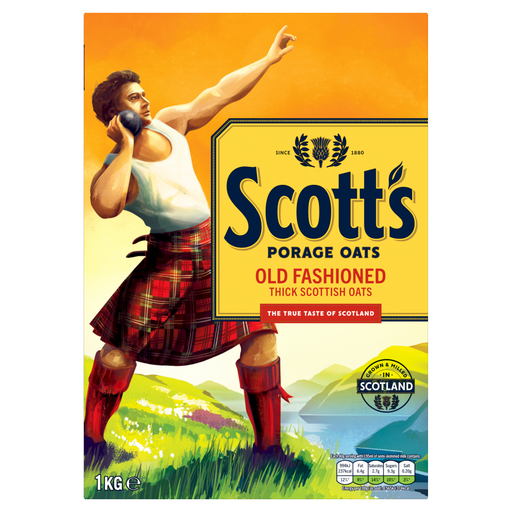
Suitable for families that prefer thicker rolled oats in a 1 kg format.
1 kg pack; thicker rolled oats; 40 g preparation guidance; transfer to an airtight container after opening.
Dry fat: 8.0 g per 100 g. The listing says it may contain wheat and barley.
 No image available
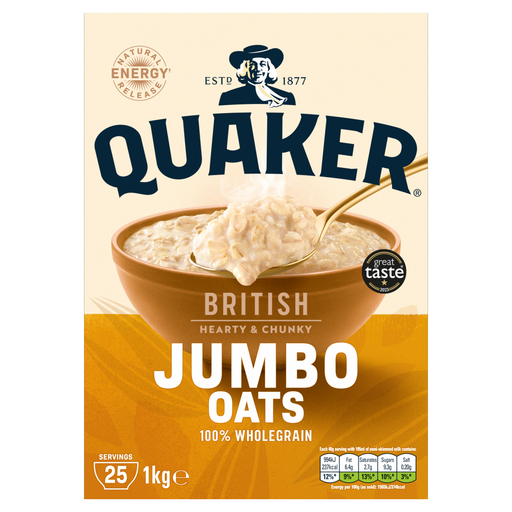
A 1 kg jumbo-oat option for households using oats across porridge, overnight oats and baking.
1 kg pack; 100% wholegrain oat flakes; store cool and dry and reseal tightly after opening.
Dry fat: 8.0 g per 100 g. The listing says it may contain traces of wheat.
Not automatically. The Advertising Standards Authority and Committee of Advertising Practice state that a solid food using a low-fat claim must contain no more than 3 g of fat per 100 g. The reviewed plain oats list 5.4 g to 8.4 g per 100 g, while a 40 g portion made with water can have a lower figure before milk and toppings are added.
Match the pack to breakfast frequency and storage space. Mornflake states that its 3 kg Whole Jumbo Oats pack contains about 75 portions of 40 g, while Waitrose lists 25 servings for its 1 kg Essential Porridge Oats. Choose the larger format only if it can be kept cool, dry and airtight after opening.
Check the dry-oat nutrition declaration, use a measured portion, and account separately for the liquid and additions. Water-prepared values for the reviewed products are around 2.2 g to 3.4 g of fat per 40 g serving, but those figures do not include milk, yoghurt, nuts, seeds, nut butter, cream or other toppings.
No. Choose a product specifically labelled gluten free when this is required and check the current allergen declaration before purchase. Waitrose states that its Free From oats are produced to avoid cross-contamination, while standard Mornflake Jumbo Oats and Jordans Organic Porridge carry different allergen cautions.
Do not assume so without clinical confirmation. Royal Free London NHS Foundation Trust lists porridge oats among wholegrain cereals to avoid in its low-fibre guidance. A lower-fat aim and a low-fibre medical requirement are separate considerations.