What to compare before buying
Choose the oat format first, then compare suitable packs by their displayed price per kilogram, ingredients, storage instructions and delivery conditions.
| Priority |
What to check |
Your needs |
| Repeat-use cost |
Compare displayed £/kg across different pack weights. For direct orders, include minimum basket requirements and delivery charges. Choose a pack size you can keep dry and use while quality is maintained. |
I want a cupboard pack that remains economical over many breakfasts, rather than one that merely has a low pack price. |
| Texture and preparation |
Choose jumbo flakes for thicker porridge and flapjacks. Smaller flakes absorb liquid more quickly for smoother, faster porridge. Check whether sachets or pots solve a real preparation need. |
A thick, chewy bowl and a quick weekday breakfast are different priorities, so I would choose the format I will actually use. |
| Ingredients |
Read the ingredient list for plain oats or added ingredients such as soy protein. Check the full allergen statement where it matters to your household. |
I may want a single-ingredient oat base so that toppings and sweetness remain my choice, or I may deliberately want a protein-added product. |
| Gluten-free and allergen suitability |
Use an explicit gluten-free label where required. Check ingredients and precautionary allergen statements on every pack; organic or 100% oats wording does not establish gluten-free suitability. |
If I require gluten-free oats, I need the pack claim and allergen information to match that requirement rather than relying on a plain-oat description. |
| Storage and dates |
Follow the individual pack’s storage directions. Check the best-before date, keep opened oats cool and dry, and use an airtight container if the pack advises it. |
I want a larger pack only when I have space to keep it in good condition and can rotate it through the pantry. |
Joybuy porridge oat options
Joybuy product options for plain, textured, organic and gluten-free porridge-oat pantry needs. Compare the displayed price per kilogram before choosing between them.
 No image available
Scotts Porage Oats Old Fashioned Porridge Oats 1kg
A 1kg plain-oat option for households wanting a thicker rolled-oat texture.
100% rolled oats; stated preparation is 4–5 minutes on the hob or 2–3 minutes in a microwave. Store after opening as directed and compare the displayed £/kg before buying. May contain wheat and barley.
Joybuy
 No image available
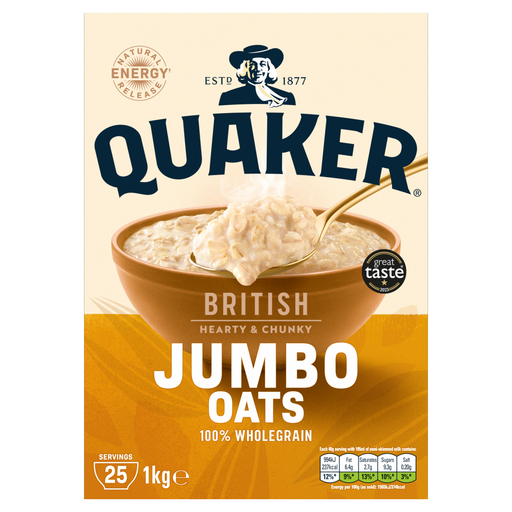
Quaker Jumbo Rolled Oats 1kg
For a 1kg jumbo-oat pack intended for porridge, overnight oats and baking.
100% wholegrain oat flakes with cool, dry storage guidance. Compare the displayed £/kg with other suitable formats; the product may contain traces of wheat and is not presented as gluten free.
Joybuy
 No image available
Flahavan's Organic Porridge Oats 2kg (2 x 1kg)
A two-pack option for frequent users who prefer to keep one 1kg pack unopened.
Contains 100% organic wholegrain oat flakes. Store in a cool, dry place and compare the displayed £/kg with smaller suitable packs; the listing does not make a gluten-free claim.
Joybuy
 No image available
Morrisons Free From Gluten Free Oats 1kg
A 1kg plain-oat choice where an explicitly gluten-free product is required.
Described as 100% gluten-free oat flakes and wheat free, with resealing and cool, dry storage guidance. Check the delivered pack label and compare its displayed £/kg before buying.
Joybuy
 No image available
Flahavan's Organic Porridge Oats 1kg
A 1kg organic plain-oat option for regular cupboard breakfasts.
Contains 100% organic wholegrain oat flakes with cool, dry storage instructions. Compare the displayed £/kg against suitable plain and gluten-free alternatives; the listing does not establish gluten-free suitability.
Joybuy
Frequently asked questions
How should I compare value between a bag, sachets and a porridge pot?
Compare the displayed price per kilogram before comparing pack prices. In the observed Waitrose category, Essential Porridge Oats were listed at £1/kg, while Quaker original sachets were £14.07/kg and a Waitrose porridge pot was £15/kg. Sachets and pots can still suit a genuine need for portioning or portability.
Should I buy jumbo oats or quick-cook oats for my pantry?
Choose jumbo oats for thick, textured porridge and flapjacks. Choose quick-cook oats for a smoother bowl prepared faster: Mornflake says its smaller flakes absorb water or milk more quickly. Compare the price per kilogram once you have selected the texture and preparation speed you will use.
Are plain, organic or 100% oats automatically gluten free in the UK?
No. Coeliac UK says standard oats can be contaminated when produced alongside wheat, barley or rye, and that descriptions such as 100% oats, pure oats or organic do not show gluten-free suitability. If gluten-free oats are required, choose a product labelled gluten free and check its allergen information.
What should I check on a porridge-oat pack?
UK pre-packed food labels must show information including ingredients with allergens, net quantity and a best-before or use-by date, according to the Department for Environment, Food & Rural Affairs and the Food Standards Agency. For oats, check the ingredient list, allergen statement, gluten-free claim where required, net weight, date and storage instructions before decanting the pack.
How should I store a bulk bag of porridge oats?
Follow the pack instructions first. The cited Quaker listing advises cool, dry storage and, after opening, keeping the bag tightly folded or using an airtight container. GOV.UK distinguishes best-before dates, which concern quality, from use-by dates, which concern safety; use the earliest best-before pack first.


