Parents of children aged 2 to 5
For carers considering oats within a varied diet and checking fibre across the day rather than relying on one meal. The NHS gives a guide of about 15g of fibre a day for children aged 2 to 5.


For most toddlers, plain unsweetened rolled oats are the simpler starting point; consider fibre across the whole day rather than choosing the pack with the largest fibre figure. NHS guidance says children aged 2 to 5 need about 15g of fibre a day, while under-2s should not have wholegrain starchy foods as their only option because they can become full before taking in enough calories and nutrients.
For carers considering oats within a varied diet and checking fibre across the day rather than relying on one meal. The NHS gives a guide of about 15g of fibre a day for children aged 2 to 5.
For carers who want a simple oat-based meal without making high-fibre wholegrain foods the only starchy choice. The NHS notes that these foods can fill young children before they have taken in enough calories and nutrients.
For households that need to check the exact pack allergen statement and the setting's own policy, particularly where oats, wheat, barley, milk, nuts or sesame matter. Department for Education guidance applies to school allergy arrangements in England.
Choose when: You want to control the ingredients and add suitable foods yourself as part of a toddler dinner.
Check first: Plain oats are not automatically gluten-free, and an adult-labelled serving is not a toddler portion guide.
Choose when: A modestly more concentrated fibre option fits a child aged 2 or over and the rest of the day remains varied.
Check first: Wheat bran changes both the fibre concentration and the allergen considerations.
Choose when: A more concentrated fibre product is appropriate for the child's usual diet and is tolerated.
Check first: These formulations can have additional ingredient and manufacturing-allergen restrictions.
| Priority | What to check | Your needs |
|---|---|---|
| Appropriate fibre amount | Compare fibre per serving or per 100g. Consider plain oats, bran and inulin products in the context of the whole day's food. | I want fibre spread across meals rather than concentrated in one bowl. The NHS guide for children aged 2 to 5 is about 15g across the day. |
| Energy and variety | For under-2s, avoid making wholegrain starchy foods the only choice. Plan oats as one part of a varied meal. | A filling dinner should still leave room for enough calories and nutrients from other foods. NHS guidance highlights this consideration for young children. |
| Added ingredients | Read the ingredients list for plain oats or added sugar. Check preparation guidance before adding salt or sugar. | I want a simple base and control over what goes into the finished meal. The NHS says children over 12 months do not need salt or sugar added to food or cooking water. |
| Allergens and setting rules | Check cereals-containing-gluten wording, may-contain statements and any gluten-free claim on the exact pack. Confirm nursery or school rules before packing. | I need the product to match the child's diagnosed needs and the setting's policy. In England, Department for Education guidance covers school allergy-safety arrangements. |
A 40g serving of Mornflake Fibreful Oatbran Porridge lists 10.2g of fibre, while the NHS guide for ages 2 to 5 is about 15g for the entire day. Under-2s should not receive only wholegrain starchy foods.
Compare the pack's fibre figure with the child's age and usual meals. Plain rolled oats are often the more straightforward baseline.
Plain oats can still carry wheat or barley cross-contact wording, while bran, seeds, flavourings and manufacturing methods can add further relevant allergens.
Read the current ingredients, allergen and may-contain statements for the exact SKU, particularly for children with an allergy, coeliac disease or a nursery or school food policy.
Compared products show 40g or 45g portions, but those figures are useful for product comparison rather than setting a child's serving size.
Serve an age-appropriate amount, taking account of appetite and the rest of the day's food.
Some flavoured sachets contain added sugar. For example, Quaker Oat So Simple Hazelnut Chocolate lists 6.9g of sugars per 36.5g sachet.
Use unsweetened plain oats as the base where suitable, and check the label before choosing a flavoured product. NHS guidance says not to add salt or sugar to a toddler's food or cooking water.
A mainstream UK porridge range with rolled oats, sachets and gluten-free options across the range.
A UK oat specialist offering conventional porridge oats and more concentrated oat-bran options.
A wholegrain rolled-oat range including Irish Porridge Oats, organic oats and quick oats.
A cereal brand offering organic wholegrain rolled porridge oats alongside products containing fruit, nuts and seeds.
A retailer own-label range covering plain Scottish and essential porridge oats, plus oats with wheat bran.
Joybuy product options for the plain-oat route in a toddler dinner, with fibre, ingredients and allergen checks kept central to the choice.
 Image unavailable
A plain oat base where a specifically labelled gluten-free and wheat-free product is required.
Lists 100% gluten-free oat flakes and 3.4g fibre per stated 40g portion. The 40g amount is not a toddler serving recommendation; oats remain relevant for a child with an oat allergy.
 Image unavailable
A plain-oat option for gradually planning fibre across the day.
Lists 100% oatmeal and 3.6g fibre per stated 40g portion, with 0.4g sugars and 0g salt per portion. It may contain wheat and barley.
 Image unavailable
A simple wholegrain oat base that leaves the rest of the meal under the carer's control.
Lists 100% organic wholegrain oat flakes and 3.3g fibre per stated 40g portion. The listing identifies oats as containing gluten, so it is not for a specifically gluten-free requirement.
 Image unavailable
A plain-ingredient sachet option with microwave preparation stated on the listing.
Each 38.5g sachet lists wholegrain rolled oats as its only ingredient and provides 3.5g fibre before milk is added. A full sachet is not automatically an appropriate toddler portion.
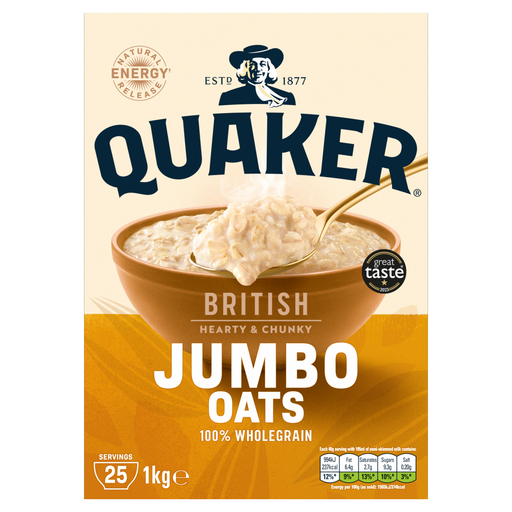 Image unavailable
A 100% wholegrain oat-flake option for a meal with controllable additions.
The listing gives 9.0g fibre per 100g, 1.0g sugars and 0.01g salt per 100g. It may contain traces of wheat; check pack cooking instructions and serve an age-appropriate amount.
No. For children aged 2 to 5, the NHS guide of about 15g of fibre applies to the whole day. For children under 2, NHS guidance says wholegrain starchy foods should not be the only choice because their fibre content can fill a child before enough calories and nutrients are eaten.
It can be one starchy component of a varied meal for a child over 12 months, rather than a complete dinner on its own. Use suitable additions or accompaniments for variety, and do not add salt or sugar, in line with NHS guidance.
Do not assume they are gluten-free. Food Standards Agency rules set a maximum of 20mg/kg gluten for a gluten-free claim, while ordinary oat products may have wheat or barley cross-contact warnings; Quaker Traditional Rolled Oats, for example, state that they may contain wheat and barley.
Yes. In England, Department for Education guidance says schools must have allergy-safety arrangements for pupils with medical conditions, and school caterers must provide allergen ingredient information for food they serve. Check the individual setting's policy and the exact product label for home-packed food.
Follow the exact product instructions. Waitrose Scottish Porridge Oats state not to reheat once cooled; prepare only what is needed and check the serving temperature before giving it to a child.