Regular porridge households
If you make porridge several times a week and want one pack to last through a normal grocery cycle, compare pack weight and price per kilogram first. Waitrose & Partners lists plain 1kg oat packs in its current range.


For households making porridge several times a week, a plain 1kg pack is usually the most practical starting point when you are happy to measure portions at home. Choose organic or jumbo oats when those product characteristics matter to you, and choose sachets when fixed portions and quick microwave preparation solve a genuine weekday routine problem. If gluten-free or allergen suitability is essential, rely on the current pack claim and allergen statement rather than assuming all oats are alike.
If you make porridge several times a week and want one pack to last through a normal grocery cycle, compare pack weight and price per kilogram first. Waitrose & Partners lists plain 1kg oat packs in its current range.
If you need a quick, fixed-portion breakfast for workdays, microwaveable sachets can suit the routine. Tesco Groceries describes Quaker Original sachets as ready in two minutes.
If gluten or another allergen matters in your household, select oats from the exact current claim and allergen panel. Food Standards Agency guidance explains that gluten-free labelling has a defined threshold, while individual oat products can carry different allergen warnings.
Choose this when: porridge is a regular household breakfast and you are happy to measure servings yourself.
Consider: loose oats need portioning and preparation, and allergy statements can differ between packs.
Choose this when: organic certification or a jumbo, heartier oat texture matters more than selecting solely by unit price.
Consider: organic status does not establish allergen suitability, so check the exact pack wording.
Choose this when: a repeatable portion and rapid weekday preparation are more useful than a large loose-oat pack.
Consider: sachets reduce measuring but provide smaller pre-set portions and still need an allergen-panel check.
| Priority | What to check | Your needs |
|---|---|---|
| Pack value | Compare pack weight and the displayed price per kilogram. Check whether a 1kg pack provides enough servings for your usual week. | A single pack needs to cover repeated breakfasts without paying extra for a smaller format that does not suit the household routine. |
| Preparation and portions | Check whether you will measure loose oats at home or prefer individual portions. Confirm the preparation method and serving size. | On rushed mornings, a microwaveable sachet may be more convenient; at home, I may prefer choosing my own portion and toppings. |
| Oat type and ingredients | Check whether the pack is plain oats, rolled oats, jumbo oats or a flavoured product. Read the ingredient list rather than relying on the front label. | I want a plain oat base where I can decide what to add, or I may specifically want the texture of jumbo or rolled oats. |
| Allergens and gluten-free claims | Read the current ingredient list, allergen statement and precautionary wording for the exact SKU. Choose a labelled gluten-free pack only when that claim is required. | Where wheat, barley, soya, nuts, oats or gluten are relevant, I need a pack whose current label fits the household requirement. |
A small box of sachets can appear cheaper at first glance while providing fewer breakfasts than a larger loose-oat pack.
Compare the displayed price per kilogram, pack weight and number of portions for every candidate before deciding whether the convenience suits your routine.
Organic wholegrain oats can still carry warnings for wheat, barley, other gluten sources, soya or nuts, depending on the product and manufacturing arrangements.
Read the exact ingredients, allergen statement and precautionary wording on the current SKU, particularly when packaging or recipes change.
A plain oat product without a gluten-free claim should not be treated as a gluten-free choice. Food Standards Agency information states that food labelled gluten-free must contain no more than 20mg/kg gluten.
Where gluten-free suitability is necessary, select a pack explicitly labelled gluten-free and confirm the current allergen information.
Named oat products are sold in formats such as bags and sachets, so a single retail pack is not necessarily a reusable metal container.
If a metal tin is essential, verify the packaging on the exact product page. Otherwise, compare one retail pack by weight, ingredients, storage suitability and unit price.
A relevant own-label route for a value-led weekly big shop, with plain 1kg porridge oats and a separate gluten-free own-label option listed in the current Waitrose & Partners range.
Relevant when choosing between 1kg rolled or jumbo oats and microwaveable portion sachets. Waitrose & Partners lists both 1kg Quaker oats and Quaker Oat So Simple sachets.
Relevant for shoppers seeking a 1kg organic British wholegrain-oat pack.
A relevant choice for shoppers who want a 1kg organic wholegrain option. Flahavan's describes its Organic Oats as rolled oats in a recyclable bag.
Relevant for buyers seeking organic wholegrain rolled or jumbo-style porridge oats rather than simply the lowest-cost 1kg pack.
A brand to consider only when exploring recipe-led breakfast cereal or flavoured-porridge options alongside plain oats.
Joybuy product options for a weekly breakfast shop, covering plain 1kg oats, organic or jumbo oats, and portioned microwaveable sachets.
 No image available
A 1kg option for repeated breakfasts where a gluten-free and wheat-free oat pack is required.
States 100% gluten-free oat flakes, 25 portions of 40g and 8.6g fibre per 100g. Oats are a declared allergen; check packaging if a literal metal tin is essential.
 No image available
A plain loose-oat choice for households that are happy to portion breakfast oats at home.
States 100% oatmeal, 25 portions and 9g dietary fibre per 100g. Store in a cool, dry place and use airtight storage after opening; the listing states that it may contain wheat and barley.
 No image available
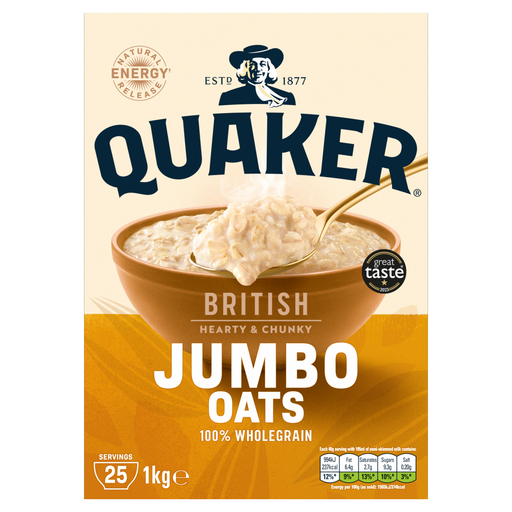
A 1kg jumbo rolled-oat option for porridge, overnight oats or baking.
States 100% wholegrain oat flakes and 9g dietary fibre per 100g. The listing states that it may contain traces of wheat, so do not treat it as a verified gluten-free option.
 No image available
A 1kg organic wholegrain option for buyers who want loose oats for regular home breakfasts.
States 100% organic wholegrain oat flakes, with nutrition information on both 100g and 40g serving bases. The candidate declares oats as an allergen and describes the product as containing gluten.
 No image available
A portioned microwave option for busy mornings or office use where measuring loose oats is inconvenient.
Contains six 38.5g sachets with a stated microwave method of 2½ minutes, and lists wholegrain rolled oats as the ingredient. This is a smaller format than the 1kg loose-oat options; check the current allergen panel before buying.
For regular home use, a 1kg pack is a practical starting point because it can cover repeated breakfasts and lets you measure portions yourself. Compare price per kilogram, pack weight and portions before choosing; sachets can still suit you when fixed portions and rapid microwave preparation are more important.
Compare nutrition information on the same basis, usually per 100g, and check the serving size separately. NHS guidance says adults should aim for 30g of dietary fibre a day as part of a healthy balanced diet and identifies porridge oats as a fibre-containing food.
No. Choose a pack specifically labelled gluten-free when that requirement applies. Food Standards Agency information states that food labelled gluten-free must contain no more than 20mg/kg gluten, and the current pack should still be checked for allergens and precautionary statements.
No. Organic status does not determine allergen suitability. The checked Mornflake Organic product states that it is not suitable for wheat or barley allergy sufferers because of its manufacturing methods, while Jordans Organic Porridge states that it may contain other gluten sources and nuts.
Follow the pack instructions and keep oats in a cool, dry place. For a large weekly-shop pack, reseal it or transfer it to a clean, dry airtight container to help protect it from moisture.