What to check before buying
Start with the preparation route, then choose the texture and ingredient profile that fit the intended breakfast. Check the current pack label whenever gluten or allergens matter.
| Priority |
What to check |
Your needs |
| Preparation and portions |
Check whether the pack gives hob, microwave or both methods; compare the stated portion and liquid quantity; decide whether pre-measured sachets are useful. |
I want a breakfast I can make with the equipment available, without more measuring or cooking than suits the routine. |
| Texture and uses |
Choose standard rolled oats for general flexibility; select jumbo oats when a thicker, more textured porridge is wanted; treat oatbran as a different format. |
A bowl with more bite matters to me, or I want oats that can also be used for overnight oats or baking. |
| Convenience format |
Check whether quick oats are intended for microwave preparation; look at sachet size and required liquid; keep loose oats and portioned formats as separate choices. |
I would prefer a straightforward microwave breakfast, even if a loose pack remains more practical for regular cupboard use. |
| Fibre formulation |
Read the ingredient list to distinguish rolled oats, oatbran and oats blended with wheat bran; compare fibre figures per 100g only between clearly identified products. |
I am choosing a particular oat format and do not want to assume that a bran product will prepare or taste like ordinary rolled oats. |
| Gluten and allergens |
Look for an explicit gluten-free label where needed; read may-contain statements; check for oat, wheat, barley, soya and nut information on the exact pack. |
I need to accommodate a gluten-free diet or a specific allergy. Coeliac UK notes that plain, pure or organic oats do not by themselves establish gluten-free status. |
Joybuy porridge oat options
These Joybuy options cover plain rolled oats, explicitly gluten-free oats, microwave sachets, jumbo oats and oatbran for the different cupboard needs discussed above.
 No image available
Scotts Porage Oats Old Fashioned Porridge Oats 1kg
A plain rolled-oat option for regular porridge and flexible oat use, with stated hob and microwave directions.
1kg pack; 100% rolled oats; 9g fibre per 100g. The listing advises checking the pack where wheat or barley must be avoided.
Joybuy
 No image available
Morrisons Free From Gluten Free Oats 1kg
An explicitly gluten-free plain-oat route for porridge or baking where that label is required.
1kg pack; 100% gluten-free oat flakes; 25 portions; 8.6g fibre per 100g. Oats remain an allergen, including in gluten-free products.
Joybuy
 No image available
Quaker Oat So Simple Big Bowl Original 6 Pack 231g
A pre-portioned microwave option when measuring oats is less convenient.
Six 38.5g sachets; 100% wholegrain rolled oats; stated 2½-minute microwave preparation. Check the current allergen statement if gluten-free oats are needed.
Joybuy
 No image available
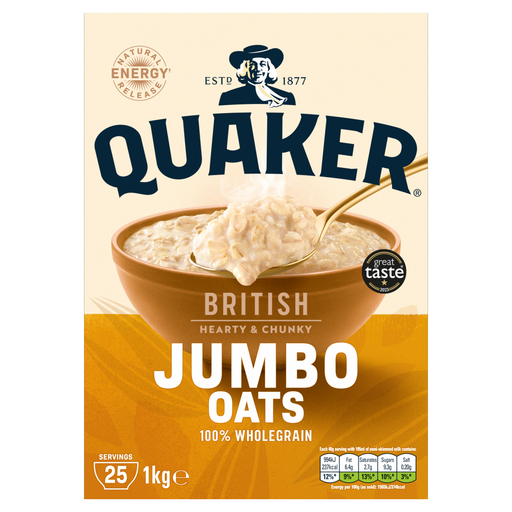
Quaker Jumbo Rolled Oats 1kg
A jumbo-oat choice for shoppers who specifically want a more substantial texture in porridge, overnight oats or baking.
1kg pack; 100% wholegrain oat flakes; 9g fibre per 100g. The listing notes possible wheat traces, so do not assume gluten-free suitability.
Joybuy
 No image available
Mornflake Mighty Oats Original Oatbran 800g
A specialist oatbran option for shoppers who want this distinct oat format rather than ordinary rolled oats.
800g pack; 100% oatbran; 19.4g fibre per 100g. The listing states it is unsuitable for wheat or barley allergy sufferers due to manufacturing methods.
Joybuy
Frequently asked questions
Are ordinary porridge oats suitable for a gluten-free diet in the UK?
Not automatically. Coeliac UK explains that standard oats may be produced alongside wheat, barley and rye, and that “100% oats”, “pure oats” and “organic” do not establish gluten-free status. Choose oats explicitly labelled gluten-free when that requirement applies; the Food Standards Agency states that gluten-free food contains no more than 20mg/kg gluten as sold.
Do oats themselves count as an allergen?
Yes. The Food Standards Agency states that oats must still be emphasised as an allergen even where food is labelled gluten-free or very low gluten. A gluten-related requirement and an oat allergy are separate considerations.
Which oats are easiest to make without a hob?
Quick oats and microwave sachets are the clearest options for this situation. Flahavan's describes its Quick Oats as milled lighter for quicker microwave preparation, while Quaker lists a two-minute microwave method for its Original sachets. Check the liquid quantity and microwave instructions on the individual pack.
How should dry porridge oats be stored after opening?
Follow the pack instructions. Quaker's opened-oats guidance recommends a cool, dry place and keeping the bag tightly folded or using an airtight container; Mornflake gives similar cool, dry storage advice for oatbran.
Is oatbran automatically a better choice than rolled oats?
No. Oatbran is a different oat product with its own texture and preparation considerations, rather than a universal replacement for rolled oats. It also does not remove the need to check allergen and gluten-related information on the pack.


