
24/7 Customer Support

Free returns

Same-day & Next-day Delivery

Quality Guaranteed

Unlock Your Welcome Offers: FREE Delivery | Up to 80% OFF | Free 30-day JoyPlus trial
Download the APP
A portable air pump can be a useful addition to a car boot, cycling bag, camping kit or household cupboard. The right model may help you adjust tyre pressure, inflate a football or prepare an inflatable paddle board without visiting a petrol station. However, pumps that look similar online can differ significantly in power source, pressure control, valve compatibility and intended use.
This guide explains the main buying pitfalls and compares suitable options for different UK lifestyles, from occasional household use to roadside tyre inflation and water-sports equipment.
A high maximum pressure figure can look impressive, but it does not tell you how quickly a pump will inflate a particular item. A small digital tyre inflator may reach a high pressure gradually, while a lower-pressure, high-volume SUP air pump is designed to move much more air.
For vehicle tyres, check the manufacturer’s recommended pressure in PSI or bar rather than choosing solely by the advertised maximum. For balls, air beds and pool toys, airflow and nozzle compatibility are usually more relevant than extreme pressure.
A cordless air pump is convenient away from a socket, but it depends on battery capacity and charging habits. A 12V air compressor can provide continuous vehicle power but may require the engine to be running and the cable to reach all four tyres.
Check whether the product is:
Electric compressors can become warm during extended inflation. A compact casing does not necessarily mean the pump is intended for repeated heavy use. Look for stated cooling provisions, operating instructions and recommended rest periods.
Also check the included fittings. A car tyre uses a Schrader valve, while some bicycles use Presta valves. Balls, air mattresses, swimming rings and SUP boards require different nozzles. A pump with several adapters may be more useful than one with a higher pressure rating but limited connections.
A digital tyre inflator should display pressure clearly and, where available, allow a target pressure to be set. Automatic shut-off can reduce the chance of continuing to inflate after reaching the selected figure, although you should still check the final pressure with a suitable gauge when accuracy matters.
For a car tyre air pump, consider the cable length and hose arrangement as well as pressure. A 3-metre power lead may be more practical for reaching rear or awkwardly positioned tyres. For a bicycle air pump or ball pump, a compact rechargeable model may be easier to carry.
A rechargeable air pump is practical for cycling, motorcycling and outdoor trips, but battery capacity is only one part of the decision. Charging time, battery indicators, USB compatibility and storage temperature also matter.
A 12V air compressor can suit drivers who keep an inflator in the boot. Run the vehicle engine as instructed to reduce the risk of draining the battery, park safely and avoid using a damaged cable or hose.
Manual pumps need a stable foot plate and comfortable handle, particularly when inflating larger recreational items. Electric units should have a secure hose connection, clear controls and a casing that can be stored without crushing the cable or fittings.
For UK travel, consider where the pump will live: a glove compartment, pannier, motorcycle storage box or camping equipment bag each favours a different shape and weight.
The following products match different use profiles rather than one universal specification. Always check the listing and the inflatable manufacturer’s instructions before purchase.
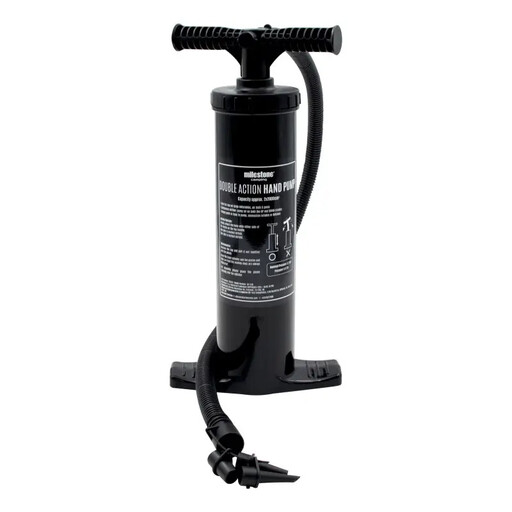
Why This Fits Their Persona: A straightforward choice for households, campers and occasional users who inflate air beds, pool toys and similar items without relying on batteries or mains power.
It does not depend on battery charge, and its three interchangeable nozzles make valve matching more practical than a single-fitting pump.
Double-action airflow works on both strokes; the 2,000cm³ capacity, foot plate and large handle support controlled manual inflation.
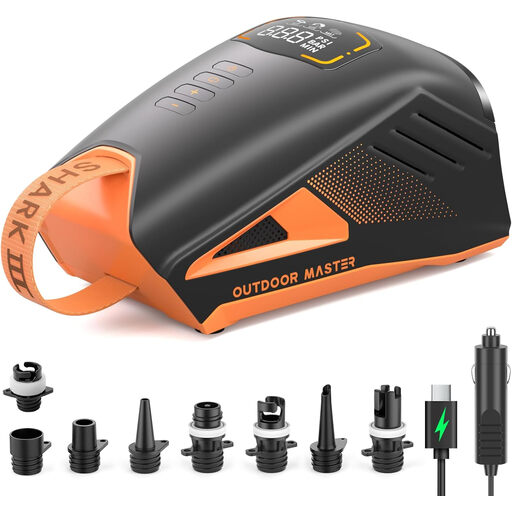
Why This Fits Their Persona: Designed for regular paddle-board users who want digital pressure control, battery operation and both inflation and deflation functions for outdoor sessions.
Its stated 20 PSI limit and digital pressure monitoring are more relevant to SUP use than choosing a general tyre compressor by maximum PSI alone.
The 74Wh battery supports stated inflation and deflation use; Type-C and vehicle DC inputs provide two charging options.
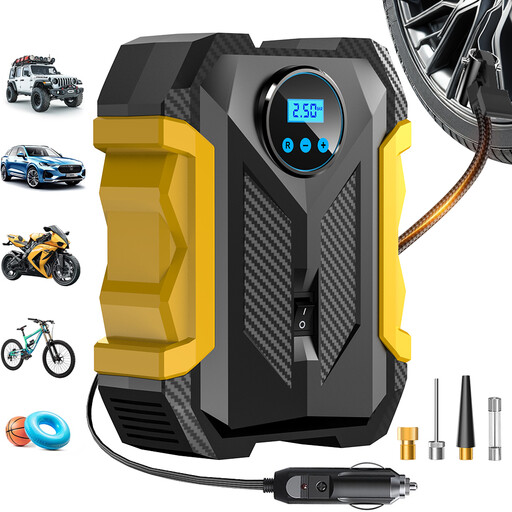
Why This Fits Their Persona: A practical boot-based option for drivers who need a corded car tyre air pump for cars, motorcycles, bicycles and selected small inflatables.
The digital display addresses the difficulty of reading a basic gauge, while the 3-metre cord helps reach tyres around a vehicle.
It uses a 12V supply and lists a 150 PSI maximum; the digital display supports pressure monitoring during use.
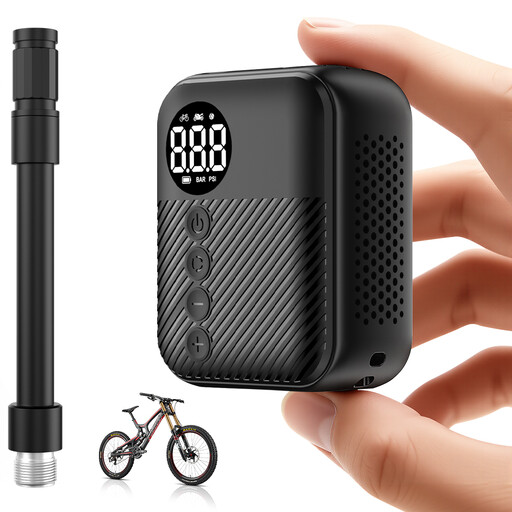
Why This Fits Their Persona: Its small rechargeable format suits cyclists, commuters and riders who prefer to carry an emergency inflator in a bag or storage compartment.
It avoids dependence on a vehicle socket and includes a digital gauge, helping users monitor pressure without carrying a separate analogue gauge.
The product is rechargeable, pocket-sized and specified up to 150 PSI, with a digital pressure reading for portable use.
We have compiled a complete, real-time list of products that fully satisfy these strict selection criteria and UK safety regulations.
Some models are designed for car tyres, including 12V electric compressors and higher-pressure cordless inflators. Confirm that the product has a suitable Schrader connection, an adequate pressure range and instructions covering vehicle use. A manual camping pump is generally intended for larger low-pressure inflatables rather than routine car tyre inflation.
The electricity used to recharge a small battery is usually modest, but running cost is not the only consideration. A rechargeable pump offers convenience away from a vehicle, while a 12V air compressor can provide continued power during roadside use. Compare charging time, battery capacity and how frequently you expect to inflate items.
Lifespan depends on frequency of use, heat management, storage and build quality. Follow the recommended duty cycle, keep the pump clean and dry, and avoid storing it with cables tightly kinked. A manual pump has no battery to replace, whereas a rechargeable model may gradually lose battery capacity over time.