
24/7 Customer Support

Free returns

Same-day & Next-day Delivery

Quality Guaranteed

Unlock Your Welcome Offers: FREE Delivery | Up to 80% OFF | Free 30-day JoyPlus trial
Download the APP
A portable air pump can be useful for maintaining car tyres, topping up bicycle tyres, preparing a paddle board or inflating sports equipment. However, product listings often present maximum pressure, cylinder count and battery capacity without explaining what those figures mean in everyday use.
The main buying mistakes are usually easy to avoid:
The right choice depends on the valve type, pressure requirement, intended number of uses and where you plan to operate it.
Pressure is commonly shown in PSI, bar or kPa. Car tyres commonly require considerably more pressure than low-pressure inflatables, while a SUP may require a lower pressure but a much greater volume of air.
A pump’s maximum PSI is only one part of the specification. Also check:
A cordless tyre inflator with around 20–35 L/min may be suitable for topping up smaller vehicle, motorcycle and bicycle tyres. A dual-stage SUP pump, such as one offering 350 L/min in its first stage and 70 L/min in its second, is designed for a very different task.
For a rechargeable air pump, battery capacity is usually stated in mAh or Wh. A larger number can support more inflation cycles, but actual runtime also depends on pressure, temperature and motor load.
Check whether the product offers:
For example, the Porbi Q16 has a 4000mAh battery, approximately 25 minutes of runtime and a stated output of 26 L/min. Its product information indicates support for topping up two empty 195 car tyres, with approximately 7–8 minutes per tyre. Treat figures like these as usage guidance rather than a guarantee for every tyre size or temperature.
A bicycle tyre pump may need a Presta adapter, while most car and motorcycle tyres use Schrader valves. Sports balls usually require an inflation needle. SUPs and other inflatables often use proprietary or wide-mouth valves.
Before ordering, confirm:
In the UK, also check the product packaging and instructions for relevant conformity markings, importer information and electrical safety details. Do not exceed the pressure recommended by the item’s manufacturer, even if the pump has a higher maximum rating.
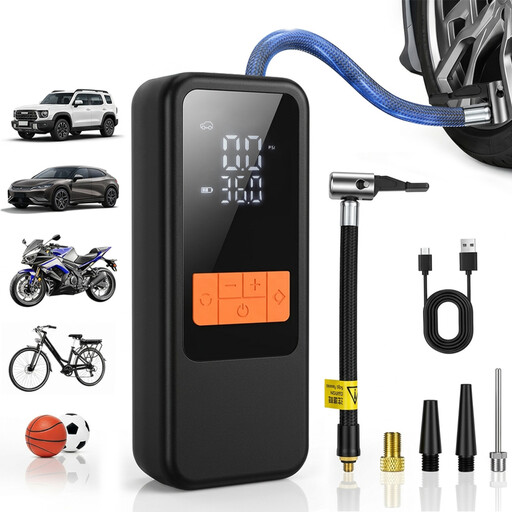
Why This Fits Their Persona: A compact option for drivers, cyclists and households needing one rechargeable pump for occasional top-ups, balls and small inflatables.
Its five modes distinguish car, motorcycle, bicycle, ball and custom use, rather than presenting one generic setting for every item.
150 PSI maximum pressure, 26 L/min airflow, Type-C charging and two LED modes.

Why This Fits Their Persona: Suits motorists wanting a cordless tyre inflator with a larger battery for repeated roadside or household use.
The 7500mAh battery, digital display and automatic stop provide more practical information than maximum PSI alone.
160 PSI rating, 35 L/min airflow, four preset modes, power-bank function and PSI, kPa and bar display.
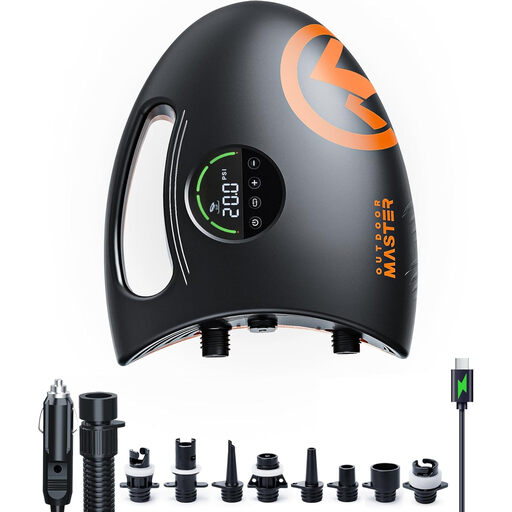
Why This Fits Their Persona: Designed for SUP and inflatable boat users who need repeated board inflation at campsites, launch points or beside the car.
It is a dedicated 20 PSI SUP pump, not a low-pressure toy pump or a small tyre inflator being used outside its intended purpose.
88.8Wh rechargeable battery, dual-function inflation and deflation, digital pressure setting and Type-C or DC inputs.
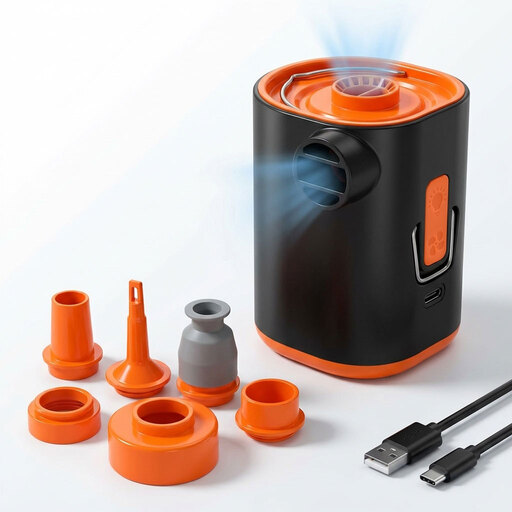
Why This Fits Their Persona: A lightweight companion for camping, air mattresses, inflatable toys and other low-pressure items where portability matters.
Its stated 4,800Pa pressure makes its low-pressure purpose clear; it should not be purchased for car, motorcycle or bicycle tyres.
300 L/min airflow, inflation and deflation capability, metal hanging hook and up to five hours of stated illumination.
We have compiled a complete, real-time list of products that fully satisfy these strict selection criteria and UK safety regulations.
Some are. Look for a digital tyre inflator or car air compressor with a pressure range suitable for your vehicle, a secure Schrader connection and enough battery or cable length. A low-pressure pump intended for toys or small air mattresses is not suitable.
Runtime varies with tyre size, starting pressure, temperature and motor load. Compact models may provide around 15–25 minutes, while larger battery systems can offer longer operation. Check the stated inflation examples and charging time rather than relying only on the mAh figure.
No. The maximum pressure does not indicate suitability for every product. A 160 PSI model is generally aimed at high-pressure items such as tyres and balls, whereas SUPs, air beds and pool inflatables may require a high-volume, lower-pressure pump with the correct nozzle.