
24/7 Customer Support

Free returns

Same-day & Next-day Delivery

Quality Guaranteed

Unlock Your Welcome Offers: FREE Delivery | Up to 80% OFF | Free 30-day JoyPlus trial
Download the APP
A flat battery can turn a normal commute, school run or weekend trip into an expensive roadside delay. A portable car battery jump starter offers a practical alternative to relying on another vehicle, but not every compact battery pack is suitable for every car.
The main buying mistakes usually come from three marketing traps:
The first specification to check is vehicle voltage. Most cars, motorcycles, SUVs, pickups and lawnmowers use a 12V electrical system, making a 12V jump starter suitable for these applications. Larger commercial vehicles may use 24V systems and require a different type of equipment.
Next, check engine capacity and fuel type. A jump starter for petrol and diesel cars should clearly state its supported limits. For example, the AstroAI S8 is specified for engines of up to 6.0L petrol and 3.0L diesel. This is more useful than judging the product solely by its headline amp rating.
Diesel engines can require more starting power, especially in cold UK weather. If your vehicle has a larger diesel engine, compare the manufacturer’s stated compatibility with your vehicle handbook rather than assuming a 1500A car jump starter will be sufficient.
A 1500A peak current rating describes the maximum short-duration output under stated conditions. It does not mean the jump starter continuously supplies 1500A, nor does it guarantee successful starting in every situation.
Battery capacity is another important figure. It may be shown in watt-hours (Wh) or milliamp-hours (mAh), but mAh figures should be read alongside voltage. The AstroAI S8 lists 37Wh / 10,000mAh at 3.7V, plus a 45C high-rate lithium battery.
For occasional emergency use, prioritise:
A compact car jumper starter battery pack is more convenient to store than a bulky lead-acid unit, but its smaller size makes correct charging and storage particularly important.
A suitable emergency car battery booster should provide safeguards such as reverse polarity, short-circuit, overcurrent, overvoltage, overload, overcharge and over-discharge protection. These features help reduce the consequences of common connection and charging errors, although they do not replace careful setup.
A jump starter with torch can be useful when checking terminals in an unlit car park or at the roadside. Strobe and SOS modes may also improve visibility when seeking assistance. USB outputs can turn the unit into a car jump starter power bank for charging a phone, but this should be treated as a secondary function rather than the main purchasing reason.
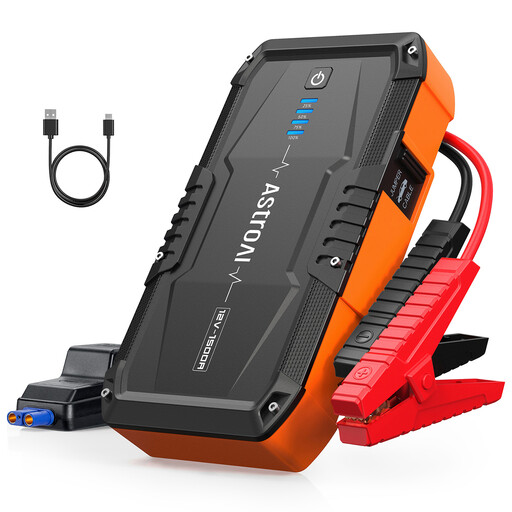
Why This Fits Their Persona: This compact option suits drivers who want one portable jump box for a car, motorcycle, SUV, pickup or lawnmower without carrying a large roadside unit.
It states compatibility of up to 6.0L petrol and 3.0L diesel engines and is specifically intended for 12V systems, rather than relying only on an amp headline.
1500A peak current, 37Wh capacity, dual USB-A outputs and a three-mode LED light in a 0.95lb compact body.
Why This Fits Their Persona: Drivers who value integrated safety functions and a tidy, low-storage design can keep this unit in a boot, travel bag or glove compartment.
The smart jumper cable includes eight listed protections, including reverse polarity and short-circuit protection. The manual should still be followed for every connection.
Smart boost mode supports low-voltage batteries, while the USB-C input and three torch modes add practical flexibility.
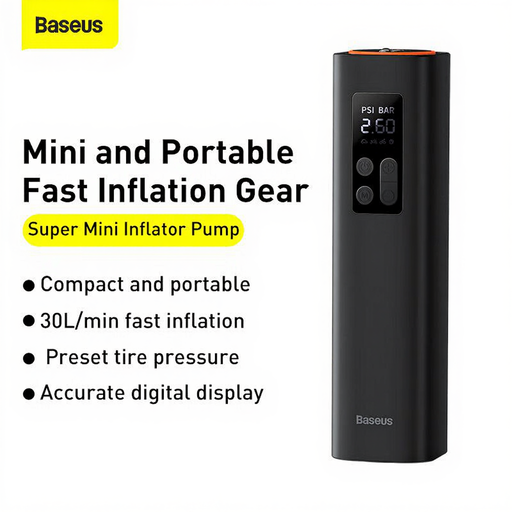
Why This Fits Their Persona: Frequent commuters, road-trip travellers and vehicle owners building a broader emergency kit may want tyre inflation support alongside a jump starter.
It is a separate 12V cigarette-lighter-powered inflator, so drivers do not mistake a jump starter’s USB power bank function for a tyre compressor.
The 3m power cable provides reach around the vehicle and the package includes an air hose plus three nozzles.
We have compiled a complete, real-time list of products that fully satisfy these strict selection criteria and UK safety regulations.
Before connecting a jump starter for up to 6.0L petrol and 3.0L diesel engines, check the manual and confirm that the vehicle uses a 12V system.
Do not use a 12V jump starter on 24V equipment. Avoid touching the clamps together, and stop if cables become unusually hot, damaged or loose.
Service life depends on charging habits, storage temperature and frequency of use. Check the charge periodically rather than leaving the unit unused for long periods. Lithium packs may perform less effectively in extreme cold, so avoid storing one permanently in a freezing boot.
No. A portable battery booster is designed to provide starting assistance, not replace a battery charger. Once the engine starts, drive or use a suitable mains charger according to the vehicle manufacturer’s guidance. If the battery repeatedly goes flat, arrange a vehicle inspection.