
24/7 Customer Support

Free returns

Same-day & Next-day Delivery

Quality Guaranteed

Unlock Your Welcome Offers: FREE Delivery | Up to 80% OFF | Free 30-day JoyPlus trial
Download the APP
A portable car fridge freezer can make road trips, camping weekends and long-distance driving far more convenient. However, not every electric cool box is designed to freeze food, run safely from a vehicle battery or cope with the limited space inside a car.
The main buying mistakes usually come from confusing different cooling technologies and overlooking practical installation details. Before choosing a 12V car fridge, check these common pitfalls.
Many compact mini fridges use thermoelectric cooling. These models can reduce the internal temperature below the surrounding temperature and may also offer a warming mode, but they generally cannot freeze food.
For example, a 4-litre thermoelectric unit may cool to around 20°C below ambient temperature. On a warm day, that may not produce refrigerator-level temperatures. A compressor cool box, by contrast, is designed to achieve a specific set temperature and can usually operate as a fridge or freezer.
A portable fridge freezer may cool quickly when empty and pre-chilled. Results can vary according to ambient temperature, ventilation, how often the lid is opened and whether food is loaded warm.
Look beyond a single cooling-time claim. Check the temperature range, insulation, lid seal and compressor ventilation requirements. These details are more useful for campers, anglers and motorhome owners who need consistent storage over several days.
A 12V car fridge can draw power continuously, including when the engine is off. Without suitable battery protection, extended use may reduce the vehicle battery charge.
A unit should also be secured during travel. Sudden braking, sharp turns and uneven tracks can make a loose portable cooler box slide or tip. Check whether the design includes handles, non-slip feet or suitable tie-down guidance.
Choose a compressor-based portable fridge freezer if you need genuine freezing capability, chilled meat storage or a set temperature below 0°C. Models such as the EUHOMY 18L list a temperature range of -20°C to +20°C, allowing use as either a refrigerator or camping freezer.
Thermoelectric models are more suitable for drinks, packed lunches, skincare or keeping pre-warmed food at a moderate temperature. They are often lighter and more affordable, but their cooling depends on the surrounding temperature.
Capacity should match the length of your trips and the available vehicle space:
A dual-zone design can separate chilled and frozen food and may reduce odour transfer. Measure the available space carefully, including lid clearance and room around ventilation outlets.
A flexible 12V and 240V fridge can be used in a car, campervan, motorhome, boat, garage or campsite with the appropriate cable. Some products include both AC and DC adapters, while others require a separate mains adapter.
Check the product specification for:
Always follow the supplied instructions and avoid obstructing airflow. A portable fridge freezer should sit on a stable surface and be secured in a moving vehicle.
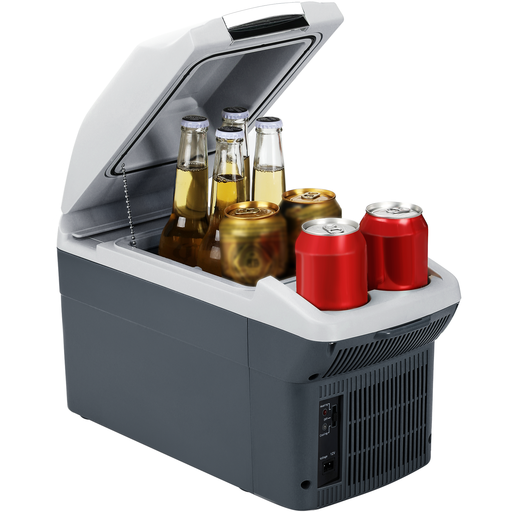
Why This Fits Their Persona: Its compact 9-litre format suits drivers who want chilled drinks and warm snacks without dedicating boot space to a large camping fridge.
The listing clearly identifies cooling and warming functions rather than presenting it as a freezing compressor appliance. An optional AC adapter is needed for home use.
12V operation, approximately 40 dB noise and a carrying strap make it convenient for everyday driving and short trips.
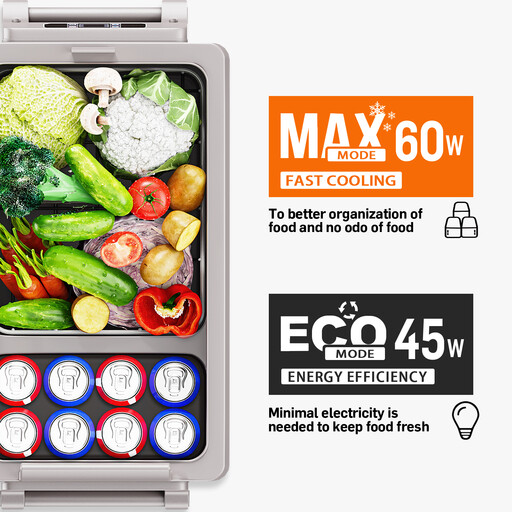
Why This Fits Their Persona: The larger dual-zone layout is suited to families, caravanners, motorhome owners and people who need separate food and drink storage.
Its compressor system, stated -20°C to +20°C range and three-level battery protection provide clearer information than a generic “electric cool box” description.
49.4-litre capacity, dual storage areas, 12/24V DC and AC compatibility, plus ECO and MAX modes.
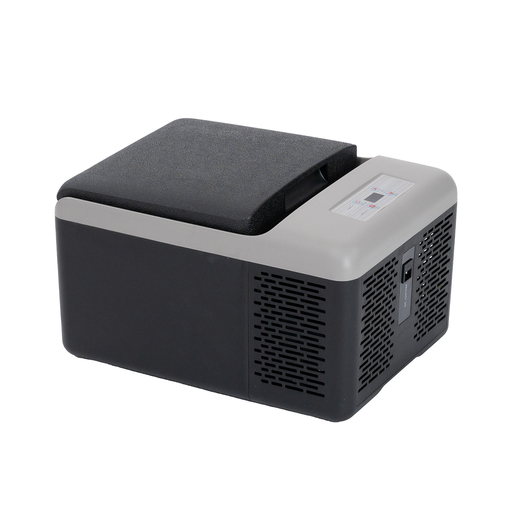
Why This Fits Their Persona: Anglers, lorry drivers, boat users and campers needing a compact freezer for food or bait may prefer its compressor-based design and low-temperature range.
It is specified as a compressor fridge/freezer with cooling down to -20°C, rather than a thermoelectric cooler that cannot freeze.
Three-level battery protection, temperature memory, 6.7 kg weight and operation on inclines of up to 45 degrees according to the product information.
We have compiled a complete, real-time list of products that fully satisfy these strict selection criteria and UK safety regulations.
It can, provided the vehicle socket remains powered and the battery has sufficient capacity. Continuous operation may discharge the battery, so use the appliance’s battery-protection setting and consider a leisure battery or portable power station for extended camping.
A compressor cool box actively refrigerates and can usually freeze at a selected temperature. A thermoelectric cooler lowers the temperature relative to ambient conditions and may provide warming, but it normally cannot freeze. Thermoelectric models are often compact and lighter; compressor models are more suitable for long trips and frozen storage.
Running cost depends on wattage, duty cycle, ambient temperature, insulation and electricity prices. A model using around 45W will not necessarily draw that amount continuously because the compressor cycles on and off. ECO mode, good ventilation and pre-chilled contents can help reduce operating time. Check the product’s energy information and your power supply before buying.