
24/7 Customer Support

Free returns

Same-day & Next-day Delivery

Quality Guaranteed

Unlock Your Welcome Offers: FREE Delivery | Up to 80% OFF | Free 30-day JoyPlus trial
Download the APP
By the Joybuy Product Recommendation Officer
A portable car fridge can make motorway trips, camping weekends and caravan holidays more convenient. It can keep drinks cool, store packed lunches and, with the right compressor system, freeze food while you travel. However, not every product described as a car fridge works like a household refrigerator.
The main buying mistakes usually come from confusing cooling technologies, overlooking power requirements and choosing a capacity that does not suit the vehicle. Before selecting a 12V car fridge, consider the following practical points.
Many compact units use thermoelectric technology. These products are often described as a thermoelectric cooler and warmer, but they generally cool by a stated number of degrees below the surrounding temperature rather than reaching a fixed refrigerator temperature.
For example, a unit rated to cool up to 20°C below ambient temperature may perform differently in a warm car on a summer day. It may be suitable for drinks and snacks, but it cannot freeze food. If you need a genuine portable freezer, look for a compressor cooler box with a stated temperature range below 0°C.
A 9-litre car cooler, an 18-litre travel fridge and a 49.4-litre portable fridge freezer serve very different purposes. Capacity may also be affected by internal baskets, dividers and the shape of the cooling compartment.
Check what you normally carry: cans, bottles, lunch boxes, meal containers or fishing bait. Also measure the available area in your car, boot, motorhome or boat. A larger 12V and 24V fridge may offer more storage but can be difficult to lift and may obstruct access or visibility.
A product that runs from a cigarette lighter socket is not automatically suitable for continuous use when the engine is off. Check whether the socket remains powered, whether the cable reaches the intended position and whether the unit has battery protection.
Compressor models also need ventilation around the cooling system. Allow the clearance stated by the manufacturer; restricting airflow can affect performance and create unnecessary heat. When transporting a larger cooler box, secure it with suitable straps so it cannot slide during braking or sharp turns.
There are two main categories:
A car cooler box with warming mode is useful for keeping pre-heated food warm, but warming is not a substitute for safe food storage. Follow the product instructions and handle perishable food appropriately.
For vehicle use, look for 12V DC compatibility. Owners of lorries, buses and some larger recreational vehicles may also need 24V DC support. An AC/DC portable fridge with a household adapter can be used at home, in a garage or at a campsite with a suitable mains supply.
Battery protection is particularly useful for compressor coolers. Multi-level protection settings can help reduce the risk of excessive vehicle battery discharge, but they do not replace sensible use of a separate leisure battery or power station when camping overnight.
Noise ratings around 40–42 dB may be suitable for many vehicles, tents and bedrooms, but the perceived sound can vary by surroundings and operating mode. A sealed lid, gasket or magnetic closure helps reduce temperature loss when the cooler is closed.
For frequent carrying, compare handles, shoulder straps, weight and external dimensions. A compact mini fridge for car use may fit on a passenger seat, while a large camping fridge may be more practical in a boot, caravan or motorhome storage area.
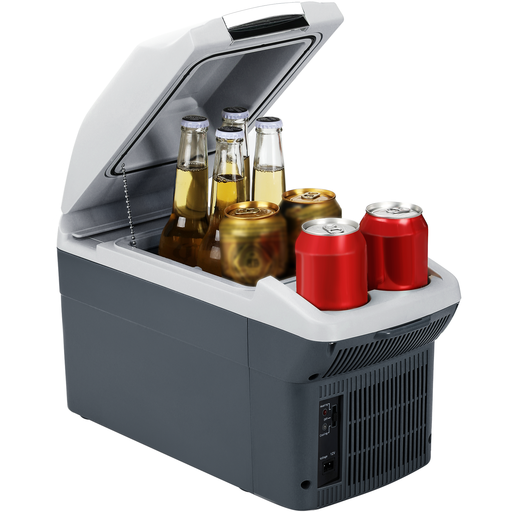
Why This Fits Their Persona: A practical choice for UK drivers who want a compact unit for drinks, sandwiches, snacks and short trips without carrying a large compressor appliance.
Its description clearly identifies 12V DC operation and cooling and warming modes, helping buyers distinguish it from a compressor portable freezer.
9L capacity, approximately 40 dB operation, dual cup holders and an adjustable shoulder strap.
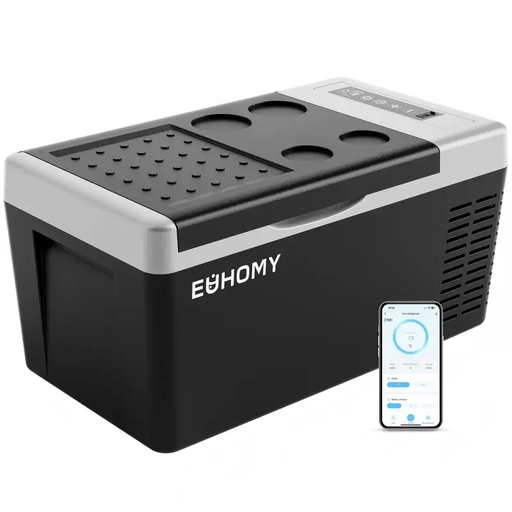
Why This Fits Their Persona: Suitable for campers, caravan users and boaters who want a refrigerator and freezer in one unit, with both vehicle and household power options.
The compressor system has a stated -20°C to +20°C range, while three-stage battery protection helps address power-management concerns.
18L storage, 12/24V DC and 100–240V AC compatibility, app control and approximately 42 dB operation.
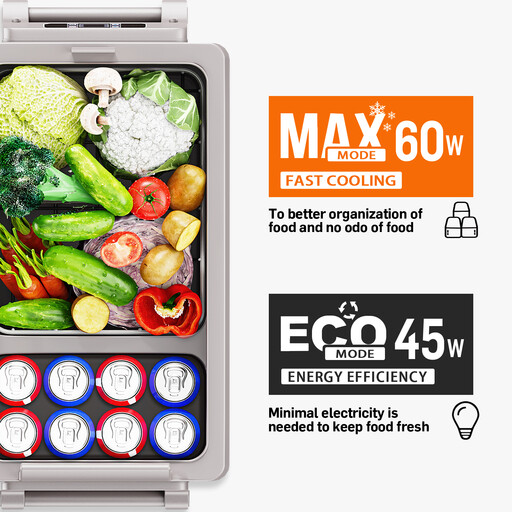
Why This Fits Their Persona: Designed for longer trips, group camping, motorhomes, lorries, boating and fishing where substantial food and drink storage matters more than a small footprint.
Its dual storage areas, compressor cooling, battery protection and stated ventilation clearance address the common capacity and continuous-use pitfalls.
49.4L capacity, two storage zones, 12/24V DC and 240V AC operation, LCD controls and a stated 40 dB noise level.
If freezing is not required, a small electric cool box may be more convenient. The AstroAI 4-litre mini fridge holds up to six 330ml cans, operates from 12V DC or 220–240V AC, and offers cooling and warming. Its thermoelectric system cools up to 20°C below ambient temperature but cannot freeze.
For slightly more room, the AstroAI 6L cooler and warmer accommodates up to eight cans in its standard arrangement and supports AC/DC use. These models can suit a bedroom, office, skincare storage or occasional car travel, provided expectations remain focused on cooling rather than freezer performance.
We have compiled a complete, real-time list of products that fully satisfy these strict selection criteria and UK safety regulations.
Check whether your vehicle’s accessory socket remains live when the ignition is off. Continuous operation can discharge a starter battery. A model with adjustable battery protection is helpful, but a leisure battery or portable power station may be more appropriate for overnight camping.
Noise depends on the compressor, fan, surface and operating mode. The listed models specify approximately 40–42 dB, but placing the unit on a solid, level surface and leaving ventilation space can help it operate as intended.
Energy use varies with ambient temperature, contents, target temperature, insulation and mode. Compressor models may list an average wattage or energy class, while thermoelectric units require continuous power for cooling. Compare the stated consumption rather than relying on capacity alone, and avoid opening the lid more often than necessary.