
24/7 Customer Support

Free returns

Same-day & Next-day Delivery

Quality Guaranteed

Unlock Your Welcome Offers: FREE Delivery | Up to 80% OFF | Free 30-day JoyPlus trial
Download the APP
A portable car fridge can make long drives, camping trips and daily commutes more convenient, but choosing the wrong type may lead to warm drinks, drained batteries or an appliance that takes up too much space. The right model depends on whether you need simple cooling, genuine freezing, home-and-car flexibility or enough capacity for several people.
Before buying, look beyond phrases such as “ice-free”, “energy-saving” or “car refrigerator”. These descriptions can refer to very different technologies and usage conditions.
Many compact units marketed as a mini car fridge use thermoelectric technology. This can cool below the surrounding temperature and may also provide warming, but it generally cannot freeze food. Cooling performance is also affected by hot weather, direct sunlight and ventilation.
A compressor cooler box, by contrast, is designed to reach a set temperature independently of ambient conditions within its stated range. It is the more suitable format if you need a genuine 12V fridge freezer for meat, frozen food or extended trips.
A 5L, 9L or 18L label indicates the internal volume, not necessarily the number of bottles or lunch boxes it will hold. Shelves, insulation and the shape of the compartment can reduce usable space. Check internal dimensions where provided, especially if you plan to store tall bottles, meal containers or skincare products.
Some vehicles turn off the cigarette-lighter socket when the ignition is switched off. Others continue supplying power, which can gradually discharge the starter battery. A battery protection system is useful, but it does not remove the need to check your vehicle’s socket behaviour and select an appropriate protection setting.
For drinks, snacks and personal items, a thermoelectric electric cool box may be sufficient. Look for the stated cooling difference, such as “up to 18–22°C below room temperature”, rather than assuming the unit will reach a particular temperature in all conditions.
For freezing or stable refrigeration, choose a compressor model. For example, some compressor units specify a range from -20°C to +20°C, allowing them to function as either a fridge or freezer. Pre-chilling food and leaving room for air circulation can reduce running time.
A 12V car fridge normally connects to a vehicle accessory socket. Larger models may also accept 24V DC, which is relevant to lorry, bus and some commercial vehicle users. An AC/DC portable fridge can be more versatile for caravans, motorhomes, boats, bedrooms, offices and garages because it accepts household mains power as well as vehicle power.
Check whether the mains adaptor is included. Some compact coolers require an optional 220–240V adaptor, while others include both AC and DC cables.
Cooling vents must remain clear. Compressor models commonly require around 10cm of clearance around the ventilation area, although the product instructions should take priority. Place the unit on a stable, level surface and secure larger models with suitable straps during travel.
For overnight use, look for selectable low, medium and high battery-protection settings. These settings help reduce the risk of excessive battery discharge, but they are not a substitute for a leisure battery or a suitable power station during extended stationary use.
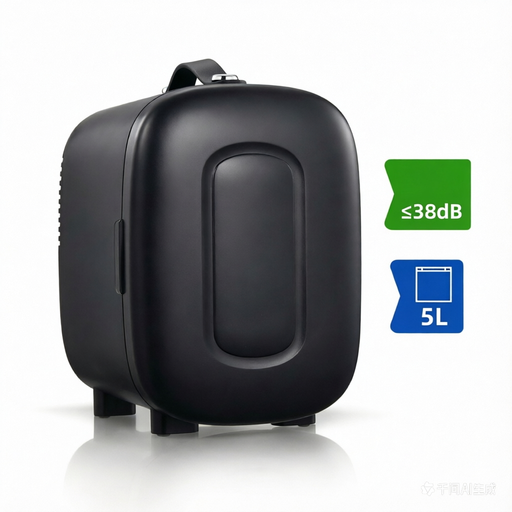
Why This Fits Their Persona: A compact choice for commuters, bedroom use, office snacks and short car journeys where a large camping fridge would be unnecessary.
Its 5L capacity and stated space for up to six 330ml cans make the storage expectation clearer than an unspecified “personal” size. Cooling is relative to ambient temperature, so it does not overpromise freezer performance.
5L interior; 240V AC and 12V DC power; cooling and warming modes; removable shelf and condensation tray.
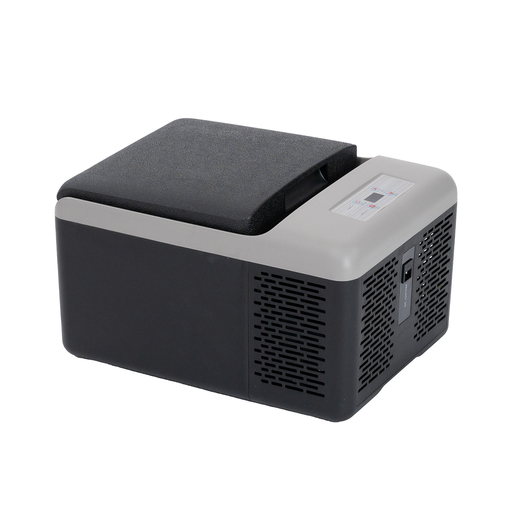
Why This Fits Their Persona: Suited to drivers, boat users and campers who want compressor refrigeration in a relatively compact format without moving to a large RV fridge.
The compressor design and stated temperature down to -20°C distinguish it from a thermoelectric car cooler and make its fridge/freezer role explicit.
9L compressor capacity; three-level battery protection; 12V operation; stated operation on uneven roads and inclines up to 45°.
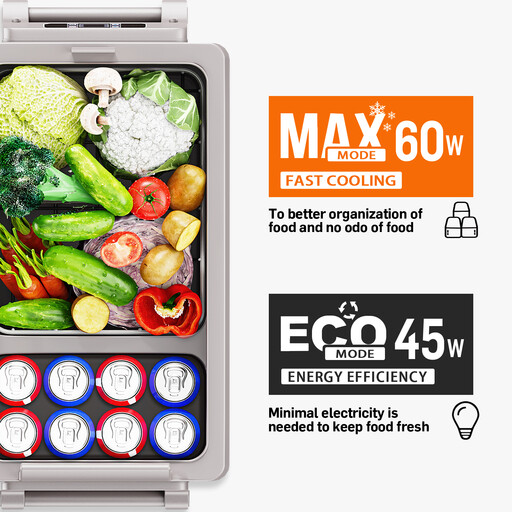
Why This Fits Their Persona: A high-capacity option for caravan and motorhome owners, lorry drivers, boat users and groups spending several days away from a mains fridge.
The listed 49.4L capacity and dual storage areas address the limited-space problem, while 12/24V DC compatibility supports cars, campervans and larger vehicles.
49.4L capacity; two storage zones; -20°C to +20°C setting range; 12/24V DC and 240V AC operation; three battery-protection levels.
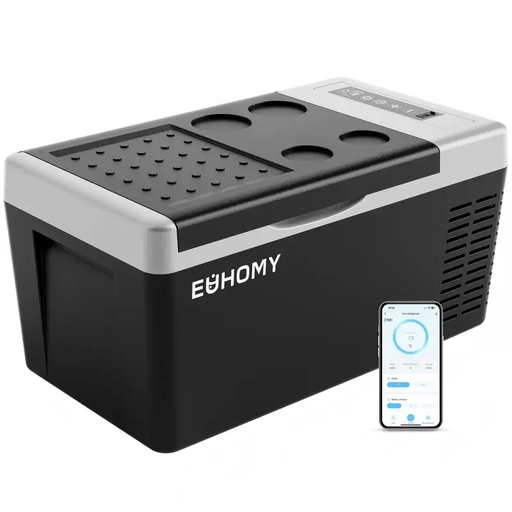
Why This Fits Their Persona: Practical for couples, weekend campers and households wanting one portable fridge freezer for the car, campsite or home.
It uses compressor refrigeration rather than a cooling chip and lists a defined -20°C to +20°C range. Battery protection and both AC and DC inputs make the power arrangement more transparent.
18L capacity; 12/24V DC and 100–240V AC compatibility; app control; three-stage battery protection; stated 42dB operating noise.
We have compiled a complete, real-time list of products that fully satisfy these strict selection criteria and UK safety regulations.
Yes, if the accessory socket remains live while the engine is off. Battery-protection settings can reduce the risk, but the result depends on the vehicle battery, ambient temperature, fridge size and running pattern. For overnight or multi-day use, a leisure battery or power station is usually more appropriate.
Noise varies by model and installation. The listed EUHOMY 18L model specifies approximately 42dB, while some compact thermoelectric models specify around 40dB. Ventilation clearance and a stable surface can also affect perceived noise.
Lifespan depends on cleaning, ventilation, power stability, handling and storage conditions. Avoid obstructing vents, protect the compressor from impact and follow the manufacturer’s instructions. After a power interruption, some compressor models require several minutes before restarting.