
24/7 Customer Support

Free returns

Same-day & Next-day Delivery

Quality Guaranteed

Unlock Your Welcome Offers: FREE Delivery | Up to 80% OFF | Free 30-day JoyPlus trial
Download the APP
Gone are the days of relying on melting ice and soggy sandwiches for your meals on the road. Whether you're planning a weekend camping trip in the Peak District, a family holiday to Cornwall, or you're a long-haul driver crossing the country, having reliable mobile refrigeration can transform your travel experience. A high-quality portable car fridge ensures your food stays fresh, your drinks remain chilled and you have the freedom to eat well, wherever your journey takes you.
However, the market is filled with options, from basic electric coolers to advanced compressor models. This guide is designed to help you understand the key features to look for, so you can choose a unit that meets your specific needs for camping, boating or long-distance travel.
Making the right choice comes down to understanding a few core principles. Here are the most important factors to consider before you buy.
The single most important distinction is the cooling technology. Many people are familiar with a basic 12v cool box, which typically uses a thermoelectric system. These units can only cool to a certain number of degrees below the ambient temperature. On a hot summer day in the UK, this may not be enough to keep dairy or meat at a safe temperature.
A compressor cooler box, on the other hand, functions just like your fridge at home. It uses a refrigerant and a compressor to achieve and maintain a precise temperature, regardless of how warm it is outside. This means you can set it to 4°C for chilling milk or even -18°C to function as a portable freezer for car use, making it a true camping fridge freezer. For reliable food safety and freezing capability, a compressor model is the superior choice.
A versatile travel fridge should offer flexible power options. Look for models that can run on both a vehicle's 12V/24V DC socket and a standard 220-240V AC mains outlet. This allows you to pre-cool the unit at home before your trip and use it in your car, campervan, or boat.
Equally important is a built-in battery protection system. This feature monitors your vehicle's battery voltage and automatically shuts the fridge off if the power level drops too low, ensuring you always have enough charge to start your engine. Most units offer three settings (Low, Medium, and High) so you can adjust the cut-off point based on your battery's health and your needs.
Capacity is measured in litres and dictates how much you can store.
Consider the unit's physical dimensions to ensure it fits in your vehicle's boot or footwell. Features like sturdy handles, durable wheels and internal baskets also make a significant difference in how easy the car refrigerator is to pack, move, and organise.
Here are a few models that offer a strong combination of performance, features and practicality for different types of users.
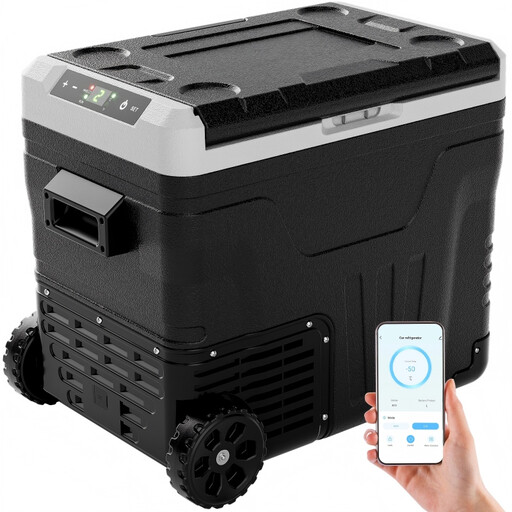
Why It Stands Out: With its generous 50-litre capacity and dual-zone storage, this unit is built for serious adventures. The removable divider allows you to create separate fridge and freezer compartments, reducing odour mixing. Its robust wheels and handles make moving it from the car to the campsite straightforward, even when fully loaded.
Pros:
Who is it for? Families, groups and long-haul travellers who need maximum storage space and the flexibility of separate fridge and freezer zones. It's an excellent choice for extended camping holidays or as a primary boat fridge.

Why It Stands Out: This compact and efficient 18-litre model proves that powerful cooling can come in a small package. It's lightweight and portable, making it easy to fit in almost any vehicle. The magnetic lid seal enhances insulation, helping it maintain temperature efficiently. Despite its size, it offers the same true refrigeration and freezing performance as larger units.
Pros:
Who is it for? Solo adventurers, couples or anyone needing a reliable cooler for day trips, fishing, or commuting. It also serves well as a secondary fridge in a larger campervan setup.

Why It Stands Out: The 35-litre model strikes an excellent balance between capacity and portability. It's large enough for a weekend away for a small family but still manageable to move, thanks to its wheels and handles. Like the 50L version, it offers dual-zone storage with a divider and baskets, providing great organisational flexibility in a mid-sized frame.
Pros:
Who is it for? Couples or small families heading out for a weekend of camping. It's also a popular choice for campervan conversions where space is a consideration but a decent capacity is still required.
If these models aren't quite what you're looking for, don't worry. There are many different sizes and configurations available to suit every need and vehicle. Explore our full range of portable coolers to find the perfect travel companion for your next adventure.
1. Can a portable car fridge drain my car battery? This is a common concern, but quality models are designed to prevent it. Look for a 12v fridge with a three-stage battery protection system (often labelled L/M/H). This feature automatically shuts the unit down if it detects the vehicle's battery voltage has dropped to a pre-set level, ensuring you always have enough power to start your engine.
2. What is the difference between a 12v cool box and a portable compressor fridge? A standard 12v cool box uses thermoelectric cooling, which can only reduce the internal temperature by a fixed amount (e.g., 20°C) below the surrounding air temperature. A portable compressor fridge works like your home refrigerator, allowing you to set and maintain a precise temperature (from chilling to freezing) regardless of the weather outside. For storing perishable food safely, a compressor model is essential.
3. How noisy is a portable freezer for a car? Modern compressor technology has become remarkably quiet. Many high-quality units operate at noise levels below 45 decibels, which is quieter than a typical conversation and similar to the hum of a domestic fridge. This makes them perfectly suitable for use in a campervan fridge or tent where you might be sleeping nearby.