
24/7 Customer Support

Free returns

Same-day & Next-day Delivery

Quality Guaranteed

Unlock Your Welcome Offers: FREE Delivery | Up to 80% OFF | Free 30-day JoyPlus trial
Download the APP
A portable car fridge can make long drives, weekend camping and caravan trips considerably easier. However, the wrong model may leave drinks lukewarm, drain a vehicle battery or take up more space than expected.
Before buying a 12V car fridge, look beyond capacity and promotional cooling claims. The most useful comparison is between compressor refrigeration and thermoelectric cooling, alongside power compatibility, ventilation and the way you intend to use the unit.
Many compact products are described as a “fridge” even though they use a thermoelectric cooling chip. A thermoelectric mini fridge generally lowers the internal temperature relative to the surrounding air; it does not function as a true freezer.
For example, a unit advertised as cooling by 18–22°C below ambient temperature may perform differently inside a warm car on a summer day. It may be suitable for cans, snacks, skincare products and packed lunches, but not for freezing meat or storing food for extended periods.
If you need frozen storage, look for a compressor cooler box with a stated negative temperature range, such as -20°C to +20°C.
A 12V car fridge normally draws power through a cigarette lighter or accessory outlet. Some sockets switch off when the ignition is turned off, while others remain live and could gradually discharge the vehicle battery.
Check whether the product has low-voltage battery protection and whether the cooler offers adjustable low, medium and high protection settings. You should also confirm that your vehicle’s socket and fuse can support the stated load. Disconnect the fridge when the vehicle will be parked for a long period unless you have a suitable auxiliary battery system.
A portable fridge needs space around its ventilation area to release heat. Pushing it tightly against luggage, a boot wall or a seat can reduce cooling performance and increase running time.
In a moving vehicle, the appliance should be secured with suitable straps or placed on a stable, level surface. A loose camping cooler box can slide during braking or cornering, particularly in a van, boat or motorhome.
Choose a portable fridge freezer with a compressor if you need reliable low temperatures, frozen storage or use in changing outdoor conditions. Compressor units are generally more suitable for camping, fishing, boating, caravanning and long-distance travel.
A thermoelectric car cooler and warmer is usually lighter and more compact. It can cool drinks and snacks, or warm food and beverages, but its cooling performance depends on room or vehicle temperature. These units are often practical as a mini fridge for car, office, bedroom or skincare storage.
Capacity figures do not always show how much usable space is available. Before purchasing, measure the bottles, lunch boxes or containers you plan to store. Also check the internal dimensions, shelf layout and whether the lid opens freely in your intended location.
A 4–6 litre model may suit a driver who needs a few cans, snacks or personal-care items. An 18 litre camping fridge gives more flexibility for a couple travelling overnight, while a 49.4 litre dual-zone model is designed for larger groups, motorhomes, boats or extended trips.
An AC/DC portable fridge is more versatile because it can operate from a 12V or 24V vehicle supply and a household mains socket. This allows you to pre-cool items at home before leaving and continue using the unit at a campsite, garage or holiday accommodation.
Check the stated temperature range, cooling method and noise rating. A thermoelectric model may list a warming function of up to 66°C, while compressor models can offer freezer-level temperatures. Noise ratings around 40–42 dB may be relevant if the unit will be used near a bed or inside a quiet campervan.
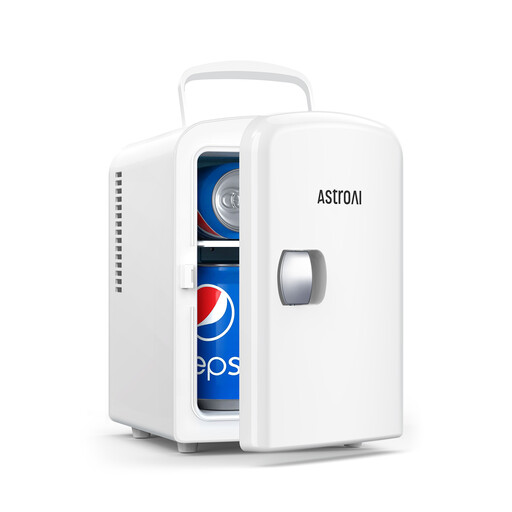
Why This Fits Their Persona: A compact option for drivers, office users and bedroom storage, with enough space for several cans, snacks or skincare products.
Its description clearly identifies thermoelectric cooling and states that it cannot freeze, helping buyers set realistic expectations.
4-litre capacity, 12V DC and 220–240V AC cables, plus cooling and warming modes up to 66°C.
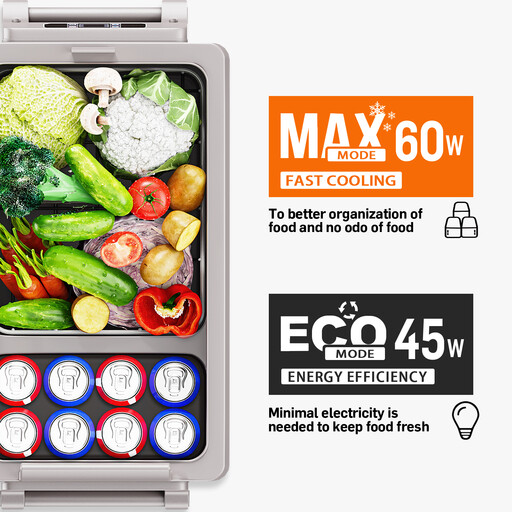
Why This Fits Their Persona: Its large dual-zone layout suits caravan owners, boat users, anglers and families carrying varied food and drinks.
It specifies a compressor system, a -20°C to +20°C setting range and three battery-protection levels rather than relying only on general cooling language.
49.4-litre capacity, two storage zones, 12/24V DC and 240V AC compatibility, with an LCD touch panel and Bluetooth control.
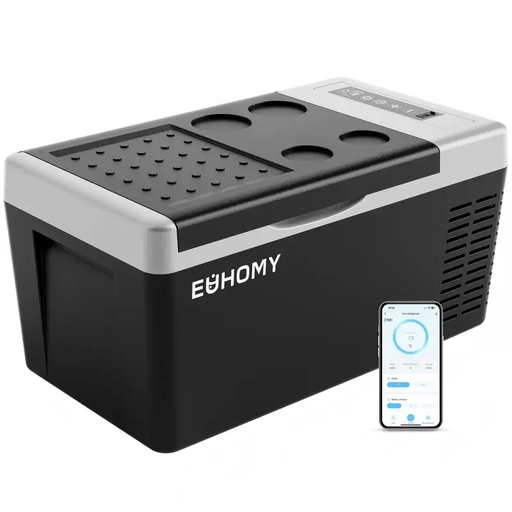
Why This Fits Their Persona: A middle-capacity travel fridge for campers, van travellers and boat owners who need genuine refrigeration without the footprint of a larger unit.
The compressor, stated temperature range and required ventilation clearance make its intended use clearer than a generic “cooler” label.
18-litre storage, -20°C to +20°C settings, 12/24V DC and 100–240V AC operation, plus app control and three-stage battery protection.
We have compiled a complete, real-time list of products that fully satisfy these strict selection criteria and UK safety regulations.
It can if the socket remains live after the ignition is switched off. Battery protection helps reduce the risk, but it is not a substitute for checking your vehicle’s electrical system. For overnight use, consider a leisure battery or portable power station.
Running cost depends on the model, ambient temperature, insulation, selected mode and usage pattern. Compressor units may cycle on and off after reaching the target temperature, while thermoelectric models generally need continuous power for cooling. Compare the stated wattage and energy information rather than relying on the product category alone.
There is no universal lifespan. Regular cleaning, adequate ventilation, careful transport and avoiding overloaded sockets can support dependable operation. Compressor models also need protection from excessive movement and should be installed with the clearance specified by the manufacturer.