
24/7 Customer Support

Free returns

Same-day & Next-day Delivery

Quality Guaranteed

Unlock Your Welcome Offers: FREE Delivery | Up to 80% OFF | Free 30-day JoyPlus trial
Download the APP
A flat battery is more than an inconvenience; it can disrupt your entire day, leaving you stranded at the most inconvenient times. While a portable car jump starter seems like a simple solution, the market is flooded with options that often over-promise and under-deliver. As a Joybuy Product Recommendation Officer, my role is to help you see past the marketing jargon and choose a device that offers genuine reliability when you need it most.
Before you buy, be aware of these common purchasing pitfalls that can lead to wasted money and a false sense of security.
jump starter power bank intended to charge your phone, but it says very little about its core function as an emergency car starter. A high-capacity battery with poor discharge components will fail to start a vehicle, no matter how many times it can charge your tablet.To ensure you get a dependable tool, focus on these non-negotiable specifications. Analysing them will help you find a car battery booster that matches your vehicle and needs.
Ignore the peak amp hype and look for the starting amperage or, at the very least, the recommended engine compatibility. A 12V vehicle jump starter needs enough power to crank your specific engine type. Here is a general guide:
jump starter for large engines (e.g., up to 10.0L petrol or 8.0L diesel), you will need a powerful unit, often advertised as a 3000A jump starter or higher, to provide adequate cranking power.Your jump starter is an emergency device, and its reliability is paramount. Always check for the following:
We have selected products based on how well they align with specific user needs, focusing on objective features and practical applications. The following recommendation is an example for a driver with demanding requirements.
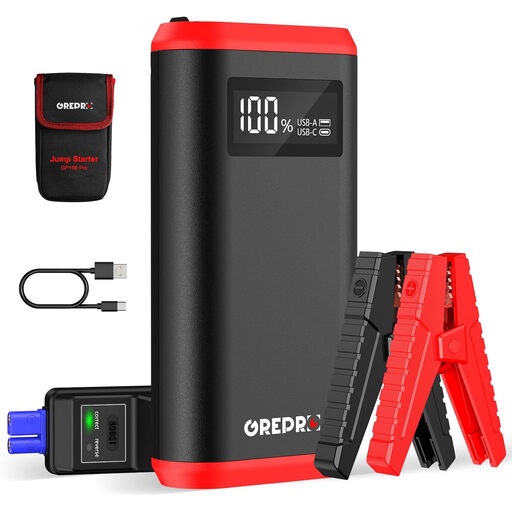
Why This Fits Their Persona: This unit is designed for those who cannot afford to be stranded. It is suitable for owners of SUVs, vans, trucks and boats with large engines (up to 10.0L petrol or 8.0L diesel), providing substantial power for demanding starts. It's a practical choice for tradespeople, long-distance travellers and families with larger vehicles.
It sidesteps the "peak amps" illusion by clearly stating its compatibility with large engine sizes, a practical measure of its power. It also features smart clamps with ten safety protections, avoiding the risk of using an uncertified device.
Its primary advantage is its high power output, capable of starting demanding 12V engines. The clear LCD screen shows remaining power, and the integrated LED flashlight adds practical utility in an emergency.
We have compiled a complete, real-time list of products that fully satisfy these strict selection criteria and UK safety regulations, including models for smaller cars and different budgets.
Here are answers to some common questions UK drivers have about portable jump starters.
1. How long does a portable car jump starter hold its charge? Most modern lithium-ion jump starters can hold a significant portion of their charge for 3 to 6 months. However, performance can be affected by storage temperature. It is good practice to check the charge level and top it up every 2-3 months to ensure it is ready when you need it.
2. Can I leave a car battery booster connected to the battery? No. A portable jump starter is designed for temporary use to start the engine. Once the vehicle is running, you should disconnect the clamps immediately in the correct order (usually black/negative first, then red/positive). Leaving it connected could damage the jump starter, the vehicle's electronics or both.
3. Is a 3000A jump starter too powerful for a small car? No, you cannot use a jump starter that is "too powerful." The vehicle's starter motor will only draw the amount of current it needs to turn over the engine. A high-amperage jump starter simply has a higher capacity, meaning it is capable of providing the necessary current for larger engines without being overworked. Using a 3000A unit on a small car is perfectly safe, provided the voltage matches (12V for most passenger vehicles).