
24/7 Customer Support

Free returns

Same-day & Next-day Delivery

Quality Guaranteed

Unlock Your Welcome Offers: FREE Delivery | Up to 80% OFF | Free 30-day JoyPlus trial
Download the APP
A flat battery can leave a car, van or motorcycle unusable at the worst possible time, particularly during a cold British morning or after a vehicle has been parked for several weeks. A portable car jump starter offers an alternative to waiting for roadside assistance, but choosing the right model requires more than comparing peak amps.
Marketing descriptions often combine jump starting, tyre inflation, phone charging and lighting into one compact device. Those features can be useful, provided the specifications match your vehicle and the unit is maintained correctly. This guide explains the main buying pitfalls, the technical details worth checking and suitable options for different UK motorists.
A high amp figure can attract attention, but it does not tell you everything about compatibility or everyday usability. Check the manufacturer’s stated engine capacity for petrol and diesel engines, as diesel vehicles generally require more starting power than similar-sized petrol cars.
Also confirm that the device is designed for a 12V system. A 12V jump starter should not be used with 24V heavy-duty trucks or equipment unless the product documentation specifically permits it. A large amp rating does not make a 12V unit suitable for a 24V vehicle.
A car jump starter with air compressor can be convenient for topping up a tyre, but portable compressors have duty-cycle limits. For example, the AstroAI S8 Air advises a maximum of 10 minutes of continuous inflation followed by at least 10 minutes of cooling. The air tube may also become hot.
Ignoring these instructions can shorten component life or create a handling risk. Check the compressor’s maximum pressure, inflation rate, automatic stop function and recommended rest period rather than focusing only on a headline “PSI” figure.
A booster that is left in a boot without checking its charge may be flat when needed. Useful features include a battery-level display, storage for the leads and accessories, and clear connection warnings. A torch with SOS or strobe modes can assist during a night-time roadside stop, but it should complement—not replace—high-visibility clothing, a warning triangle and appropriate roadside procedures.
Match the portable jump box to the engine size shown in its product information. The AstroAI S8 is listed for engines up to 6.0L petrol and 3.0L diesel, while the GREPRO 3000A is listed for up to 10.0L petrol and 8.0L diesel. The WOLFBOX 3000A is listed for up to 8.0L petrol and 6.0L diesel.
These figures are product specifications, not a guarantee that every vehicle will start in every condition. Battery age, engine condition, temperature, cable connection and the vehicle’s electrical system can all affect results.
Look for smart clamps and clearly described protection features, such as reverse polarity, short-circuit, over-current, over-voltage, overcharge and over-temperature protection. These features are intended to help reduce incorrect-connection and electrical risks, but the instructions still need to be followed.
For a typical 12V jump-start procedure:
Do not allow the clamps to touch each other. If the device shows an error, disconnect it and correct the connection before trying again.
A lithium battery jump starter is generally easier to carry than traditional lead-acid packs. Capacity may be shown in watt-hours or milliamp-hours, so compare like with like and check the charging input. The AstroAI S8 has a stated 37Wh capacity, while the WOLFBOX model has 59.2Wh and a 65W charger.
A vehicle power bank with USB outputs can charge a phone or navigation device during an emergency. However, using USB power reduces the available charge, so recharge the unit after use. Storage guidance varies: some products advise charging every three months, while the WOLFBOX instructions recommend recharging every six months. Follow the supplied manual rather than relying on a generic schedule.
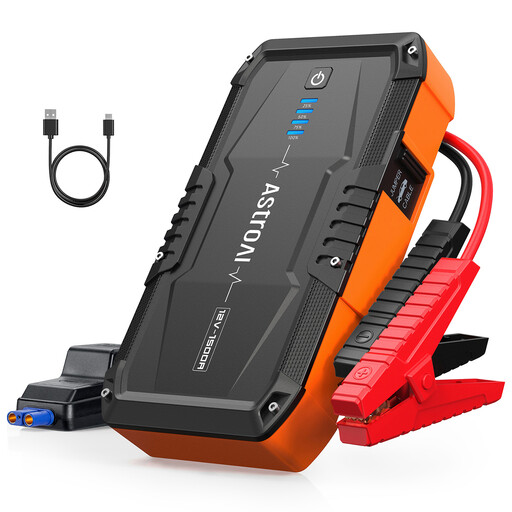
Why This Fits Their Persona: A compact choice for commuters, small-car owners and motorcycle riders who want a straightforward emergency car battery starter for a 12V vehicle.
Its stated compatibility is limited to 12V vehicles and up to 6.0L petrol or 3.0L diesel engines, making the intended use clearer than an unspecified amp-only listing.
1500A peak current, 37Wh capacity, dual USB-A outputs and three LED modes. The listed protections include reverse polarity, over-current and short-circuit protection.
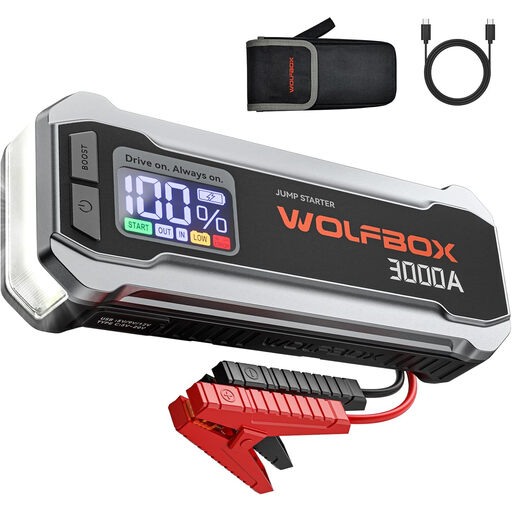
Why This Fits Their Persona: Suitable for drivers who prioritise charge visibility and faster recharging for regular travel, family vehicles and small vans.
The LED display shows the battery level, helping prevent the common mistake of storing an apparently charged unit without checking it.
59.2Wh capacity, 65W charging and stated compatibility with up to 8.0L petrol or 6.0L diesel engines. It also includes an LED light with illumination and SOS modes.
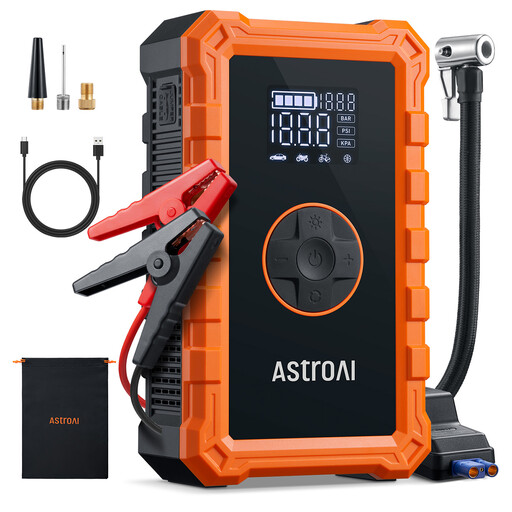
Why This Fits Their Persona: A practical match for travellers, outdoor users and motorists who want a tyre inflator jump starter as part of a compact roadside emergency kit.
The 2.4-inch screen shows preset and real-time pressure, while the automatic stop and stated 10-minute operating limit make compressor use easier to manage.
1500A output, 150PSI compressor, five preset modes and USB power-bank ports. It is listed for up to 6.0L petrol and 3.0L diesel engines.
Keep the booster in a dry, moderate-temperature location rather than leaving it exposed to prolonged heat or frost. Inspect the casing, cable and clamps periodically. Do not use a damaged cable or swollen battery pack.
For winter journeys, check the charge before departure and carry a torch, reflective jacket, gloves and a basic roadside emergency kit. A booster can help with a weak 12V battery, but it will not repair a failed alternator, damaged starter motor or severely defective battery. If the vehicle repeatedly needs a jump, arrange a mechanical inspection.
We have compiled a complete, real-time list of products that fully satisfy these strict selection criteria and UK safety regulations.
Some models include a boost function for very low voltage, but results depend on the vehicle and battery condition. Follow the manual, ensure the booster has sufficient charge and use the correct connection sequence. A jump starter is not a substitute for replacing a failed battery.
Service life varies with storage temperature, charging habits and frequency of use. Recharge it after operation and follow the stated maintenance interval—often every three to six months. Avoid storing it fully discharged for long periods.
It can be useful if you regularly travel long distances or want one device for emergency starting and tyre top-ups. If you only need occasional battery assistance, a smaller jump box may be easier to store and less costly. Check the compressor’s duty cycle before inflating larger vehicle tyres.