
24/7 Customer Support

Free returns

Same-day & Next-day Delivery

Quality Guaranteed

Unlock Your Welcome Offers: FREE Delivery | Up to 80% OFF | Free 30-day JoyPlus trial
Download the APP
A flat battery can leave UK drivers stranded outside work, at home or on an unfamiliar rural road. A portable car jump starter offers a compact alternative to relying on another vehicle, but choosing by peak-amp figures alone can lead to disappointment.
Before buying, check the vehicle compatibility, charging method, clamp safety and any extra functions you genuinely need. The right 12V car battery booster should be easy to store, simple to operate and sufficiently charged when an emergency occurs.
A high peak-current figure may look impressive, but it does not automatically confirm suitability for your engine. Petrol and diesel engines can have different starting requirements, particularly in cold weather. Always compare the stated engine capacity with your vehicle handbook and check whether the device is designed for a jump starter for petrol and diesel cars.
Also confirm the system voltage. Most cars, motorcycles and many recreational vehicles use 12V systems, while some commercial vehicles use 24V. A 12V booster should not be connected to a 24V system unless the manufacturer specifically permits it.
Milliamp-hour figures describe stored energy, but they do not by themselves determine cranking capability. A device with a large stated capacity may be useful as a portable power bank, yet still require suitable clamps and sufficient starting current for a larger engine.
Look for both the stated capacity and the manufacturer’s petrol and diesel compatibility. The ability to recharge the booster quickly is also relevant if it is kept in a vehicle for occasional use.
A jump starter left in a boot may face cold mornings, summer heat and long periods without use. Lithium units should be stored and maintained according to the supplied instructions; some products require periodic charging.
Safety features are equally important. Look for reverse-polarity protection, spark protection, over-current protection, temperature protection and clear status indicators. Always inspect the cables and casing before use, and remove the clamps promptly after the engine starts.
Choose a booster with a stated capacity above your engine size, allowing some margin for cold starts and an ageing battery. For example, the ACEZUK M01 listing specifies support for engines up to 7.0L petrol and 5.5L diesel, while the GOOLOO GE1500 listing specifies up to 6.0L petrol and 4.0L diesel.
A car battery booster pack is intended to assist with starting; it is not a replacement for a failing battery or a vehicle charging system inspection.
USB-A ports can charge many everyday devices, while USB-C fast charging is more convenient for newer phones, tablets and some laptops. Check the actual output rating rather than assuming that every USB-C port supplies the same power.
Some products include a car charger or support higher-wattage USB-C input. Others require a compatible wall charger, which may need to be purchased separately. Keep the unit charged before a long journey and follow the recommended maintenance interval.
A car jump starter with air compressor can reduce the number of separate roadside tools you carry. Check maximum pressure, airflow, hose length, preset controls and automatic shut-off. A tyre inflator is useful for correcting pressure, but it should not be used to ignore a puncture or damaged valve.
An LED emergency light with steady, flashing or SOS modes can improve visibility during a breakdown. It should complement high-visibility clothing, hazard lights and a safe position away from moving traffic.
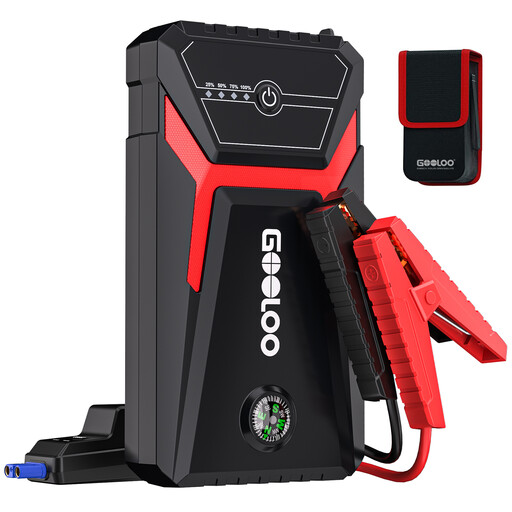
Why This Fits Their Persona: A practical option for everyday UK cars, motorcycles and smaller recreational vehicles, with a compact format for boot storage.
Its listing states compatibility with up to 6.0L petrol and 4.0L diesel engines, making the intended use clearer than relying on the amp figure alone.
1500A peak current, two USB outputs, three light modes and ten listed safety protections.
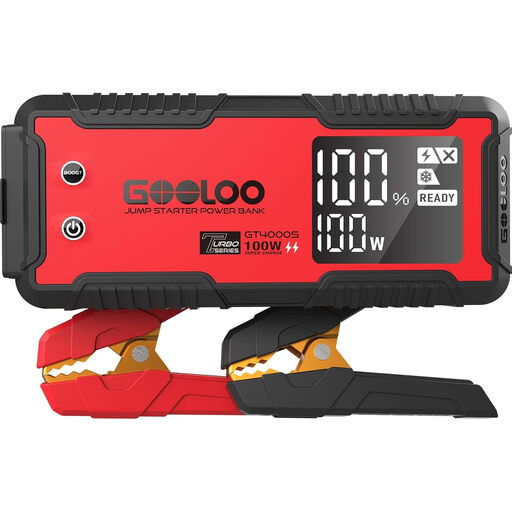
Why This Fits Their Persona: Suitable for drivers who want higher stated capacity, faster recharging and support for larger 12V vehicles.
The listing identifies 12V use and states support for up to 10L diesel and all petrol engines; it also notes that it is not for 24V commercial trucks.
4000A peak current, 100W two-way charging, a display, three USB ports and a 400-lumen light.
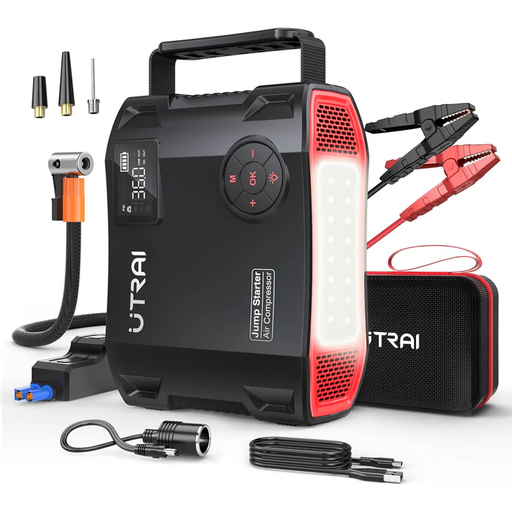
Why This Fits Their Persona: A multi-function choice for SUV, van, outdoor and long-distance users who want starting assistance and a tyre inflator in one case.
The product details specify vehicle limits, a 150PSI compressor, preset pressure and automatic shut-off, rather than presenting inflation as an unspecified extra.
6000A peak current, 45L/min airflow, 18W USB-C charging and a 1600-lumen emergency light.
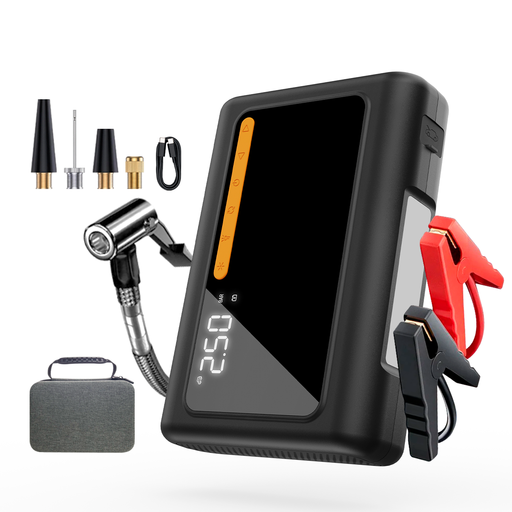
Why This Fits Their Persona: Designed for owners who prioritise long storage intervals and an integrated compressor for occasional roadside use.
The listing identifies sodium-ion chemistry, 12V operation and a stated operating range of -40°C to 80°C; verify all storage guidance in the manual.
1500A peak current, 150PSI air pump, PD60W charging and three LED light modes.
We have compiled a complete, real-time list of products that fully satisfy these strict selection criteria and UK safety regulations.
Do not use a damaged pack, swollen battery or frayed lead. If the vehicle repeatedly needs a boost, arrange a battery and charging-system inspection.
Service life depends on battery chemistry, storage temperature, charging habits and usage. Follow the manufacturer’s maintenance instructions, keep the unit dry and recharge it at the recommended interval. A stated cycle count or standby period is a product specification, not a guarantee of performance in every situation.
Many models include USB-A or USB-C outputs and can charge phones, tablets and other compatible devices. Check the output rating and cable requirements. A separate 5V charger may still be useful for regular home charging rather than using the emergency booster as an everyday adapter.
It can reduce dependence on assistance for a simple flat battery, but it does not replace breakdown cover. The total cost includes the initial purchase, occasional recharging and possible replacement after the battery pack reaches the end of its useful life. Choose a model that matches your vehicle rather than paying for specifications you will not use.