
24/7 Customer Support

Free returns

Same-day & Next-day Delivery

Quality Guaranteed

Unlock Your Welcome Offers: FREE Delivery | Up to 80% OFF | Free 30-day JoyPlus trial
Download the APP
There are few things more frustrating than the dead silence that follows turning the key in your ignition. A flat battery can happen to anyone, anywhere, turning a routine commute or a family holiday into a stressful waiting game for roadside assistance. A portable car jump starter seems like the obvious solution, but the market is flooded with devices making bold claims.
As a Joybuy Product Recommendation Officer, my role is to help you see past the marketing clutter. Many UK drivers invest in an emergency car starter only to find it fails when they need it most. Before you buy, be aware of these common purchasing pitfalls:
To make a smart purchase, focus on the specifications that directly impact performance and safety. Here are the crucial factors to check.
While a high peak amp rating, such as on a 3000A jump starter, indicates a powerful unit, the most important detail is the stated engine compatibility. Look for a clear rating for both petrol and diesel engines, measured in litres (L). A device suitable for a 2.0L petrol car may be completely ineffective on a 3.0L diesel van. If you drive a larger vehicle, you must find a jump starter for large engines to ensure it has enough power. Always choose a model rated for an engine size equal to or greater than your own.
Virtually all passenger cars, vans and motorhomes in the UK use a 12V battery booster system. Ensure any device you consider is designed for 12V systems. Beyond this, look for a "smart" cable or built-in intelligent chip that offers a minimum of eight safety protections. These should include reverse polarity, over-current, overload, over-voltage and over-charge protection. These features prevent dangerous sparks and protect your car's computer from damage if you accidentally connect the clamps incorrectly.
Many modern jump starters double as a car starter with power bank capabilities. This is a genuinely useful feature for charging phones, tablets or GPS units in an emergency. When evaluating this function, check the type and number of USB outputs. A model with both USB-A and modern USB-C ports offers greater versatility. The built-in LED torch is another practical addition, with modes like flashlight, strobe and SOS providing crucial visibility for nighttime breakdowns or signalling for help.
We have analysed the market based on these practical criteria. Instead of a simple list, we have matched specific products to the UK drivers who would benefit most from them.
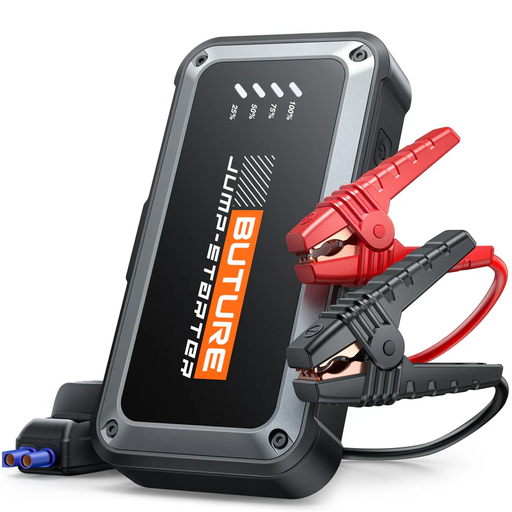
Why This Fits Their Persona: This unit is ideal for owners of SUVs, vans, motorhomes or older cars with large engines. Its high power output and rugged, dustproof build make it a reliable companion for rural living, camping trips and demanding work vehicles.
It moves beyond the 'peak power' illusion by clearly stating its capability for large engines (up to 9.0L petrol / 8.5L diesel). It also features 10 built-in safety protections, addressing the risk of unverified safety claims.
Its primary advantage is its broad vehicle compatibility and reliable power. The multi-mode wide-angle LED light is genuinely useful for roadside repairs or as a warning signal.
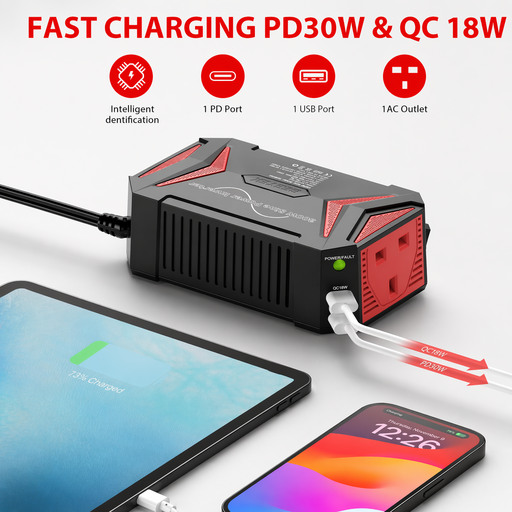
Why This Fits Their Persona: For the commuter or field professional who relies on their car as a mobile office, this inverter is an essential part of a roadside kit. It provides a 230V AC outlet for a laptop and features modern, fast-charging ports (PD30W & QC3.0) to keep a phone and other devices at 100% between appointments.
While not a jump starter, it avoids the 'impractical extras' trap by focusing on superior charging. Instead of a weak, slow USB port, it offers dedicated high-speed charging standards that are genuinely useful for modern electronics.
The Pure Sine Wave technology provides clean, stable power, which is safer for sensitive devices like laptops and cameras compared to more basic inverters. The silent cooling fan adjusts automatically, ensuring quiet operation.
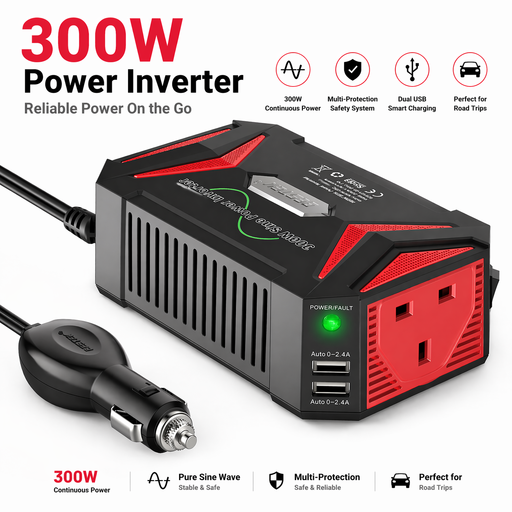
Why This Fits Their Persona: This compact inverter is perfect for family road trips and camping. It can power a small cooler, a portable DVD player or a games console from the AC outlet, while the dual USB ports keep everyone's tablets and phones charged, preventing any "are we there yet?" arguments.
It delivers on its core promise: providing reliable power. The dual 4.8A smart USB ports are a practical feature, automatically providing the optimal charge to two devices at once, which is far more useful than a single, underpowered port.
Its ultra-compact and lightweight design makes it easy to store in a glove box or centre console, so it's always on hand when needed. The full protection system guards against overload, ensuring safety when multiple devices are connected.
We have compiled a complete, real-time list of products that fully satisfy these strict selection criteria and UK safety regulations.
Most manufacturers recommend recharging the unit every 3 months to ensure the internal battery remains healthy and ready for use. When fully charged, a quality jump starter can hold its charge for 3 to 6 months, but regular top-ups are a good habit to get into.
Yes, it is generally safe. Modern "smart" jump starters, like the ones with intelligent protection systems, will only deliver the amount of current the car's battery and starter motor draw. The device won't force 3000A into a small hatchback that only needs 300A to start. The safety features prevent overpowering the system.
For most drivers, yes. The one-time cost of a reliable car battery booster pack UK is often less than a single emergency call-out fee. It provides peace of mind and self-reliance, allowing you to get back on the road in minutes rather than waiting hours for assistance, which is particularly valuable in rural areas or during poor weather conditions.