
24/7 Customer Support

Free returns

Same-day & Next-day Delivery

Quality Guaranteed

Unlock Your Welcome Offers: FREE Delivery | Up to 80% OFF | Free 30-day JoyPlus trial
Download the APP
A flat battery can turn a routine commute, school run or weekend trip into an expensive roadside delay. A portable car jump starter offers a practical alternative to relying on another vehicle, but choosing one involves more than looking for the largest number printed on the box.
Peak-current figures, engine compatibility, battery care and built-in accessories all affect whether a device suits your vehicle. Some products also combine a car battery booster pack, portable tyre inflator, power bank and LED emergency light, making them useful additions to a boot-based roadside kit.
A listing showing 1500A to 7000A may look impressive, but peak current is not the only specification that matters. Check the manufacturer’s stated compatibility with your engine size and fuel type, as well as the starting current where provided.
A small petrol car may not need the same output as a large diesel van. Conversely, a high peak rating does not make a device suitable for a 24V vehicle. Most consumer models in this category are designed for 12V systems, so they should not be connected to heavy commercial equipment unless the product specifically states that they are compatible.
A petrol and diesel jump starter may support both fuel types but still have an engine-size limit. For example, one model may support petrol engines up to 6.0L and diesel engines up to 3.0L, while another is specified for substantially larger engines.
Before buying, compare the product’s stated limits with your vehicle handbook. Allow extra consideration for vans, SUVs, older batteries and cold weather, where starting demand may be higher.
A jump starter is only useful if it has sufficient charge when needed. Leaving a lithium device in direct summer sunlight, storing it in a damp boot or forgetting to recharge it for long periods can reduce its readiness.
Look for a clear battery display, suitable charging input and storage instructions. Some products recommend recharging every three to six months, while sodium-ion models are marketed with lower self-discharge. These are product specifications rather than a guarantee of performance in every situation, so follow the supplied manual.
Confirm all three points:
A 12V jump starter should not be used with 6V or 24V systems. If your vehicle has a non-standard battery arrangement, seek advice from the manufacturer or a qualified vehicle professional before connecting it.
Peak current indicates the maximum output claimed by the manufacturer, while starting current can offer a more practical indication of normal starting support. Battery capacity, shown in watt-hours or milliamp-hours, affects how often the unit can be used as a car power bank or for repeated starting attempts.
Do not compare milliamp-hour figures from different voltage systems without checking watt-hours. A larger capacity can also mean a heavier unit, so consider whether it will remain easy to lift and store.
If you want a jump box with air compressor, check:
For general roadside use, reverse-polarity protection, short-circuit protection, over-current protection and clear connection warnings are useful features. They do not replace correct connection. Switch off the vehicle, identify the positive and negative terminals, attach the red clamp to positive and the black clamp to negative or the recommended vehicle ground point. Remove the clamps promptly after the engine starts, following the instructions.
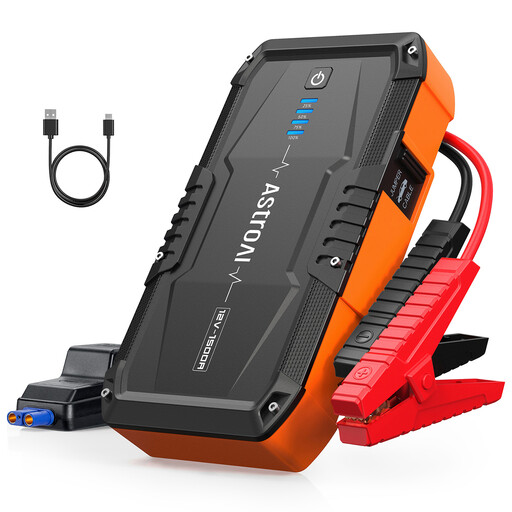
Why This Fits Their Persona: A compact option for UK commuters and small-car owners who need a straightforward emergency car starter without an integrated compressor.
Its stated compatibility is limited to 12V vehicles up to 6.0L petrol and 3.0L diesel, making the intended use clearer than a generalised “fits everything” claim.
1500A peak current, 37Wh battery, dual USB-A outputs and three LED modes including SOS.
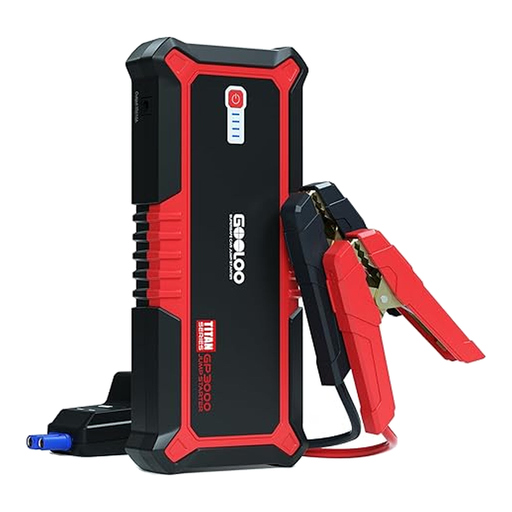
Why This Fits Their Persona: Suits drivers who want a durable-feeling multi-purpose pack for commuting, family travel and occasional outdoor use.
The listing specifies 9L petrol and 7L diesel compatibility, while its display, USB-C charging and protection features make status and connection checks easier.
3000A peak output, 15W USB-C, 400-lumen LED light and a 15V DC port for compatible accessories.
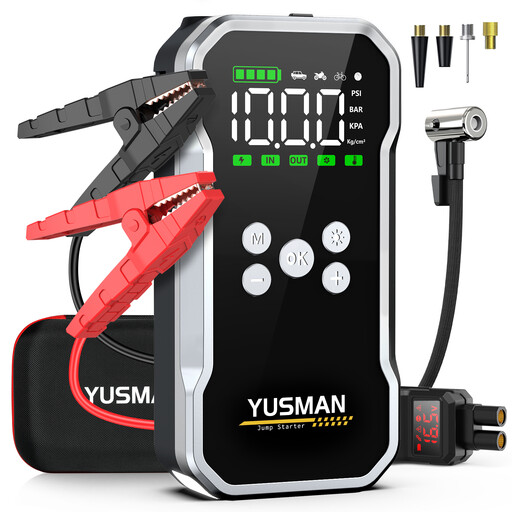
Why This Fits Their Persona: Designed for road-trip travellers, SUV owners and outdoor users who want one device for starting, inflation, lighting and charging.
It states separate petrol and diesel limits and gives the compressor’s 150PSI rating, filling modes and automatic protection details.
Four functions, 150PSI air pump, two USB ports, three torch modes and a supplied storage case.
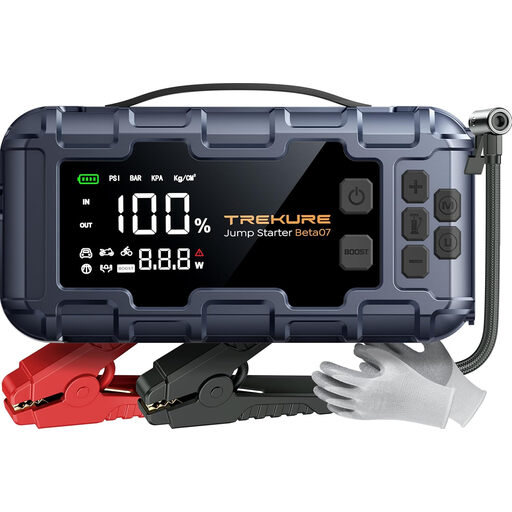
Why This Fits Their Persona: A high-output option for larger 12V petrol and diesel vehicles, particularly when tyre inflation and device charging are also priorities.
The product information states 12V compatibility, a 160PSI compressor and a 45W USB-C charging system, allowing buyers to assess its separate functions.
6000A peak output, 160PSI inflator, 3.3-inch display, 45W USB-C and dual USB-A ports.
We have compiled a complete, real-time list of products that fully satisfy these strict selection criteria and UK safety regulations.
Some models include a boost or force-start mode for very low-voltage batteries, but this is not universal. Check the instructions, charge the unit to the required level and follow the connection sequence. A damaged, frozen or failed battery may need professional replacement rather than a jump start.
Follow the manufacturer’s guidance. Many lithium models recommend checking and recharging every few months, while other designs specify longer standby periods. Inspect the display before a long journey and recharge after use.
Only if it has an integrated compressor. A standard car battery jumper starter may provide USB charging and an LED light but no air pump. If tyre inflation is important, check the PSI rating, airflow, automatic shut-off and cooling instructions before ordering.