
24/7 Customer Support

Free returns

Same-day & Next-day Delivery

Quality Guaranteed

Unlock Your Welcome Offers: FREE Delivery | Up to 80% OFF | Free 30-day JoyPlus trial
Download the APP
A flat car battery rarely happens at a convenient time. It may occur outside your home, on a rural road, during a cold morning commute or halfway through a family trip. A portable car jump starter can provide useful roadside backup, but choosing one based only on a large amp figure can lead to an unsuitable or difficult-to-use purchase.
This guide explains the specifications that matter for UK drivers, common marketing traps and which types of motorists may suit selected models.
A high peak-current number attracts attention, but it does not tell you everything about suitability. Engine size, petrol or diesel fuel type, battery condition and the device’s stated vehicle compatibility also matter.
For example, a 12V jump starter rated for up to 6.0L petrol and 3.0L diesel engines may be suitable for many passenger cars, motorcycles and lawnmowers, but not necessarily for a larger commercial vehicle. Always compare the starter with your vehicle handbook and battery system.
Some battery booster packs function only as jump starters, LED emergency torches and USB power banks. Others include a compressor. If you need a jump starter with air compressor, check the maximum pressure, preset controls, automatic shut-off and recommended operating cycle.
A stated 150 PSI maximum does not mean every tyre will inflate at that speed. Inflation time depends on tyre size, starting pressure and the compressor’s duty cycle.
Lithium battery products gradually lose charge while stored. A portable car jump starter that has not been checked may have insufficient power when needed. Some products also specify storage conditions, charging intervals or temperature limits.
Check the display before long journeys and recharge the unit according to the manual. Avoid leaving it permanently on a dashboard in direct summer sunlight or in damp conditions.
Most cars, SUVs, vans and motorcycles use a 12V jump starter, but larger trucks and some specialist equipment may use 24V systems. Never connect a 12V unit to a 24V vehicle.
Look for clearly stated engine compatibility, such as:
A higher amp rating can provide greater starting capacity, but it should not replace checking the manufacturer’s stated limits.
Useful protection features include reverse-polarity protection, spark protection, short-circuit protection, over-current protection and over-temperature protection. These features reduce the likelihood of damage from an incorrect connection, but users must still identify the positive and negative terminals correctly.
A clear LCD or digital display can show battery level, charging status, output information, pressure settings or error codes. This is more practical than relying on a single light when working beside a vehicle at night.
A battery booster pack may also operate as a USB power bank for phones and tablets. An LED emergency torch with steady, strobe or SOS modes can be useful during a roadside incident, although it should not replace high-visibility clothing or hazard lighting.
For tyre emergencies, compare:
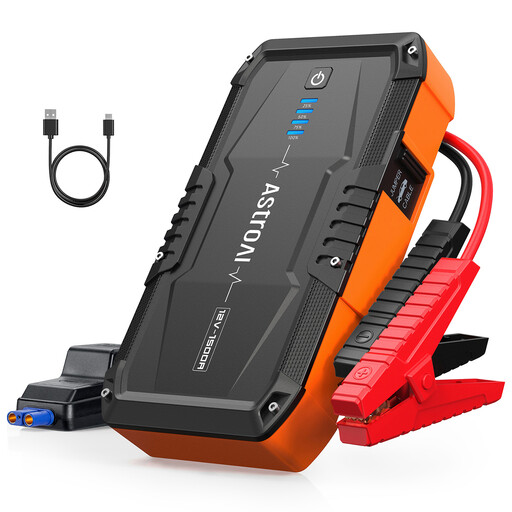
Why This Fits Their Persona: A compact choice for UK motorists who mainly need emergency starting support for a car, motorcycle, SUV or lawnmower.
Its stated compatibility is up to 6.0L petrol and 3.0L diesel engines, making the intended use clearer than relying on the amp figure alone.
1500A peak current, dual USB-A outputs, three lighting modes and eight listed protection functions.
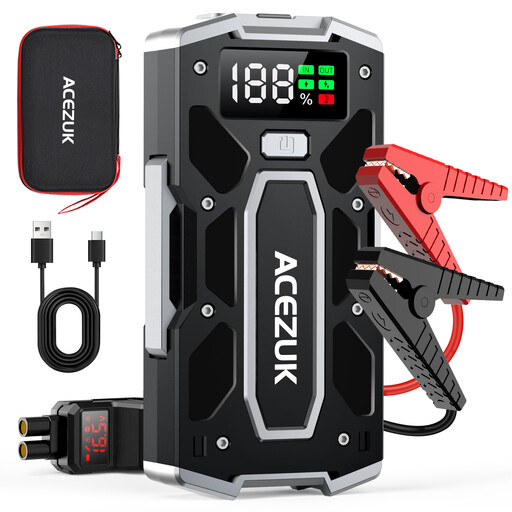
Why This Fits Their Persona: Suited to drivers seeking a high stated starting-current figure and broad compatibility for larger petrol or diesel vehicles.
The product information specifies up to 10.0L petrol and 8.0L diesel engines, alongside a display showing battery level and temperature alerts.
8000A peak current, two USB outputs, four torch modes and eight listed safety protections.
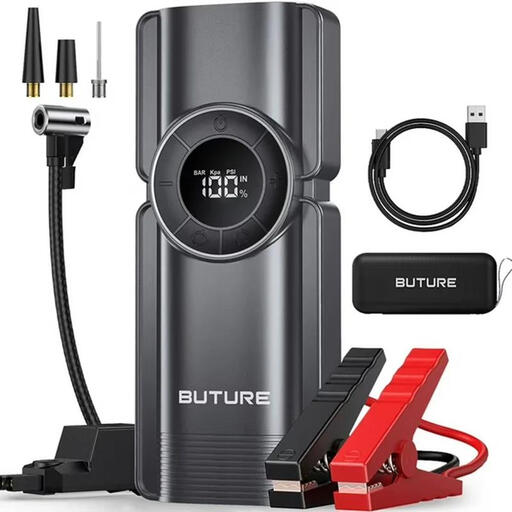
Why This Fits Their Persona: A practical match for motorists wanting one device for battery assistance, tyre pressure top-ups and mobile charging.
It lists preset pressure controls and automatic shut-off, while the instructions specify a maximum 10-minute inflation period followed by a rest period.
3500A peak current, 150 PSI inflator, digital display, dual USB outputs and a supplied storage case.
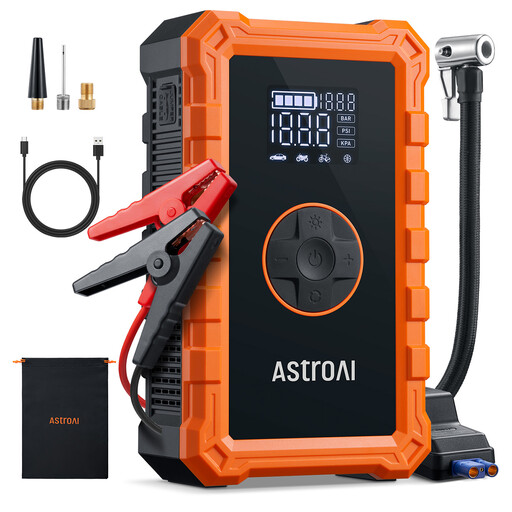
Why This Fits Their Persona: Suitable for drivers who want a compact car jump starter with starting, inflation, lighting and charging functions.
The 2.4-inch display shows battery, operating status and pressure information, while the instructions highlight the compressor’s cooling requirement.
1500A peak current, 150 PSI automatic-stop inflator, 5 pressure presets and USB charging.
Before using any emergency battery starter, switch off the vehicle’s electrical accessories and check that the unit has sufficient charge. Connect the red clamp to the positive terminal and the black clamp to the negative terminal or approved vehicle ground, following the product manual.
Keep the clamps apart when they are not connected. Once the engine starts, remove the clamps promptly and in the order stated by the manufacturer. Do not repeatedly attempt to start the vehicle without allowing the device to rest. If the battery repeatedly fails, the issue may require roadside assistance or inspection by a qualified automotive professional.
Some shoppers arrive while comparing a smart jump rope or adjustable skipping rope for home, gym or outdoor exercise. Those products are separate from vehicle equipment: a smart model may record repetitions and training data, while a leather or PVC skipping rope may offer adjustable length and foam-covered handles. For more products across the wider jumps category, use the collection below.
Storage time varies by battery design, temperature and usage. Check the charge level every few months and recharge it according to the manual. If the product instructions specify periodic charging or storage at around half capacity, follow those directions rather than leaving it unused indefinitely.
Only if the product lists your diesel engine size within its compatibility range. Diesel engines can require substantial starting current, particularly in cold weather. Confirm both the 12V system and the stated diesel capacity before purchase.
It can provide useful emergency tyre pressure top-ups, but it is not a replacement for regular tyre checks. Inflate tyres to the pressure shown in your vehicle handbook or the manufacturer’s label, allow the compressor to cool when instructed and have damaged or persistently deflating tyres inspected.