
24/7 Customer Support

Free returns

Same-day & Next-day Delivery

Quality Guaranteed

Unlock Your Welcome Offers: FREE Delivery | Up to 80% OFF | Free 30-day JoyPlus trial
Download the APP
A flat battery can leave you stranded outside the home, at a supermarket or on a dark rural road. A portable car jump starter offers a practical alternative to waiting for roadside assistance, but choosing the right model requires more than comparing peak amp numbers.
Some products combine a car battery booster, tyre inflator, LED emergency light and power bank. Others are designed only for starting a 12V vehicle. The wrong choice may be incompatible with your engine, difficult to recharge or unsuitable for the conditions in which you expect to use it.
This guide explains the specifications that matter and compares suitable options for different UK motorists.
A large peak-current figure may attract attention, but it does not alone confirm suitability for your vehicle. Engine type, engine capacity, battery condition and the jump starter’s voltage system also matter.
Check the manufacturer’s stated compatibility with your vehicle. A device labelled for 12V systems must not be used with a 24V heavy-duty vehicle or a 6V system.
Petrol engines generally require different starting support from diesel engines, particularly in larger vehicles. Some compact models support petrol engines but exclude diesel vehicles entirely.
Before buying, check:
Lithium jump starters gradually lose charge while stored. Leaving one in a boot for several years without checking it can mean discovering an empty battery during an emergency.
Look for a clear battery display, a suitable charging input and instructions on maintenance. Several models recommend recharging approximately every six months. Avoid leaving the unit in prolonged heat or extreme cold, and store it in a dry place.
Choose a 12V jump starter with a stated engine capacity above your vehicle’s requirements. For example, a product rated for up to 6.0L petrol and 3.0L diesel is aimed at a different user from a model rated for up to 8.0L petrol and 6.0L diesel.
Peak current is useful as a comparison figure, but it should be read alongside the manufacturer’s petrol and diesel compatibility information. If your battery is severely discharged, a boost mode may be necessary. Follow the instructions carefully rather than repeatedly attempting to start the engine.
A jump starter with air compressor can also act as a portable tyre inflator. Check the maximum pressure, hose and nozzle arrangement, display units and whether automatic shut-off is available.
A 150PSI rating describes the pump’s maximum stated pressure, not the recommended pressure for your vehicle tyres. Always use the pressure shown in your vehicle handbook, fuel flap or door-frame label. A preset function with automatic stop can reduce the risk of overinflation, but the pressure should still be checked with a reliable gauge.
Useful features include:
The clamps must be connected to the correct terminals, kept apart while energised and removed promptly after the engine starts. Read the supplied manual before an emergency occurs.
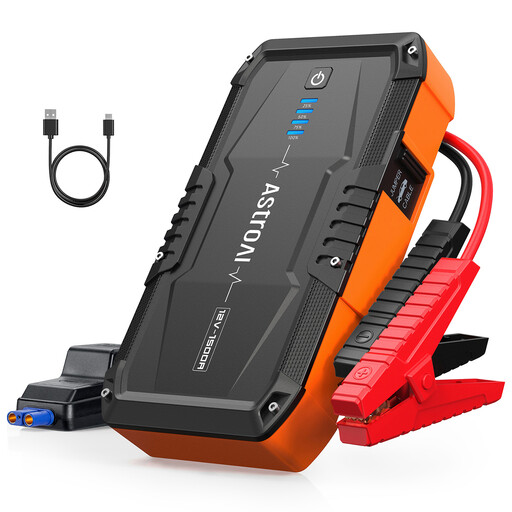
Why This Fits Their Persona: A compact option for everyday UK cars, smaller SUVs and drivers who want a jump box that is easy to store in a boot or travel bag.
Its stated compatibility is up to 6.0L petrol and 3.0L diesel, while the smart boost function is designed for low-voltage batteries. Check your vehicle before purchase.
1,500A peak current, USB-C input, three LED modes and eight listed protection functions.
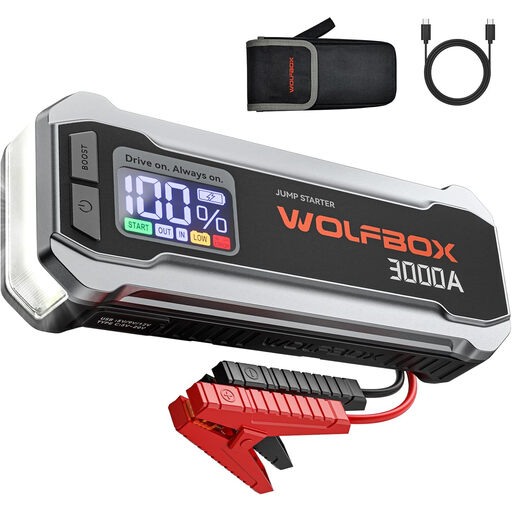
Why This Fits Their Persona: Suitable for drivers wanting a higher-capacity unit with faster charging and a clear display for regular touring or family travel.
The specification states 12V compatibility for up to 8.0L petrol and 6.0L diesel engines. It also identifies a 59.2Wh battery and six-month recharge guidance.
65W fast charging, LED display, booster function and illumination/SOS light modes.
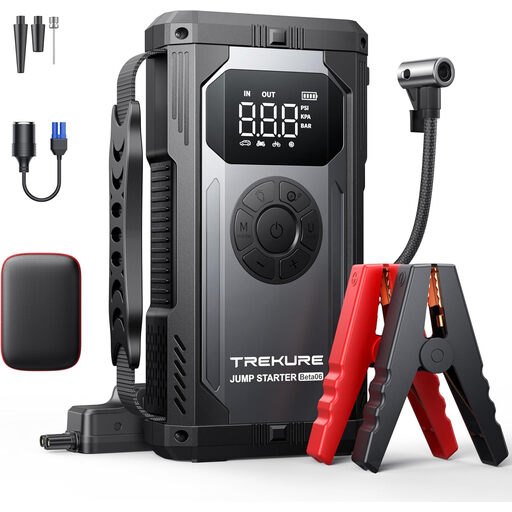
Why This Fits Their Persona: A multifunctional choice for SUVs, pick-ups, small vans, campers and outdoor users who also need a portable tyre inflator and emergency light.
The product information states 12V support, a 150PSI compressor, preset pressure control and automatic shut-off. Confirm the separate engine limits before ordering.
5500A peak current, dual USB outputs, 12V accessory socket, LCD pressure display and three light modes.
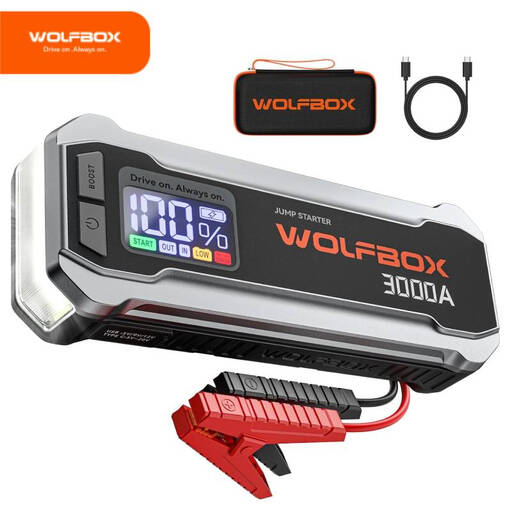
Why This Fits Their Persona: A practical car battery booster for owners of larger petrol vehicles or diesel cars who do not need an integrated compressor.
Its stated range covers 12V petrol engines up to 7.0L and diesel engines up to 6.0L, while clearly excluding 24V, 6V and motorcycle systems.
44.4Wh capacity, LED battery display, booster function and illumination/SOS light modes.
A jump starter is more useful when kept with other practical accessories. The ochama MH1 head torch set provides two headlamps, a charging box, strap and Type-C cable for hands-free checks at night or on a campsite.
For cables and adapters, the HOCO multifunctional cable storage box includes a 28cm cable, several connector types, a mirror and storage compartment. It supports up to 60W and 3A; check your device’s charging requirements before use. Browse the wider cables box range to keep vehicle and camping leads organised.
Pet owners may also consider a separate automatic pet dryer such as the Homerunpet Drybo Plus. Always supervise an animal during drying and follow the product instructions.
We have compiled a complete, real-time list of products that fully satisfy these strict selection criteria and UK safety regulations.
It is better to store it away from prolonged heat, frost and direct sunlight. Check the manual for operating and storage temperatures, and recharge it at the recommended interval. A boot may be convenient, but inspect the unit regularly for damage or swelling.
Many models recommend checking and recharging approximately every six months. Recharge it before a long journey, particularly after using the power-bank, compressor or torch functions. The exact requirement depends on the model and its battery capacity.
Only models with an integrated compressor can do both. Check the stated pressure range, hose and nozzle contents, automatic shut-off function and vehicle compatibility. A 150PSI maximum does not mean your tyres should be inflated to 150PSI; use the pressure specified for your vehicle.