
24/7 Customer Support

Free returns

Same-day & Next-day Delivery

Quality Guaranteed

Unlock Your Welcome Offers: FREE Delivery | Up to 80% OFF | Free 30-day JoyPlus trial
Download the APP
A flat battery rarely happens at a convenient time. It may occur outside work, on a rural lane, during a family trip or after a vehicle has been left unused through a cold spell. A portable car jump starter can provide useful backup without relying on another vehicle and jumper leads, but choosing one based on a large amp figure alone can lead to disappointment.
The main risks are usually hidden in the specifications. A device may advertise a high peak current but have limited engine compatibility, require frequent charging or lack the accessories needed at the roadside. Before buying, check the following points.
A 4000A jump starter or 7000A model may sound suitable for every vehicle, but the stated engine limits matter more for everyday selection. Petrol and diesel engines place different demands on a battery booster, and a product designed for a small car may not suit a large diesel van or SUV.
Look for clearly stated compatibility, such as petrol and diesel engine capacity. Also confirm that your vehicle uses a 12V battery. These products are generally not intended for 24V commercial lorries or 6V systems.
A lithium jump starter is designed to provide a short burst of starting power. It is not automatically a substitute for a mains-powered car battery charger. If your battery repeatedly loses charge, an intelligent charger may be more appropriate for maintaining it at home.
Similarly, a jump starter with an air compressor can inflate a tyre, but it may be slower than a dedicated garage compressor. Check its maximum pressure, operating time and cooling requirements rather than focusing only on the “150 PSI” figure.
A battery jump starter pack can be useless if it has been stored in a glovebox for months without checking its charge. Heat, moisture and prolonged inactivity can affect battery performance. Some manufacturers recommend recharging every three to six months, while others provide a longer stated standby period.
A useful device should also include insulated clamps, clear connection guidance, protection against reverse polarity and short circuits and a case that keeps cables and nozzles together.
Choose a 12V car battery booster with a stated petrol and diesel capacity that exceeds your vehicle’s engine size. Diesel engines often need greater starting support, particularly in colder conditions. A small hatchback, family SUV, van and motorcycle may all require different specifications.
Peak current is useful as a comparison point, but it should be considered alongside rated battery capacity, clamp design and the manufacturer’s stated vehicle range. Never connect a 12V jump starter to a 24V system unless the instructions specifically permit it.
Fast charging can make a difference when preparing an emergency car starter before a journey. For example, the GOOLOO GT4000S listing specifies 100W two-way charging, a USB-C input and an included 100W car charger. Other models use 18W or standard 5V charging, which may take longer.
Battery capacity is often shown in mAh or Wh. These figures are not directly interchangeable, so compare products using their stated charging time, number of supported starts and intended vehicle compatibility. A display showing remaining charge is particularly practical because it reduces guesswork.
For a portable jump starter with air compressor, check:
A digital display, LED emergency light and power-bank function can be useful additions, but they should not distract from the core jump-starting specifications.
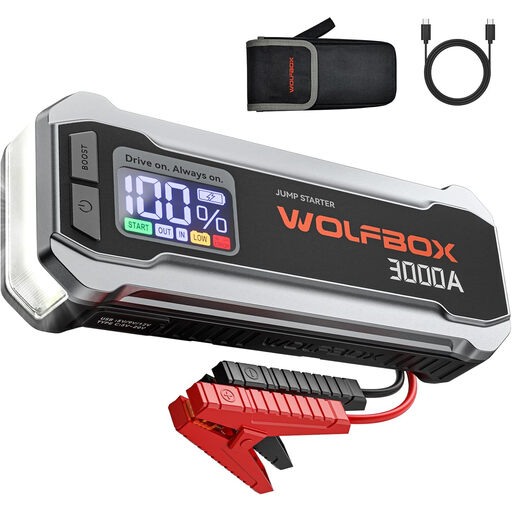
Why This Fits Their Persona: A practical option for commuters and owners of ordinary UK cars, SUVs, pick-ups and small vans who want a straightforward battery jump starter pack.
The listing states compatibility with 12V petrol engines up to 8.0L and diesel engines up to 6.0L, while the LED screen shows battery level before use.
3000A peak current, 65W charging, LED display and SOS lighting. The stated exclusions are clear: not for 24V lorries, motorcycles or 6V systems.
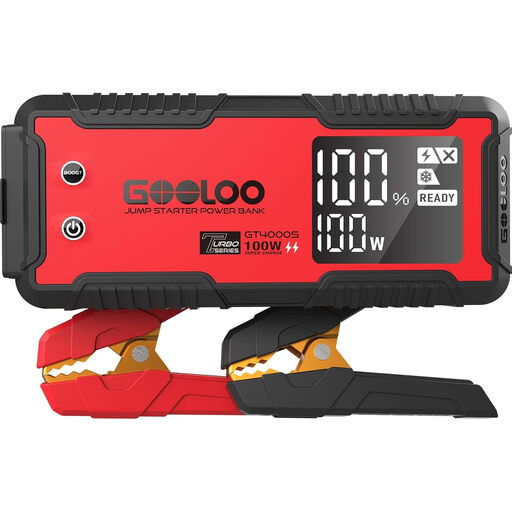
Why This Fits Their Persona: Suited to van, SUV, motorhome and larger vehicle owners who want fast charging and additional power for devices during longer journeys.
The product information states limits of 10.0L diesel and 12.0L petrol engines and clearly excludes 24V commercial lorries.
4000A peak current, 100W charging, three USB ports, a 400-lumen light and a 15V/10A output for compatible devices.
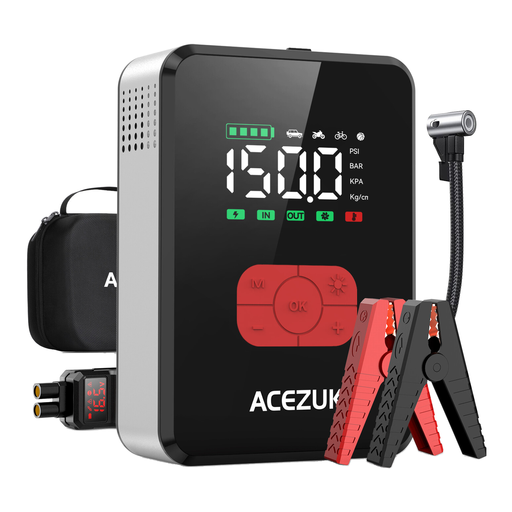
Why This Fits Their Persona: A fit for large petrol or diesel vehicles, outdoor users and families wanting jump-starting and tyre inflation in one roadside emergency kit.
Instead of listing current alone, the product details state support for 12V petrol vehicles and diesel engines up to 12L, plus an intelligent clamp display.
7000A peak current, 150 PSI air compressor, four preset modes, 3.3-inch screen and three-mode LED lighting.
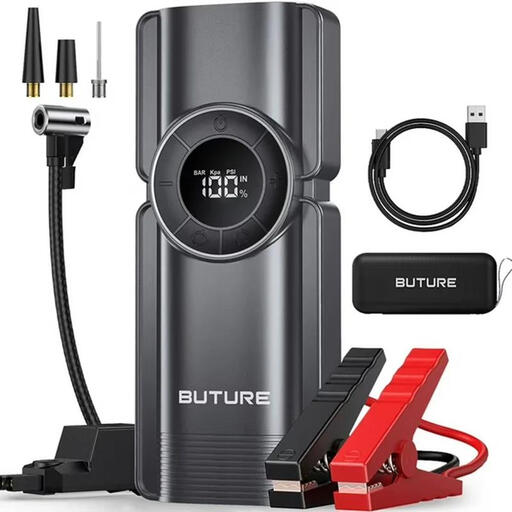
Why This Fits Their Persona: Useful for families, commuters and outdoor enthusiasts who want a compact tyre inflator and jump starter for regular travel.
The instructions specify a 10-minute inflation limit followed by a 10-minute rest period, helping buyers plan around an important operating restriction.
3500A peak current, support for up to 8.5L petrol and 8.0L diesel engines, 150 PSI automatic shut-off inflator and USB outputs.
We have compiled a complete, real-time list of products that fully satisfy these strict selection criteria and UK safety regulations.
A portable jump starter is emergency equipment, not a fix for a failing battery. If the vehicle repeatedly needs a boost, arrange a battery and charging-system inspection.
Battery life depends on storage temperature, charging habits and usage. Check the charge every few months and follow the model’s maintenance instructions. A display or indicator makes this easier. Avoid leaving the unit in a hot car for long periods.
A tyre inflator and jump starter can restore pressure when the tyre is intact and the compressor is suitable for the task. It cannot repair punctures or replace a tyre. Follow the stated operating limit, allow the air hose to cool if instructed and set pressure using the vehicle handbook or door-frame label.