
24/7 Customer Support

Free returns

Same-day & Next-day Delivery

Quality Guaranteed

Unlock Your Welcome Offers: FREE Delivery | Up to 80% OFF | Free 30-day JoyPlus trial
Download the APP
A flat battery rarely happens at a convenient time. It may leave you stranded outside work, on a rural road, in a supermarket car park or halfway through a family trip. A portable car jump starter can provide a practical alternative to relying on another vehicle, but the large number of amp ratings and extra features can make comparison difficult.
The headline figure is not the only thing to consider. Some products are unsuitable for diesel engines, some lack clear battery-status information and others include an air pump that may be too slow for regular tyre maintenance. Before buying a car battery booster, check the points below.
A high peak-current figure attracts attention, but it does not by itself confirm suitability for your vehicle. Engine size, petrol or diesel fuel type, battery condition and the product’s stated 12V compatibility all matter.
A compact 2,000A jump starter may be suitable for many family cars, while a larger diesel SUV, van or motorhome may require a model with a higher stated engine capacity. Always compare the manufacturer’s petrol and diesel limits rather than choosing by amps alone.
Most products in this category are designed for 12V systems. They should not be connected to 24V heavy-duty vehicles unless the instructions specifically allow it. Motorcycles and hybrid vehicles also need careful checking, as compatibility varies by model.
Look for clear information such as “up to 8.5L petrol” or “up to 8.0L diesel”. If your vehicle is close to the stated limit, choose a product with additional capacity rather than relying on a marketing phrase such as “universal”.
Lithium jump packs can lose charge while stored, particularly if left for long periods in a vehicle. Heat inside a parked car can also affect battery life. A jump starter is of limited value if its display shows a low charge during a roadside emergency.
Check whether the unit has a battery-level display, how often the manufacturer recommends recharging it and whether the storage case protects the cables and air hose. Follow the supplied instructions, keep the clamps apart and avoid storing the device near heat, moisture or open flames.
For most UK motorists, the essential specification is a clearly stated 12V jump-start capability matched to the vehicle. Petrol engines generally require less starting assistance than diesel engines of a similar size, so compare both figures.
A petrol and diesel jump starter should state separate limits. For example, the BUTURE beta01 is listed for engines up to 8.5L petrol and 8.0L diesel, while the UTRAI model is listed for up to 14L diesel and supports 12V petrol, diesel and hybrid vehicles. These are product specifications, not a guarantee that every vehicle will start in every condition.
Useful protections include reverse-polarity protection, short-circuit protection, over-current protection, overcharge protection and spark protection. Intelligent clamps may provide visual or audible warnings when the connection is incorrect.
Even with these safeguards, connect the red clamp to the positive terminal and the black clamp to the negative terminal or an approved vehicle ground, as directed by the manual. Turn off lights, heating and other electrical equipment before attempting a start. Disconnect the clamps promptly once the engine has started.
Buyers should also check the labelling and documentation supplied with the product, including relevant UKCA or CE markings where applicable, manufacturer details, warranty terms and operating instructions. These checks are more useful than relying on vague safety wording.
A jump starter with air compressor can be useful for correcting low tyre pressure before driving to a garage. Look for a digital pressure display, preset modes and automatic shut-off. A listed maximum of 150 PSI does not mean it should be used continuously at that pressure; follow the vehicle’s recommended tyre pressure and the product’s operating limits.
A jump starter power bank may include USB-A, USB-C or fast-charging outputs for phones and other devices. A built-in LED emergency light with steady, strobe and SOS modes can improve visibility during a roadside incident, although it should not replace a warning triangle or other appropriate roadside precautions.
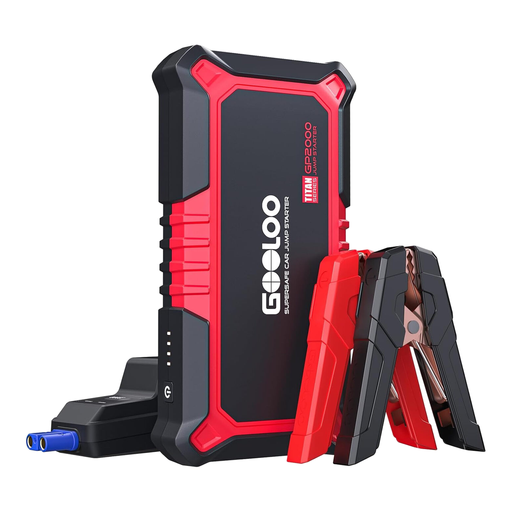
Why This Fits Their Persona: A compact option for commuters and owners of ordinary 12V cars, motorcycles or smaller SUVs who want emergency starting support without carrying a large kit.
Its stated compatibility is up to 8.0L petrol and 6.0L diesel, with a 12V system limit and a battery-status display to help prevent buying for an unsuitable vehicle.
Dual USB outputs, a 400-lumen light with SOS and strobe modes, protective smart clamps and a storage case.
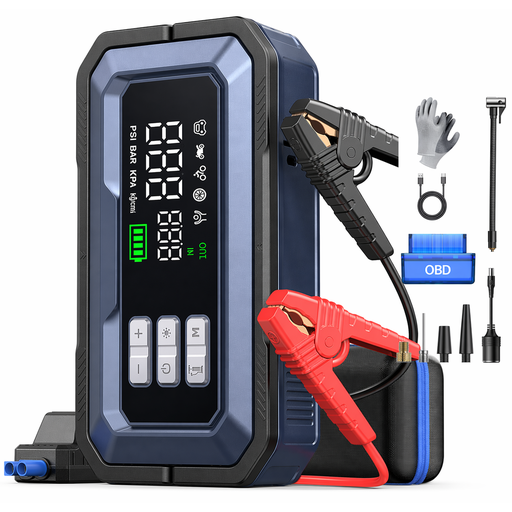
Why This Fits Their Persona: Suited to SUV, van, hybrid and outdoor users who value multiple roadside functions in one robust carry case.
The product provides separate vehicle guidance, a digital display, intelligent safety protection and temperature protection for the battery and pump.
It combines a 150 PSI portable tyre inflator, 160W 12V DC output, 18W USB-C charging, OBD2 adapter and a 2,000-lumen work light.
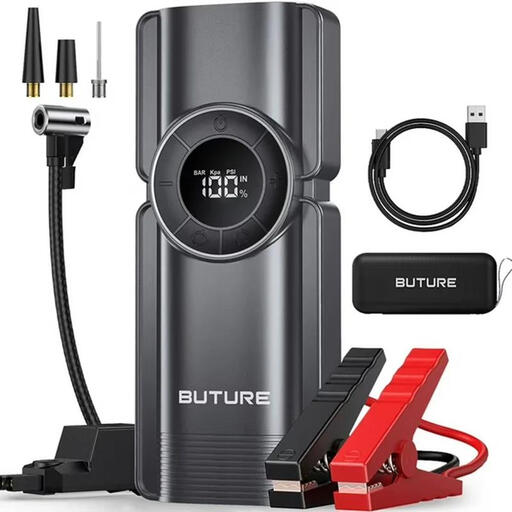
Why This Fits Their Persona: A practical match for families, long-distance drivers and van owners who want both battery assistance and occasional tyre or equipment inflation.
It states limits of 8.5L petrol and 8.0L diesel, displays battery and output information and includes reverse-connection, short-circuit and overcharge protection.
The integrated 150 PSI air compressor has preset pressure and automatic shut-off, while dual USB outputs and three lighting modes add emergency utility.
We have compiled a complete, real-time list of products that fully satisfy these strict selection criteria and UK safety regulations.
Yes, some models are designed for diesel vehicles, but the stated engine limit is important. Diesel engines often need more starting assistance, so compare the listed diesel capacity rather than the petrol figure. Confirm that your vehicle uses a 12V system.
The period varies with battery design, storage temperature and usage. Some products recommend recharging every three to six months, while others list longer standby periods. Treat those figures as manufacturer specifications and check the charge before winter journeys or long trips.
It can top up a low tyre and may be useful during a roadside emergency, but it is not a replacement for regular tyre checks or professional inspection. Use the pressure shown in your vehicle handbook or door-frame label and allow the compressor to cool according to its instructions.