
24/7 Customer Support

Free returns

Same-day & Next-day Delivery

Quality Guaranteed

Unlock Your Welcome Offers: FREE Delivery | Up to 80% OFF | Free 30-day JoyPlus trial
Download the APP
A flat tyre is more than an inconvenience; it can disrupt your entire day, whether you are on the way to a crucial meeting or starting a family holiday. While a portable car tyre inflator seems like a simple solution, the market is filled with options that often over-promise and under-deliver. Many UK drivers find their new gadget is either dead when needed, too slow to be practical, or dangerously inaccurate.
As a Joybuy Product Recommendation Officer, my role is to help you see past the marketing jargon. Before you make a purchase, be aware of these common pitfalls that lead to wasted money and frustration:
To ensure you get a reliable tool, focus on these core parameters. They are the true indicators of a quality portable car tyre inflator.
Your first decision is how the device will be powered. Each type has clear advantages for different situations.
An inflator's power is measured by its airflow (Litres Per Minute, or L/min) and its maximum pressure (Pounds per Square Inch, or PSI).
Beyond raw power, certain features separate a frustrating tool from a helpful one.
Instead of providing a simple list, we have matched our recommendations to specific types of UK drivers. This ensures you find a model that truly fits your needs.
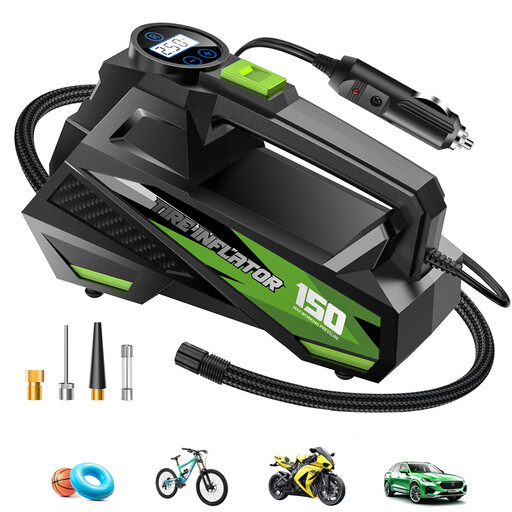
Why This Fits Their Persona: This is a straightforward, no-fuss solution for drivers who need a reliable tool for routine pressure checks and simple top-ups. It lives in the boot and is always ready for action without needing to be charged.
As a 12V tyre pump, it completely bypasses the issue of battery degradation or finding the unit uncharged. It draws consistent power directly from the car, ensuring it won't quit halfway through a job.
Features an extended power cord for easily reaching all four tyres. Its simple, mechanical design focuses on one job: reliable inflation.
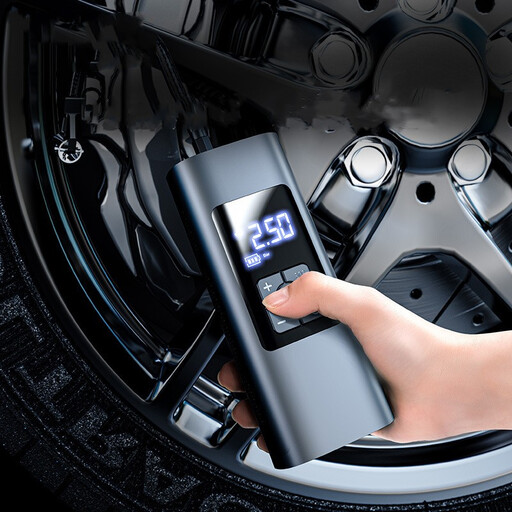
Why This Fits Their Persona: Perfect for the family that needs one tool for everything—the car, the kids' bicycles, footballs and pool inflatables. The dual-power functionality offers ultimate flexibility for use at home or on the road.
It directly solves the battery anxiety pitfall. Use it as a cordless tyre inflator for convenience, but if the battery runs low during an emergency, simply plug it into the 12V socket to finish the job.
Features a clear digital display with auto-stop, multiple nozzle adapters for various uses and a built-in LED light. The 6000mAh battery also functions as a power bank to charge a phone in a pinch.
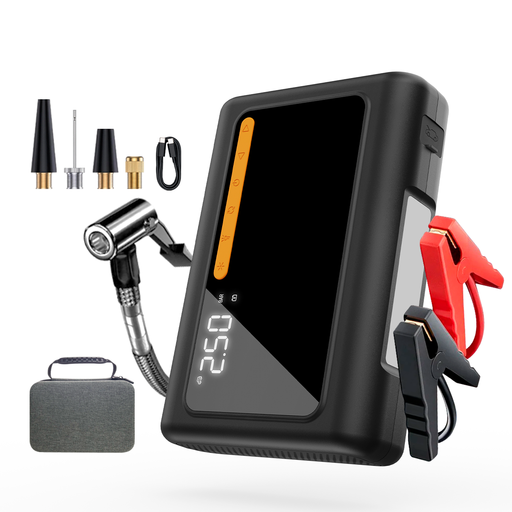
Why This Fits Their Persona: For the driver who wants a single, powerful device to handle multiple roadside emergencies. This unit combines a jump starter, a 150 PSI air compressor, a power bank and an LED torch.
It uses a sodium-ion battery, which has a very low self-discharge rate. According to the brand, it can hold a charge for years, solving the problem of finding your emergency device dead when you need it most. It also operates in a wider temperature range than typical lithium batteries.
This is a true multi-function emergency tyre inflator and survival tool. It can jump-start petrol and diesel engines, inflate tyres with its 25-cylinder pump and fast-charge devices via PD60W USB-C.
We have compiled a complete, real-time list of products that fully satisfy these strict selection criteria and UK safety regulations.
The lifespan of a portable inflator depends on its build quality and usage. A well-made device from a reputable brand, used for occasional top-ups and emergencies, should last for several years. Corded 12V models often have a longer lifespan as they do not have a battery that will degrade over time. For cordless models, the battery's health is the main factor; look for those with quality battery cells and avoid leaving them fully discharged for long periods.
It is generally safe to store most modern cordless inflators in your car. However, extreme cold can temporarily reduce a lithium-ion battery's performance and output. For optimal performance in freezing conditions, it may be helpful to bring the device indoors to warm up slightly before use. Some newer models, like those with sodium-ion batteries, are designed to perform more reliably in a wider range of temperatures, from -40°C to 80°C. Always check the manufacturer's recommended operating temperature range.
While most digital gauges are more accurate than the old analogue "pencil" gauges, their precision can vary. Reputable brands tend to use higher-quality sensors that are accurate to within 1-2 PSI. A key feature to look for is the auto-stop function, which relies on this sensor. It is good practice to occasionally cross-reference the inflator's reading with a separate, reliable digital pressure gauge to ensure it remains accurate over time.