
24/7 Customer Support

Free returns

Same-day & Next-day Delivery

Quality Guaranteed

Unlock Your Welcome Offers: FREE Delivery | Up to 80% OFF | Free 30-day JoyPlus trial
Download the APP
A portable car tyre inflator can be a useful addition to a glove box, boot or motorcycle storage compartment. It may help with routine pressure top-ups before a long journey or provide extra support during a roadside problem. However, product listings often highlight maximum PSI, extra functions and compact dimensions without explaining how those features work in everyday UK conditions.
Three buying traps deserve particular attention:
For UK drivers, the right choice depends on the vehicle, the intended frequency of use and whether you prefer battery convenience or dependable 12V power.
A cordless tyre inflator is convenient when you need to reach a tyre away from the vehicle or inflate a bicycle outdoors. Look for the battery capacity, charging method and stated usage time rather than relying on the word “wireless”.
The products in this guide include battery capacities ranging from 3,600mAh to 4,500mAh. One EAFC model specifies approximately 15–25 minutes of battery life, while another lists expected inflation times of around 60 seconds for a motorcycle or electric-bike tyre and up to 300 seconds for a small car tyre. These figures are useful indications, but actual performance can vary according to starting pressure, tyre size and temperature.
A 12V air compressor draws power from the vehicle’s cigarette-lighter socket. It avoids waiting for a battery recharge, although the car engine should generally be running during use to reduce the risk of draining the vehicle battery. A long cable is valuable because the socket and tyre may be several metres apart.
A 150 PSI tyre inflator is commonly marketed for cars, motorcycles, bicycles and balls. In practice, most passenger-car tyres require considerably less pressure. Always use the pressure shown on your vehicle’s tyre placard, handbook or manufacturer guidance; do not copy the maximum figure printed on the pump.
A digital tyre pump should allow you to select a suitable unit such as PSI, bar or kPa. A readable screen and a reliable connection to the valve are more useful than an unusually high headline pressure. An automatic shut-off air pump can stop when the preset value is reached, helping reduce the chance of overinflation, but you should still check the final reading and inspect the valve connection.
A portable car air compressor may also work as a motorcycle tyre inflator, bicycle pump or ball inflator when the correct adapters are supplied. Check whether the package includes compatible nozzles, a Presta adapter for some bicycle valves and a hose long enough for your vehicle.
Do not assume that a compact unit is designed for vans, large SUVs, trucks, trailers or specialist high-pressure equipment. Several products listed here specify compatibility with standard cars, motorcycles, bicycles and balls, while excluding large trucks or equipment requiring more than 150 PSI.
Repeated inflation can also create heat. A pump’s duty cycle, cooling instructions and recommended rest periods matter if you are correcting several tyres rather than making a small top-up.
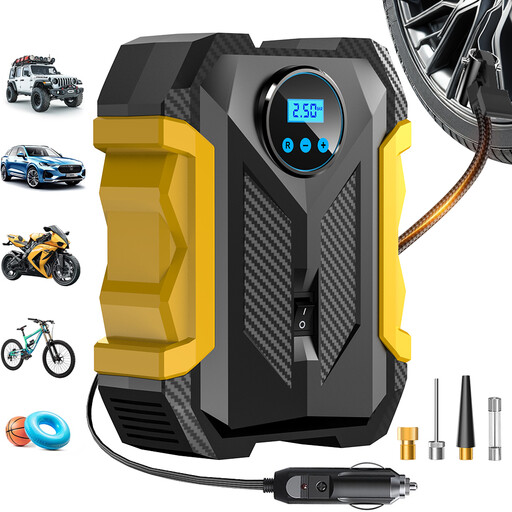
Why This Fits Their Persona: A practical option for drivers who want a straightforward pump for occasional car, motorcycle, bicycle or ball inflation without managing a rechargeable battery.
The 12V connection avoids cordless runtime limits, while the digital display makes the target pressure easier to monitor.
150 PSI stated maximum, 3m cable, digital pressure display and integrated LED light.

Why This Fits Their Persona: Suitable for motorists and cyclists who value a compact cordless format, preset modes and extra emergency functions.
Its stated 4,000mAh battery capacity, preset function and auto-off feature address common concerns around repeated manual monitoring.
150 PSI stated maximum, five inflation modes, four pressure units, LED light and USB input/output.
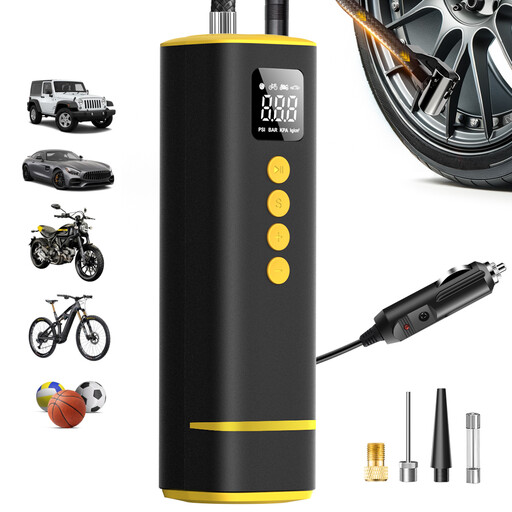
Why This Fits Their Persona: A corded format suits road-trip travellers and households that prefer a vehicle-powered tool for multiple tyre top-ups.
The extended cable reduces the limitation of short leads when reaching all four tyres, and 12V power avoids depending on a small internal battery.
12V operation, 150 PSI stated maximum and suitability for cars, motorcycles and bicycles.
We have compiled a complete, real-time list of products that fully satisfy these strict selection criteria and UK safety regulations.
It can be worthwhile for commuters, cyclists and drivers who want a compact emergency tool without a cable. Battery capacity and runtime are important, particularly in cold weather. If you regularly inflate several car tyres, a 12V air compressor may provide more consistent access to power.
Lifespan depends on frequency of use, storage conditions, heat management and care of the hose and power cable. Keep the unit dry, avoid leaving a rechargeable model permanently connected to power and follow its cooling instructions. A portable inflator is intended for top-ups and emergencies, not necessarily continuous workshop operation.
A 12V pump uses the vehicle’s electrical system, while a cordless model uses electricity during charging. For occasional pressure adjustments, the electricity cost is usually modest; the more relevant consideration is battery replacement, charging time and whether the model is powerful enough for your tyre size.