
24/7 Customer Support

Free returns

Same-day & Next-day Delivery

Quality Guaranteed

Unlock Your Welcome Offers: FREE Delivery | Up to 80% OFF | Free 30-day JoyPlus trial
Download the APP
A portable car tyre inflator can be useful for correcting gradual pressure loss, preparing a vehicle after seasonal storage or handling a roadside top-up. It may also serve as a motorcycle tyre pump, bicycle pump or inflator for sports equipment. However, product listings often highlight impressive numbers without explaining what they mean in everyday UK driving conditions.
Before buying, watch for three common traps:
For most cars, SUVs, motorcycles and bicycles, a pump rated up to 150 PSI provides a broad operating range. This does not mean you should inflate a tyre to 150 PSI. The correct pressure is set by the vehicle manufacturer and is commonly shown on the driver’s door pillar, fuel flap or handbook.
Check whether the listing clearly states compatibility with:
A compact 150 PSI tyre inflator is generally intended for everyday vehicles and small inflatables. It may not be suitable for heavy commercial tyres or equipment requiring sustained high-pressure airflow.
A cordless tyre inflator is convenient when your vehicle is parked away from a socket, while a 12V model can provide continuous power from the car. Dual-power designs offer both options and may be practical for longer journeys.
For rechargeable models, check:
A rechargeable tyre pump should be fully charged before being stored in the boot. In cold UK weather, battery performance may be reduced, so a 12V backup can be a useful feature for commuters and families.
An automatic shut-off tyre inflator stops when the preset pressure is reached, reducing the chance of continued inflation while you attend to another task. Set the correct target pressure and check that the hose connector is firmly attached before starting.
Airflow, expressed in L/min, can give a more useful indication of inflation speed than the maximum PSI figure alone. Also look for:
Avoid judging a portable air compressor solely by a “fast inflation” headline. The stated time may refer to a particular tyre size and a modest pressure increase rather than inflating a fully deflated car tyre.
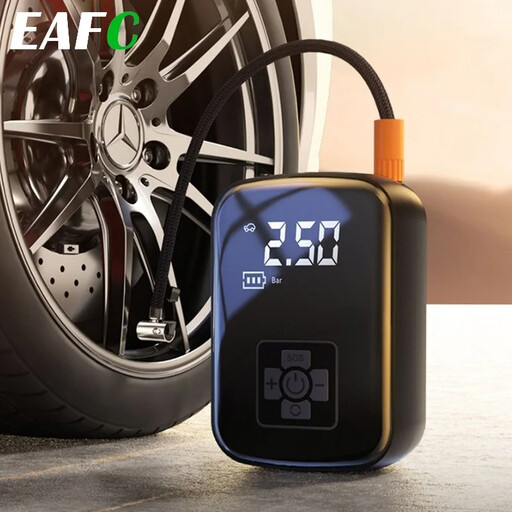
Why This Fits Their Persona: A compact option for drivers, cyclists and households wanting one rechargeable pump for routine top-ups and smaller inflatables.
The listing specifies a digital display, preset pressure and automatic stopping rather than relying only on a maximum-pressure figure.
3–150 PSI range, 25 L/min airflow, five inflation modes and a built-in light.
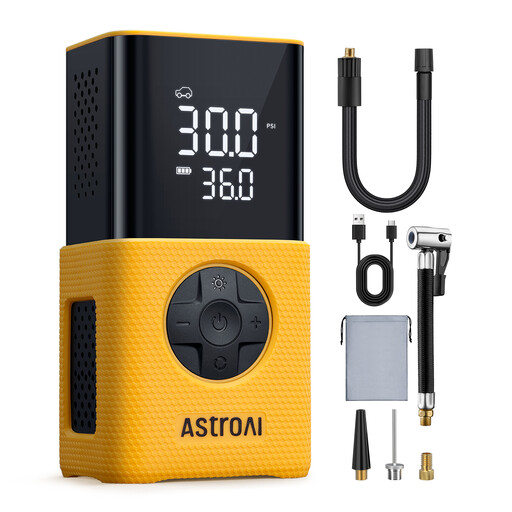
Why This Fits Their Persona: Suitable for motorists who value cordless portability, selectable modes and an integrated emergency tool for regular travel.
Its stated specifications include a 150 PSI maximum, automatic shut-off, multiple units and a defined battery capacity.
4000mAh battery, five modes, USB input/output and three light modes including SOS and strobe.
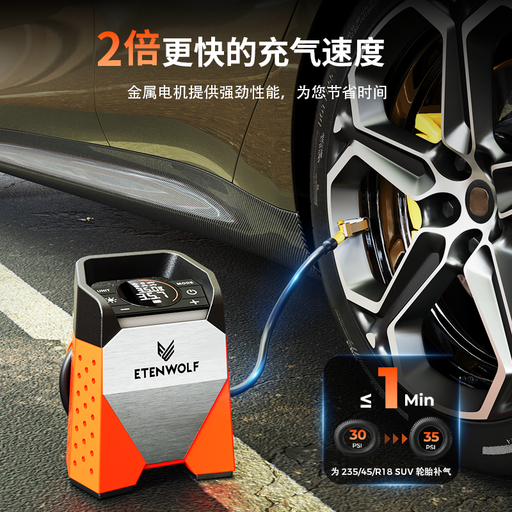
Why This Fits Their Persona: A practical match for households with cars, SUVs, bikes and balls that may need repeated inflation across a journey or outdoor trip.
The specification identifies a 12V power source, 160 PSI maximum operating pressure and a stated 100% duty-cycle description; users should still follow cooling guidance.
12V operation, 1.25 CFM airflow and included adapters for Presta valves, balls and tapered nozzles.
We have compiled a complete, real-time list of products that fully satisfy these strict selection criteria and UK safety regulations.
Park safely away from moving traffic, apply the handbrake and use hazard lights where appropriate. Check the recommended cold-tyre pressure rather than copying the number moulded into the tyre sidewall. Keep the pump and cable away from standing water, and allow the motor to cool if the instructions specify breaks.
For an electric vehicle, confirm that the pump’s battery is charged before a long trip. A cordless model avoids relying on a vehicle socket, while a 12V car air compressor can be useful as a backup. Check the packaging and instructions for relevant UK product information, charging requirements and disposal guidance.
It can be useful for gradual pressure loss and roadside top-ups, particularly for commuters, EV owners and drivers travelling in rural areas. It does not replace checking for punctures or arranging roadside assistance when a tyre is damaged.
Runtime varies with battery size, tyre dimensions, starting pressure and motor load. Treat advertised inflation cycles as product-specific estimates. Recharge the pump after use and check its charge before longer journeys.
No. The figure is a maximum pressure rating, not a universal compatibility statement. Check the product’s vehicle guidance and avoid using a compact pump for large trucks or equipment outside its stated pressure and duty requirements.