
24/7 Customer Support

Free returns

Same-day & Next-day Delivery

Quality Guaranteed

Unlock Your Welcome Offers: FREE Delivery | Up to 80% OFF | Free 30-day JoyPlus trial
Download the APP
A portable car tyre inflator can be useful for routine pressure top-ups, a slow puncture or an unexpected warning light on a rural road. However, product listings often focus on headline numbers rather than practical performance. A pump marked “150 PSI”, for example, may not inflate a car tyre quickly at normal working pressure, while a cordless model may run out of charge before all four tyres are ready.
The right choice depends on your vehicle, where you intend to use the pump and whether you prioritise compact storage, faster inflation or multi-purpose use.
A 150 PSI tyre inflator can sound powerful, but maximum pressure is not the same as inflation speed. It describes the upper pressure limit under specified conditions. Airflow, motor power, cylinder design and heat management have a greater effect on how quickly a car tyre reaches its recommended pressure.
For everyday UK cars, check whether the product is designed for passenger vehicles rather than simply choosing the highest PSI figure.
A cordless tyre inflator is easy to carry and can be used away from the vehicle. Its limitation is battery capacity. Cold weather, larger tyres and repeated inflation can reduce available runtime. If the battery is flat, the pump may be unusable unless it also supports 12V operation or USB charging.
A wired 12V tyre inflator avoids this particular problem, provided your vehicle has a suitable DC socket and the cable reaches the required wheel.
Car and motorcycle tyres generally use Schrader valves, while many bicycles use Presta valves. A pump may also need a needle for footballs or other sports equipment. Before buying, check the included hose, adapters and nozzle arrangement rather than assuming every “multi-purpose” pump includes everything required.
Choose between:
A longer cable can be useful for reaching the rear wheels of larger vehicles. The Baseus Ultra-Mini model listed in this guide includes a 3-metre 12V cigarette-lighter cable, while some compact wired pumps have shorter leads.
For an electric vehicle, confirm that the 12V socket is active when the vehicle is switched on. Do not assume the inflator can connect directly to the high-voltage traction battery.
A digital tyre pump with selectable PSI or BAR readings makes it easier to set a target pressure. An automatic shut-off tyre inflator can stop when the preset value is reached, reducing the risk of prolonged inflation. Nevertheless, check the final reading with a separate gauge if accuracy is important, and always follow the pressure shown on the vehicle’s tyre placard, fuel flap or handbook.
The recommended figure is normally a cold-tyre pressure. Allow tyres to cool before checking whenever possible.
Inflating a slightly low tyre is different from filling a completely deflated one. Look for stated inflation times, airflow and rest guidance. A compact pump may be suitable for occasional top-ups but require cooling between extended sessions.
For motorcycles, bicycles and balls, a small portable air compressor may be entirely adequate. For SUVs or multiple car tyres, consider a larger motor, a higher airflow figure and a design with clear overheating instructions.
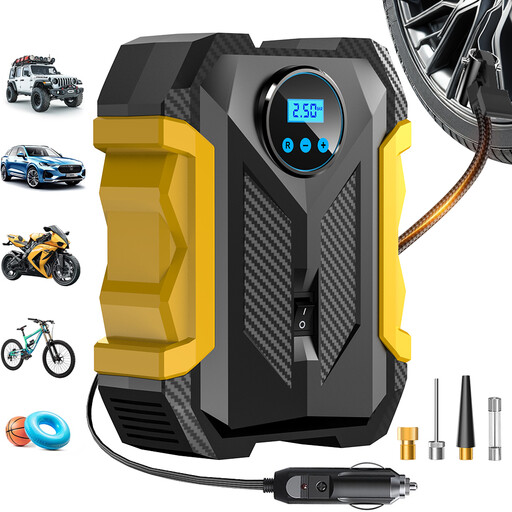
Why This Fits Their Persona: A practical option for drivers who want a vehicle-powered pump for cars, motorcycles, bicycles and balls without relying on battery charge.
Its 12V design avoids the flat-battery issue, while the digital display helps users monitor the selected pressure.
150 PSI stated maximum pressure; LED light and 3-metre cord are listed features.
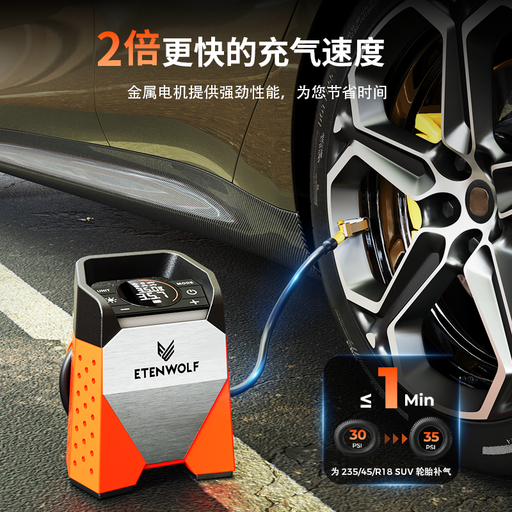
Why This Fits Their Persona: Suitable for drivers who want a rechargeable pump with a higher stated pressure ceiling and accessories for several inflation tasks.
The listing provides a stated airflow figure, battery information and operating instructions rather than relying only on a headline PSI figure.
160 PSI stated maximum operating pressure; includes a Presta valve adapter, inflation needle and USB A-to-C cable.
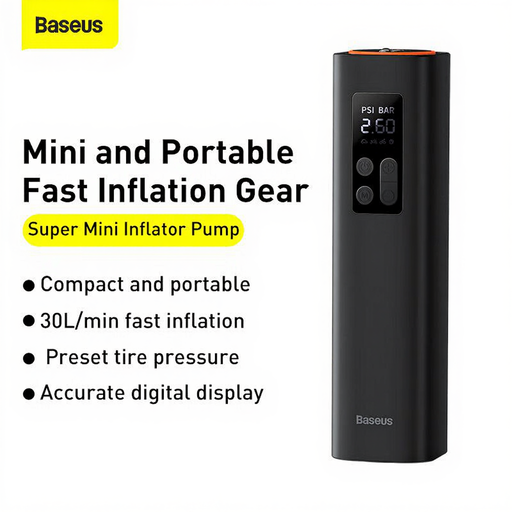
Why This Fits Their Persona: A compact choice for car owners, electric vehicle users and cyclists who value flexible storage and reach around the vehicle.
The 3-metre power cable reduces the reach problem found with some small wired pumps, and three nozzles support non-vehicle inflatables.
Includes an air hose, three air nozzles and a 12V cigarette-lighter cable; designed for cars, bicycles and electric vehicles.
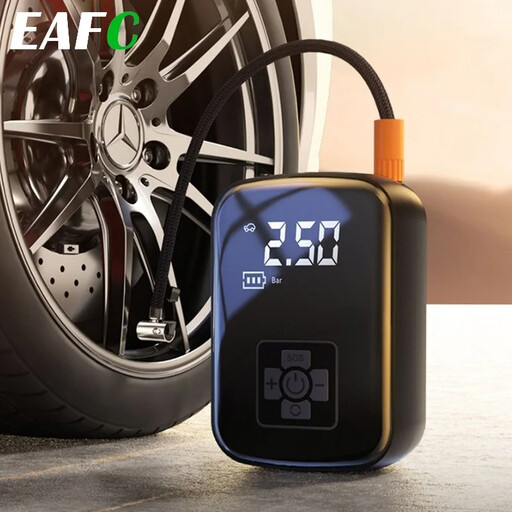
Why This Fits Their Persona: Handy for cyclists, motorcyclists and outdoor users who need a small pump for occasional top-ups without a nearby 12V socket.
Its stated 15–25-minute battery life makes runtime visible before purchase, helping buyers judge whether it suits their intended workload.
3–150 PSI range; five inflation modes, automatic stopping and built-in lighting are listed features.
We have compiled a complete, real-time list of products that fully satisfy these strict selection criteria and UK safety regulations.
It can be suitable for pressure top-ups and some emergency use, provided its battery has sufficient capacity for your tyre size and workload. For frequent inflation or several tyres at once, a 12V or dual-power model may offer more practical continuity.
Its direct electricity cost is usually modest because it operates for a relatively short period. The vehicle’s engine may need to run according to the instructions, so fuel use and safe ventilation should also be considered. Never leave a vehicle running in an enclosed garage.
Many multi-purpose pumps can handle all three, but check the valve connector and included adapters. A motorcycle tyre inflator and bicycle pump may use different fittings, and the stated pressure range should match the intended tyre. For repeated bicycle use, confirm that a Presta adapter is included or available.