
24/7 Customer Support

Free returns

Same-day & Next-day Delivery

Quality Guaranteed

Unlock Your Welcome Offers: FREE Delivery | Up to 80% OFF | Free 30-day JoyPlus trial
Download the APP
A portable car tyre inflator can be useful for routine pressure top-ups, a slow puncture or an unexpected roadside problem. However, product listings often focus on impressive maximum pressure figures while leaving out the details that matter during real use: battery endurance, power connection, inflation time and valve compatibility.
A compact portable air compressor is not automatically suitable for every vehicle. Before buying, check how the unit is powered, whether its pressure display is easy to read and whether it is intended for occasional top-ups rather than inflating several completely flat car tyres.
A rating such as 150 PSI air pump or 160 PSI sounds substantial, but maximum pressure is not the same as inflation speed. Car tyres normally operate far below these figures, and the practical result depends on airflow, motor output, hose design and battery charge.
For most UK cars, a unit with a suitable pressure range and clear controls is more useful than one selected solely for its headline PSI rating. Also check whether the listing gives an airflow figure, such as litres per minute, and whether inflation times refer to a top-up or an entirely flat tyre.
A cordless tyre inflator is convenient for driveways, bicycles and roadside use, but its runtime is limited. Cold weather, repeated inflation and larger car tyres can reduce the available operating time. A rechargeable tyre pump should be charged before a long journey and stored according to the manufacturer’s instructions.
Some models offer dual power, allowing you to use a 12V vehicle socket when the battery is low. This can be a practical alternative for motorists who want wireless convenience without depending on battery power alone.
Many car tyres use Schrader valves, while some bicycles use Presta valves. A motorcycle tyre pump or bicycle air pump may include different nozzles, but do not assume every adapter is included. For a family vehicle, confirm that the hose reaches all four wheels and that the power cable is long enough to reach the furthest tyre.
A 12V model also requires a working vehicle socket. The engine may need to be running during use, following the product instructions, to avoid placing unnecessary demand on the car battery.
Look for a stated operating range rather than only a maximum figure. Models in this selection offer pressure ratings up to 150 or 160 PSI, making them suitable for car, motorcycle, bicycle and ball inflation according to their individual listings. This does not mean they are suitable for large commercial vehicle tyres or high-pressure equipment.
Airflow is another useful comparison. For example, the EAFC model lists 25L/min, while the Porbi Q16 lists 26L/min. Higher airflow can help with quicker inflation, but actual time varies according to tyre size, starting pressure and temperature.
A rechargeable pump is convenient for roadside emergencies, but battery capacity should be considered alongside runtime. The EAFC pump lists a 3,600mAh battery and 15–25 minutes of battery life. The Porbi Q16 lists 4,000mAh and up to 25 minutes of runtime, while the GOOLOO GT160 lists 7,500mAh and up to 45 minutes of wireless continuous inflation.
A 12V car tyre inflator avoids relying entirely on a rechargeable battery. Corded options can be suitable for regular car use, provided the cable length and socket position work for your vehicle.
A digital tyre pressure gauge makes it easier to set and monitor a target value than a basic analogue dial. An automatic shut-off tyre inflator should stop when the preset pressure is reached, helping reduce the risk of continued inflation while you attend to the connection.
Always check your vehicle’s recommended cold tyre pressure on the tyre placard, usually found inside the driver’s door area, or in the handbook. Do not use the inflator’s maximum PSI as your vehicle’s recommended setting.
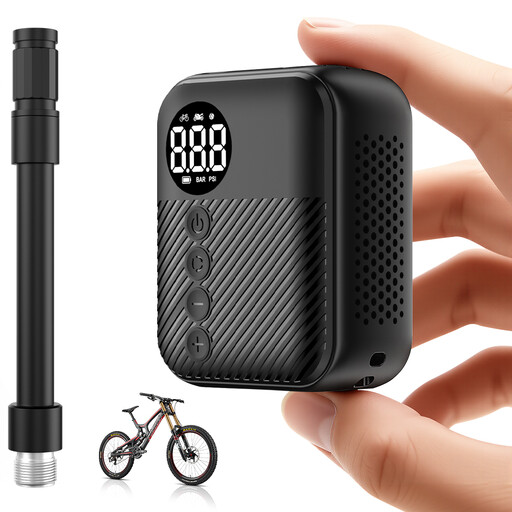
Why This Fits Their Persona: Its pocket-sized format suits cyclists, commuters and drivers wanting a compact rechargeable tyre pump for occasional top-ups.
The listing specifies a digital gauge and rechargeable battery, so buyers can check pressure and avoid relying on a vague analogue reading.
Pocket-sized design; digital pressure display; listed for bike, motorcycle and car tyres.
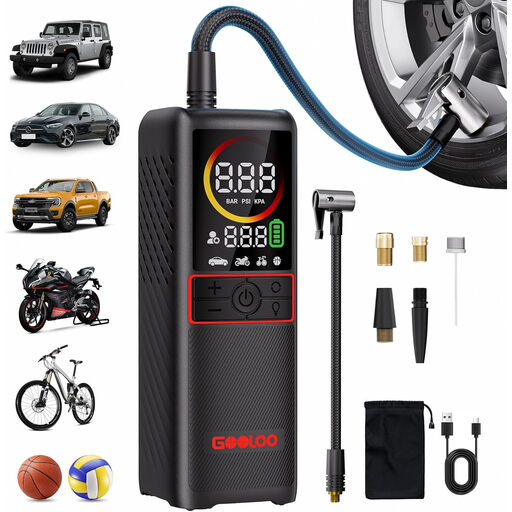
Why This Fits Their Persona: Drivers who prefer cordless operation, a larger battery and preset modes may appreciate its broader control options for cars, bikes, motorcycles and balls.
The listing states a 7,500mAh battery, preset modes, digital units and automatic shut-off, making the key operating details clear.
160 PSI maximum pressure; up to 45 minutes listed runtime; LED lighting and power-bank function.
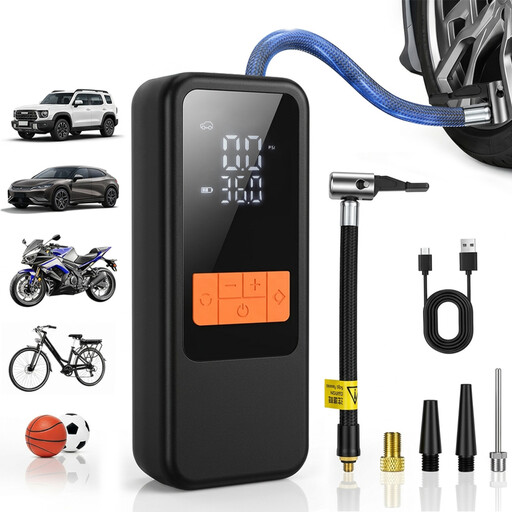
Why This Fits Their Persona: Suitable for motorists and outdoor users who want stated runtime, airflow and inflation-time figures rather than general performance language.
The product details distinguish between empty-tyre inflation and 30-second top-ups, helping set more realistic expectations.
26L/min airflow; 4,000mAh battery; five inflation modes and two LED lighting modes.
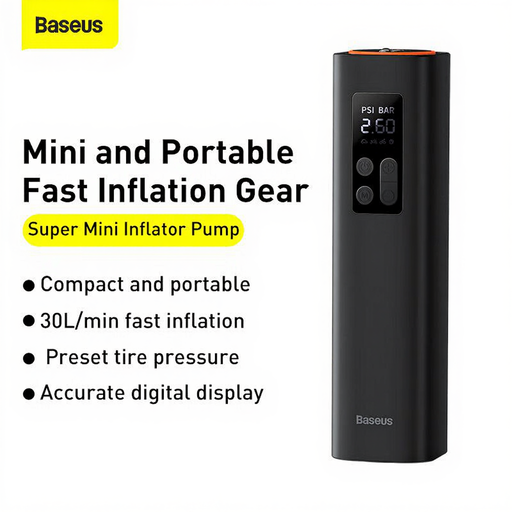
Why This Fits Their Persona: A compact option for keeping in a glove compartment, with a wired setup that avoids waiting for a battery recharge before use.
Its listed 3-metre 12V cable addresses reach concerns, while the included air hose and three nozzles clarify what is supplied.
12V cigarette-lighter power; 3-metre cable; supplied nozzles for bicycles, balls and other inflatables.
For a wider selection of electric tyre pumps, cordless models and accessories, browse the Joybuy inflation range.
It can be suitable for pressure top-ups and some roadside situations, provided its battery capacity, operating time and vehicle compatibility match your needs. For repeated use or larger tyres, a 12V model or dual-power unit may be more practical.
Battery runtime varies by model, tyre size, starting pressure and temperature. The products above list runtimes from 15–25 minutes to up to 45 minutes. These figures should be treated as stated operating guidance, not a guarantee for every inflation task.
Some models include multiple modes and nozzles for all three. Check whether a Presta adapter is supplied for bicycles and whether the product is intended for standard car tyres. A maximum PSI figure alone does not confirm compatibility with every tyre type.