
24/7 Customer Support

Free returns

Same-day & Next-day Delivery

Quality Guaranteed

Unlock Your Welcome Offers: FREE Delivery | Up to 80% OFF | Free 30-day JoyPlus trial
Download the APP
A portable compressor cool box can make long drives, campsite stays and boat trips considerably easier, but choosing the wrong model can lead to wasted money and disappointing performance. A compact 12V car fridge may look suitable online yet struggle to freeze food, while a large compressor cool box may not fit securely in your vehicle or run efficiently from a leisure battery.
Before comparing models, look beyond capacity and promotional cooling claims. The following checks can help you select a portable car fridge that suits your actual journey.
Thermoelectric mini fridges are often lighter and less expensive, but they usually cool to a set number of degrees below ambient temperature. If the vehicle interior reaches 30°C, a product advertised as cooling 20°C below ambient may only reach approximately 10°C. It may not freeze food or maintain a consistent temperature in hot weather.
A compressor cool box works more like a domestic refrigerator. Suitable models can generally operate across a wider temperature range and may function as a portable freezer. Check the cooling technology rather than relying on terms such as “car fridge” or “electric cooler”.
A large internal volume is useful for families, anglers and extended trips, but external dimensions matter just as much. Check the boot, seat or storage compartment measurements, including space needed to open the lid. A 49.4-litre model may hold substantially more food than a 4-litre personal fridge, but it also requires more room and a stronger securing method.
A 12V car fridge can draw power for many hours. Without adjustable battery protection, continuous use may reduce the vehicle battery’s ability to start the engine. Cooling units also release heat through ventilation areas. Blocking these vents can reduce performance and increase energy use.
For vehicle installation, secure the unit with suitable straps and leave the manufacturer’s recommended clearance around the compressor. Do not assume that a cigarette-lighter socket remains powered when the ignition is off.
For camping, fishing and caravan use, look for a 12V/24V fridge freezer with a stated temperature range. A unit offering settings from -20°C to +20°C provides more flexibility than a thermoelectric cooler, although actual results depend on ambient temperature, ventilation, loading and power supply.
A compressor model is generally more appropriate when you need frozen food, fresh meat or seafood to remain chilled over several days. For a few drinks or skincare items during a short journey, a thermoelectric cooler may be more practical and economical.
A versatile camping fridge should ideally support:
Check whether the mains adapter is included. Some compact car fridges only include a 12V cable, meaning a separate 240V AC cooler adapter may be required for home use.
Three-stage battery protection, usually marked low, medium and high, allows the user to select how quickly the appliance disconnects as voltage drops. This is useful when running a fridge from a starter battery or portable power station.
Noise is also relevant inside a campervan or motorhome. Published figures around 40–42 decibels can indicate relatively quiet operation, but noise may vary as the compressor starts and stops. Energy labels should be considered alongside capacity; for example, the 49.4-litre EUHOMY model is listed as Energy Class C, while its 18-litre counterpart is listed as Energy Class D.
Always check the product instructions, plug type, cable condition and required ventilation. Look for appropriate conformity markings and safety information for the UK market, and use a correctly rated socket or fused connection.
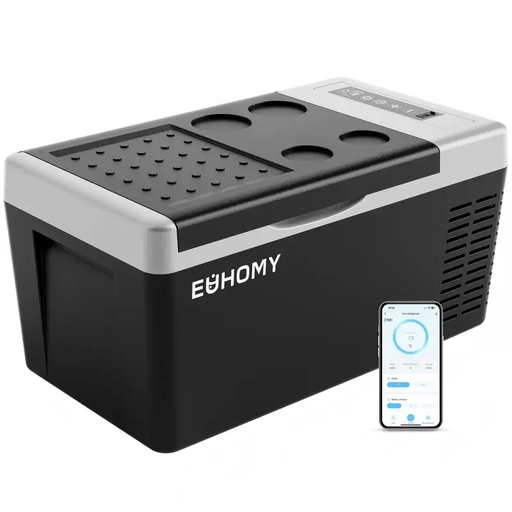
Why This Fits Their Persona: Its 18-litre capacity suits couples, solo campers and road-trippers who need a genuine fridge-freezer without carrying a full-size RV refrigerator.
It uses compressor cooling rather than thermoelectric cooling, with a stated range of -20°C to +20°C. Three-stage battery protection also helps manage vehicle power use.
12/24V DC and 100–240V AC operation, Wi-Fi app control, magnetic lid seal and an approximate operating noise level of 42 dB.
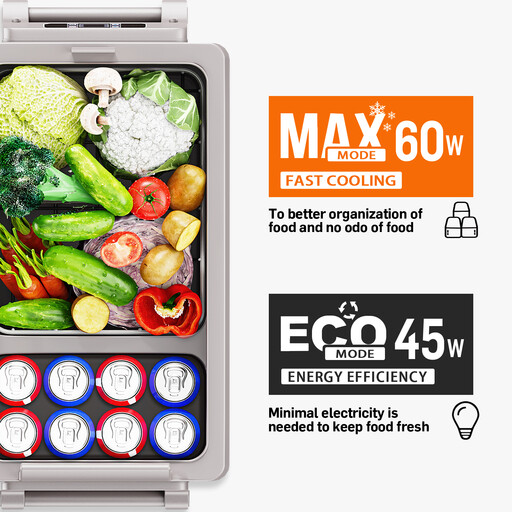
Why This Fits Their Persona: The generous capacity is suited to families, caravan owners, boat users and longer stays where separate food and drink storage is useful.
The dual storage areas can help separate different foods, while adjustable battery protection and both AC and DC power reduce installation compromises.
49.4-litre capacity, -20°C to +20°C temperature adjustment, Bluetooth control, 12/24V DC and 110/240V AC compatibility, and a listed 40 dB operating noise level.
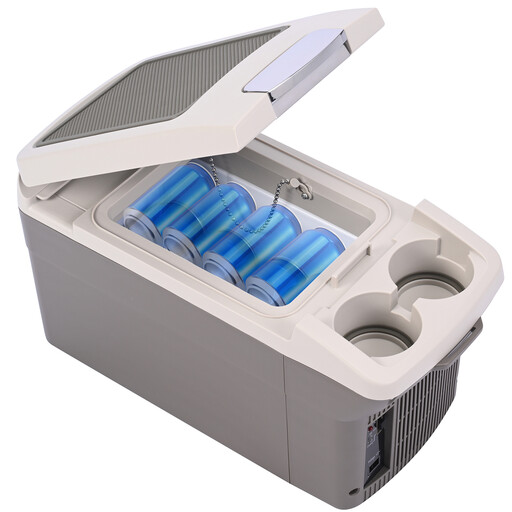
Why This Fits Their Persona: A practical choice for drivers, picnickers and anglers who prioritise a compact seat-friendly format, drink storage and warming as well as cooling.
Its listing clearly identifies semiconductor cooling, so buyers are less likely to mistake it for a compressor freezer. The optional mains adapter should be budgeted for if home use is required.
12V operation, seat-belt slot, cup holders, shoulder strap and stated cooling to approximately 4°C or warming up to 60°C, depending on conditions.
We have compiled a complete, real-time list of products that fully satisfy these strict selection criteria and UK safety regulations.
It can be worthwhile for multi-day trips because it can chill or freeze independently of campsite ice supplies. Choose a model with 12V and 240V compatibility, battery protection and sufficient ventilation. Confirm that your leisure battery or power station can support the expected running time.
Yes, if it remains connected while the engine is off. Battery protection can disconnect the appliance at a selected voltage level, but it should not replace sensible power management. For overnight use, connect the fridge to a suitable leisure battery or portable power station where possible.
Lifespan depends on ventilation, transport conditions, cleaning and power connections. Keep the compressor area clear, secure the appliance during travel, avoid overloading it and follow the manufacturer’s care instructions. A sturdy handle, seal and lid are particularly important for frequent camping or boating use.