
24/7 Customer Support

Free returns

Same-day & Next-day Delivery

Quality Guaranteed

Unlock Your Welcome Offers: FREE Delivery | Up to 80% OFF | Free 30-day JoyPlus trial
Download the APP
A portable compressor fridge freezer can make camping, caravanning, boating and long-distance driving considerably easier. Unlike a basic insulated coolbox, it actively lowers the internal temperature and, depending on the model, can freeze food and drinks.
However, product listings can make similar-looking appliances seem interchangeable. The wrong choice may leave you with insufficient space, a drained vehicle battery or a cooler that cannot freeze at all. The following guide explains the main buying traps and the specifications worth checking before you choose a 12V car fridge, camping fridge or portable freezer.
A low-cost mini fridge may be described as a car refrigerator or portable coolbox, but it may use a thermoelectric cooling chip rather than a compressor. These models usually cool to a stated number of degrees below room temperature and may also provide a warming mode. They generally cannot freeze food, and performance can reduce in a warm vehicle or tent.
A compressor model works more like a domestic refrigerator. It is designed to reach a specific temperature range, making it more suitable when you need frozen food, fresh meat or ice for several days.
A larger litre figure does not automatically mean better organisation. Check whether the space is divided into compartments, whether bottles can stand upright and whether a dual-zone design affects the freezer area.
Also measure your vehicle boot, motorhome storage bay or boat locker. Account for handles, lid clearance and ventilation space rather than relying only on the stated internal capacity.
A 12V fridge freezer can draw power for extended periods, particularly during warm weather or when set to a low temperature. If the unit lacks adjustable battery protection, it may continue running until the vehicle battery is too weak to start the engine.
Ventilation is equally important. Compressor coolers release heat through vents around the compressor. Blocking these vents can reduce cooling performance and increase energy use. Follow the manufacturer’s clearance guidance and secure the appliance during travel.
For genuine refrigeration and freezing, look for a compressor system and a published temperature range. The EUHOMY 18L model, for example, lists a range of -20°C to +20°C, allowing it to work as either a refrigerator or freezer.
By comparison, the AstroAI 6L and 4L mini fridges use thermoelectric cooling. Their listed cooling performance is based on reducing the temperature below ambient conditions, with a minimum temperature around 0°C for the 6L version. They are better suited to drinks, snacks, skincare or short trips than to frozen food storage.
For use in the UK, an AC/DC portable fridge is more flexible than a DC-only model. Check for:
A 24V compressor cooler should not be connected to an unsuitable outlet. Similarly, confirm that your vehicle’s 12V socket is rated for the appliance and remains powered when the ignition is off if continuous cooling is required.
Three-stage battery protection, usually marked low, medium and high, lets you adjust the cut-off level according to your vehicle and power setup. This is useful for overnight camping, but it is not a substitute for checking the battery condition or using a leisure battery and suitable power station.
Noise is another practical consideration in a tent or campervan. The listed EUHOMY models specify operating noise levels of approximately 40–42 decibels. Actual sound may vary with ambient temperature, ventilation and compressor workload.
Energy labels can also help compare models, but running cost depends on the set temperature, insulation, weather, ventilation and how often the lid is opened. A lower wattage figure does not guarantee lower total consumption in every situation.
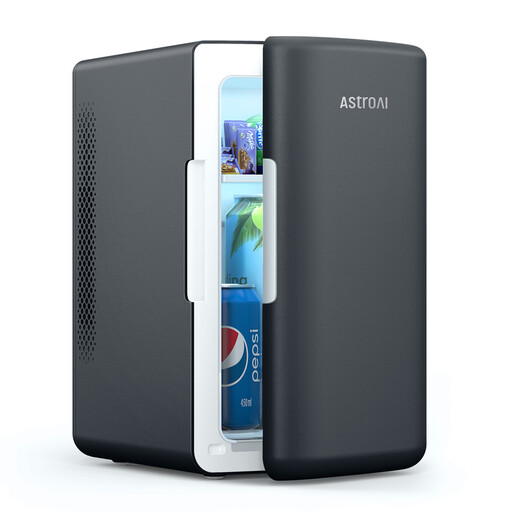
Why This Fits Their Persona: A compact option for commuters, festival-goers and occasional travellers who mainly need chilled drinks or snacks rather than a full camping freezer.
Its listing clearly identifies thermoelectric cooling, so buyers are less likely to mistake it for a freezer-capable compressor appliance.
6L capacity, 12V DC and 220–240V AC operation, plus cooling and warming modes.
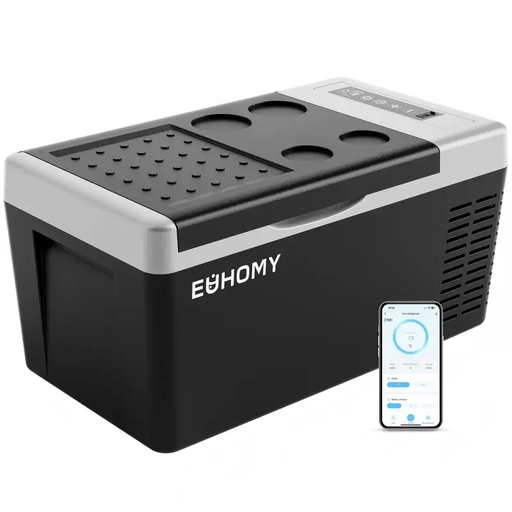
Why This Fits Their Persona: A practical choice for couples, campervan owners and boat users wanting true refrigeration in a smaller footprint.
The compressor system, -20°C to +20°C range and three-stage battery protection address the main limitations of chip-based coolers.
18L capacity, Bluetooth/app control, anti-shock design and AC/DC adaptors.
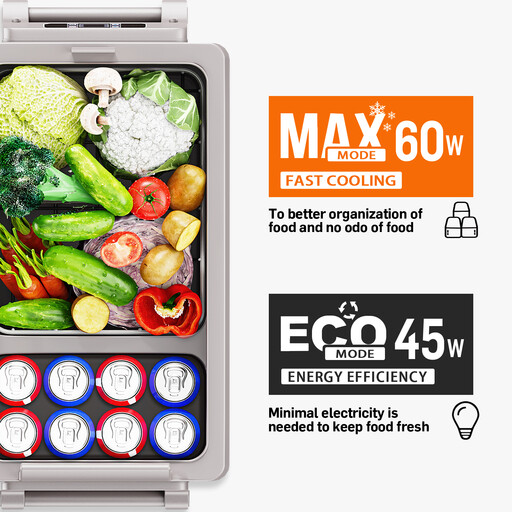
Why This Fits Their Persona: Designed for families, lorry drivers, anglers, motorhome owners and longer trips where drinks, meat, seafood and fresh food need separate storage.
Its dual storage areas, battery protection and stated 100mm ventilation clearance help address organisation, power and installation concerns.
49.4L capacity, 12/24V DC and 240V AC compatibility, with a listed 40dB operating noise level.
Before using a portable compressor fridge freezer:
We have compiled a complete, real-time list of products that fully satisfy these strict selection criteria and UK safety regulations.
Yes, provided the appliance is compatible with the vehicle’s power outlet and has adequate ventilation. A 12V car fridge can usually connect through a cigarette lighter-style socket, while lorry and bus owners may need a 24V compressor cooler. Check the socket rating and battery protection before leaving it running when the engine is off.
Running cost varies according to the unit’s energy rating, ambient temperature, selected temperature, insulation and usage. Compressor systems normally cycle on and off rather than drawing their maximum rated power continuously. Using ECO mode, pre-chilling food and keeping the lid closed can help reduce demand.
There is no single lifespan for every model. Service life depends on ventilation, transport conditions, cleaning, power stability and how frequently the appliance is moved. Keep the compressor area clear, avoid damaging the power cable and secure the unit during travel. Always follow the supplied care and operating instructions.