
24/7 Customer Support

Free returns

Same-day & Next-day Delivery

Quality Guaranteed

Unlock Your Welcome Offers: FREE Delivery | Up to 80% OFF | Free 30-day JoyPlus trial
Download the APP
The promise of a rich, aromatic espresso on a misty morning campsite or during a dreary afternoon in a hotel room is undeniably appealing. However, the growing market for the portable espresso machine is filled with marketing claims that can lead to disappointing purchases. As a Joybuy Product Recommendation Officer, my role is to help you navigate this landscape and find a machine that genuinely suits your needs, without the costly trial and error.
Before you add any device to your basket, be aware of these common pitfalls that catch out many UK buyers.
To avoid these traps, focus on the core parameters that define a machine's real-world performance. Understanding these will help you select a reliable device, whether you need a camping coffee machine or a compact unit for your office.
This is the most critical factor. Portable espresso makers fall into three main categories:
Consider how you prefer to make your coffee. The main options are:
A device designed for travel must be both compact and durable.
Based on these practical criteria, here are a few options matched to different user needs.
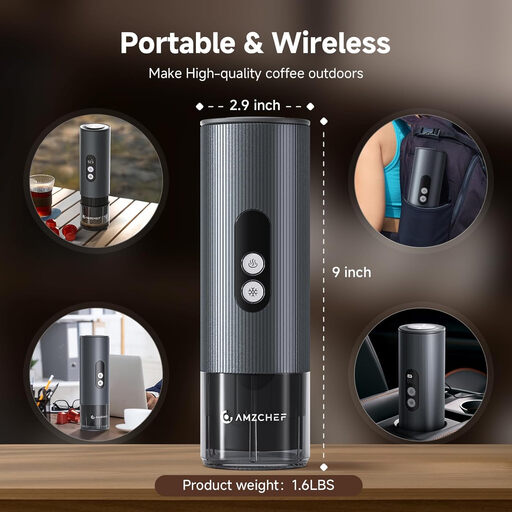
Why This Fits Their Persona: Built for those who are truly away from it all. Whether camping in the Peak District or on a long road trip, its large battery heats water from cold, meaning you are completely self-sufficient and don't need to rely on a separate kettle or power source.
It directly solves the "battery life mirage" with a substantial 9000mAh battery, providing realistic performance for multiple hot brews from cold water, not just optimistic cold brew figures.
Heats its own water in around 200 seconds. It is also a 2-in-1 system, compatible with both NS capsules and ground coffee for added flexibility on the trail.

Why This Fits Their Persona: For the coffee purist who travels for work or leisure but refuses to compromise on quality. This user grinds their own beans and wants to replicate the café experience, with full control over the extraction process.
It demolishes the "high bar pressure" myth by providing a visual pressure gauge and an adjustable OPV valve. This gives the user direct feedback and control to maintain a stable 9-10 bar pressure, prioritising quality over a meaningless peak number.
Features a commercial-grade 58mm portafilter for superior extraction and a full-metal body for durability. It also includes a pre-infusion function for better coffee saturation.

Why This Fits Their Persona: Perfect for someone with limited space in a flat or on an office desk who wants maximum variety. They might share the machine with others who have different coffee preferences, making its multi-format capability a huge asset.
This machine is the antidote to the "compatibility trap." Its 6-in-1 functionality means you are not locked into one expensive pod system. It accepts multiple major capsule brands as well as ground coffee and E.S.E. pods.
Unmatched versatility in a compact footprint. It also features hot and cold modes, allowing you to make iced coffee in the summer without needing to cool down a hot shot first.
We have compiled a complete, real-time list of products that fully satisfy these strict selection criteria and UK safety regulations.
The lifespan depends heavily on build quality and maintenance. A model with a metal body and robust internal components will generally outlast a cheaper, all-plastic version. To maximise its life, always follow the manufacturer's cleaning instructions, especially regarding descaling to prevent mineral build-up from UK hard water and handle it with care during travel.
With the right machine and good technique, it can be remarkably close. Models that allow for fine-tuning, such as those with pressure gauges or that use freshly ground coffee in a quality portafilter, can produce a genuine espresso with rich crema. However, results will always depend on the quality of your coffee beans and water, and your skill in using the device.
No. There is a clear distinction between manual and electric models. Manual presses require you to physically pump to create pressure and need an external source of hot water. Electric models use a battery to power the pump and the most advanced versions also have a built-in element to heat the water, offering the greatest convenience. Always check if an electric model heats water or just automates the pressure.