
24/7 Customer Support

Free returns

Same-day & Next-day Delivery

Quality Guaranteed

Unlock Your Welcome Offers: FREE Delivery | Up to 80% OFF | Free 30-day JoyPlus trial
Download the APP
A portable EV charger UK 3 pin Type 2 can be a practical backup for electric car owners who do not always have access to a wallbox. It can also help when visiting family, staying at accommodation with a suitable outdoor socket, or charging on a driveway where permanent installation is not possible.
However, a 3-pin charger is not simply a shorter version of a home wallbox. Charging speed, socket condition, cable routing and weather exposure all affect whether a product is suitable. Understanding these details can help you avoid paying for features that do not match your routine.
A 2.3kW EV charger using a UK household socket is designed for slower charging. It can be useful overnight or when the car is parked for several hours, but it will generally add range more slowly than a dedicated 7kW home EV charger.
If you need a quick top-up between journeys, check your vehicle’s battery capacity and estimated charging time before ordering. A portable unit is usually more suitable as a flexible home or travel charger than as your only high-speed charging method.
A UK 3-pin EV charger can draw a sustained load for several hours. Avoid connecting it through a multi-way adaptor, extension lead or daisy-chained socket. The Morrisons 3 Way Adaptor Plug with USB, for example, is rated at 13A total, but it is not designed as an EV charging accessory and its instructions state that it is not for outdoor or damp use.
Use a properly installed, undamaged socket, keep the plug fully inserted and follow the vehicle and charger instructions. If the socket, plug or cable becomes unusually warm, stop charging and arrange an electrical inspection.
A cable that is too short may require awkward parking or create a trip hazard across a path. A cable that is unnecessarily long can be harder to store and manage. Weather resistance also needs careful interpretation. An IP66 waterproof EV charger is generally protected against dust and powerful water jets; this does not mean the controller or plug should be submerged, left in standing water or exposed to heavy rain without following the instructions.
A Type 2 electric car charger is commonly used by many electric vehicles sold in Europe, but connector compatibility should still be confirmed against your car’s handbook or manufacturer specification. Check both the vehicle inlet and the charging mode supported by the car.
A Type 2 connector does not automatically mean that every charging feature will work with every vehicle. If you are buying for a plug-in hybrid, also check its maximum AC charging rate and inlet design.
The UK mains supply is nominally around 230V. At 10A, the theoretical power is approximately 2.3kW. Actual charging can vary because of the car’s onboard charger, socket condition, temperature and electrical supply.
Useful features include:
These controls do not replace safe installation or supervision. A portable electric car charger should be used according to its supplied instructions and should not be treated as a substitute for an electrician’s assessment.
Look for clearly stated protection features such as earth detection, leakage protection, overcurrent protection, overvoltage protection, short-circuit protection and temperature monitoring. The Goneo models listed below specify these functions, along with a flame-retardant housing.
For cable reach, measure the distance from the socket to the car’s charging inlet, then allow room for safe routing without sharp bends or walkways. Available lengths include 5m, 8m, 10m, 15m and 20m. Longer cables may suit a distant driveway socket, while a shorter cable can be easier to carry and store.
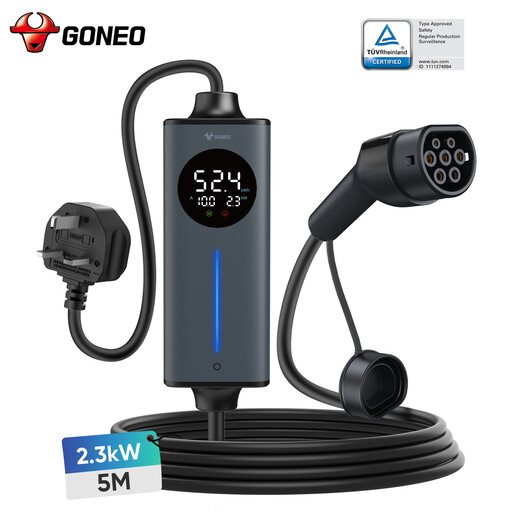
Why This Fits Their Persona: The 5m cable is a manageable option for a typical driveway where the socket is close to the vehicle. It offers a portable charging format without requiring wallbox installation.
Its listed current adjustment and temperature monitoring provide more control than an unspecified basic cable. The IP66 rating is stated, but the unit should still be kept clear of standing water.
5m cable; maximum 2.3kW output; LED display; delay charging function; Type 2 connector.
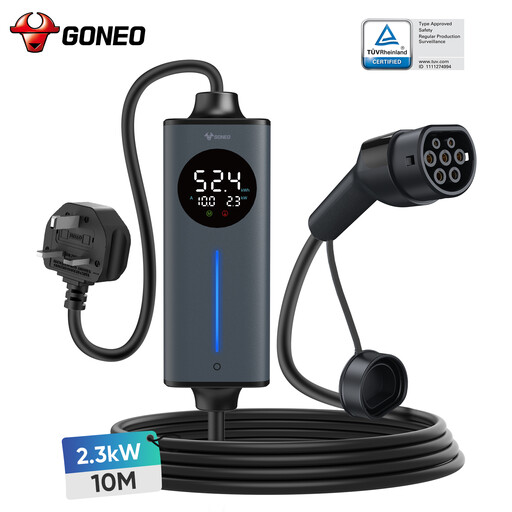
Why This Fits Their Persona: The 10m reach gives added flexibility for larger driveways, visiting relatives or travel locations where the socket position is uncertain.
The product information specifies dual leakage protection, earth detection, overheat response and protection against overcurrent, overvoltage and short circuits.
10m cable; adjustable current; real-time voltage, current and temperature display; IP66-rated housing as listed.
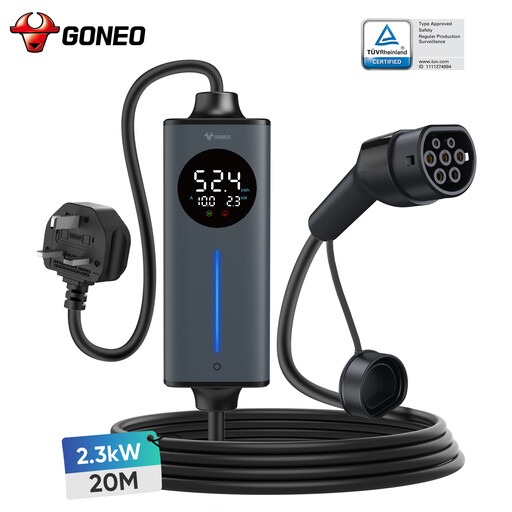
Why This Fits Their Persona: A 20m cable can suit long driveways, detached garages or temporary charging points far from the parking space, provided the route can be managed safely.
The extended reach reduces the temptation to use an extension lead. Users should still avoid placing the cable across public paths or under vehicle wheels.
20m cable; 2.3kW maximum power; adjustable 10A current; delay charging; multiple listed electrical protections.
Before the first use, inspect the plug, cable, controller and Type 2 connector. Connect directly to a suitable socket and keep the control unit supported rather than hanging from the cable. Coil the cable loosely after it has cooled, and store it dry.
To estimate electricity cost, multiply the energy used in kilowatt-hours by your tariff. For example, a charger delivering around 2.3kW for one hour uses approximately 2.3kWh, although charging losses mean the energy taken from the supply can be higher than the energy stored in the battery.
For a different cable length, compare the 8m, 15m and other portable EV charger options before purchasing. Selecting the shortest length that safely reaches the car can make handling easier, while a longer option may prevent unsafe cable stretching.
We have compiled a complete, real-time list of products that fully satisfy these strict selection criteria and UK safety regulations.
It may be suitable when connected directly to an appropriate, undamaged socket and used exactly as instructed. Check for heat, avoid adaptors and extension leads, and confirm that the circuit can handle sustained charging. If you are unsure about the socket or wiring, consult a qualified electrician.
Charging time depends on the battery size, the vehicle’s onboard AC charger and the starting state of charge. At approximately 2.3kW, a 10kWh energy requirement could take around four to five hours after allowing for charging losses. The vehicle’s display or handbook will provide a more relevant estimate.
IP66 indicates a stated level of protection against dust and powerful water jets, but it does not mean the charger can be submerged or left in pooled water. Keep the UK plug, control unit and connections protected from avoidable moisture, and follow the product instructions for outdoor use.