
24/7 Customer Support

Free returns

Same-day & Next-day Delivery

Quality Guaranteed

Unlock Your Welcome Offers: FREE Delivery | Up to 80% OFF | Free 30-day JoyPlus trial
Download the APP
A portable EV charger UK 3-pin plug Type 2 model can be useful when your electric car is parked at home, visiting family or staying somewhere without a dedicated wallbox. However, product listings often make similar chargers appear interchangeable when important differences may affect everyday usability.
Before choosing a UK electric vehicle charger, check the connector, current settings, cable length and protection features. A lower purchase price may not represent good value if the cable cannot reach your car, the charger lacks useful monitoring or the plug is unsuitable for the socket location.
A 2.3kW electric car charger connected through a UK 3-pin plug is designed for slower charging than a permanently installed home wallbox. It can be practical for overnight or occasional top-up charging, but it will not deliver the same charging rate as higher-powered dedicated equipment.
The advertised 2.3kW maximum is also not the same as the amount of energy your car receives every minute. Charging performance can vary according to the vehicle, battery state, electrical supply and conversion losses. Treat a portable car charger as a flexible backup or convenient home solution rather than assuming it will rapidly fill any battery.
The phrase “Type 2” generally refers to the connector used by many European-market electric vehicles, but it does not automatically mean every EV charging product is suitable for every vehicle. Check your car’s handbook or charge-port specification before ordering.
The mains side also matters. A UK 3-pin plug should be connected to a suitable household socket, following the charger and vehicle manufacturer’s instructions. Avoid making assumptions about extension leads, outdoor sockets or shared circuits. If the installation or socket condition is uncertain, ask a qualified electrician for advice.
A 20m cable may reach a distant driveway position, but it can be heavier and more difficult to coil neatly. Conversely, a 5m lead may be easier to store but unsuitable where the socket is far from the vehicle.
Measure the route from the socket to the car, allowing for the position of the control box and a sensible amount of slack. Do not stretch the cable across places where it could be crushed, create a trip hazard or obstruct pedestrians.
Look for an adjustable current EV charger if your household socket or electrical circuit needs a lower setting. The Goneo models listed here specify adjustable current, a maximum 2.3kW output and a 10A setting. A current display can make it easier to see what the charger is drawing while in use.
A delay-charging function is also useful for off-peak charging, where your electricity tariff offers cheaper overnight rates. Check your tariff conditions rather than assuming that every night-time period costs less.
For a portable charger used in driveways or while travelling, useful features include:
These features do not remove the need for sensible setup. Inspect the plug, cable and socket before charging, keep connections away from standing water and stop using the unit if it becomes damaged, unusually hot or discoloured.
An IP66 waterproof EV charger is described as protected against dust and powerful water jets under the relevant rating system. IP66 does not mean the charger should be submerged, left in standing water or treated as permanently weatherproof in every situation. Store the control unit and cable correctly when not in use.
For cable length, common options include 5m, 10m, 15m and 20m EV charging cable versions. Select the shortest length that comfortably reaches your charging position if portability and storage are priorities.
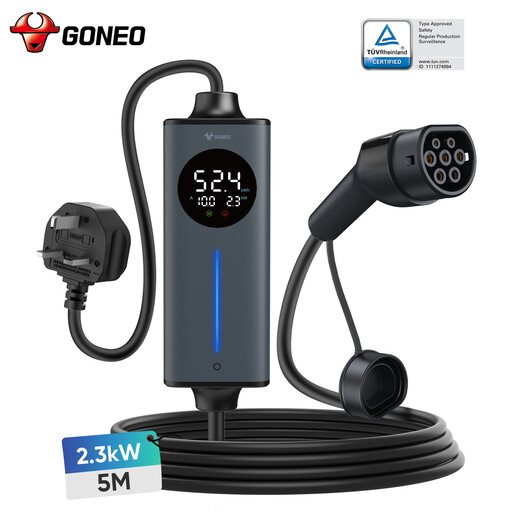
Why This Fits Their Persona: The 5m cable suits drivers charging close to a household socket who want a more compact option for routine home use or occasional travel.
The shorter lead helps avoid paying for excess cable and reduces storage bulk where the socket and vehicle are parked nearby.
Type 2 connector, UK 3-pin plug, adjustable current and stated IP66 protection.
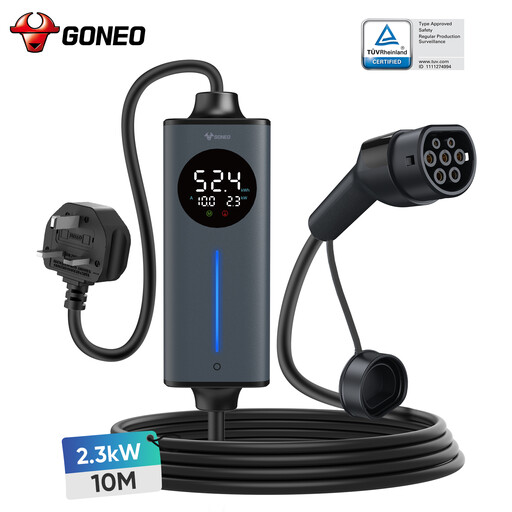
Why This Fits Their Persona: The 10m format balances reach and storage for driveway users who want more positioning flexibility without moving to the longest cable option.
The display, delay function and temperature monitoring provide more information than a basic cable with no visible operating data.
LED display, delay charging, dual temperature monitoring and multiple stated electrical protections.
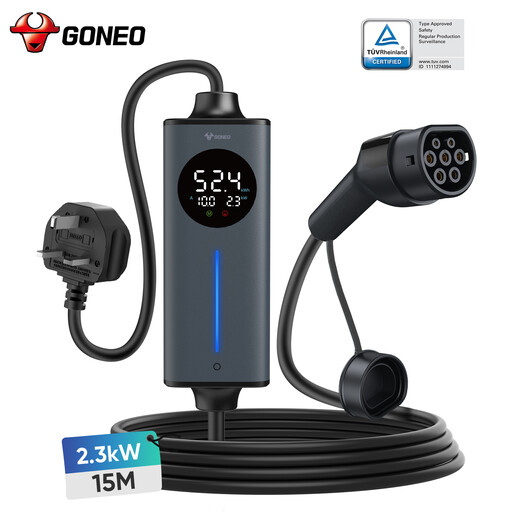
Why This Fits Their Persona: A 15m cable is suited to larger driveways, changing parking positions or travel locations where the socket is not immediately beside the car.
It addresses the common short-cable problem, while still offering the same listed 2.3kW output and adjustable-current format.
15m reach, Type 2 connection, LED information display and stated overheat shutdown or power reduction.
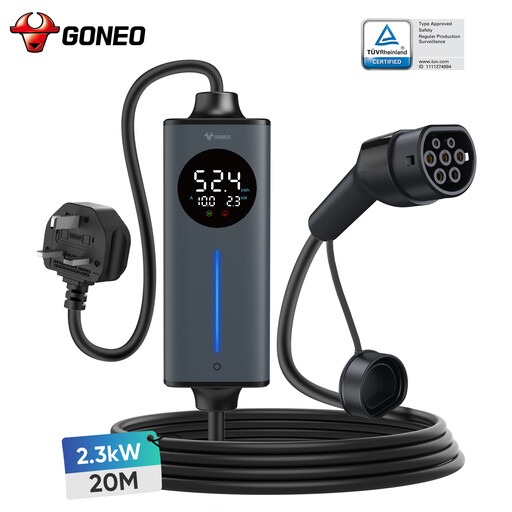
Why This Fits Their Persona: The 20m cable is intended for situations where distance is the deciding factor, such as larger properties, guest parking or varied travel locations.
It reduces the risk of discovering that a short lead cannot reach the vehicle, but buyers should plan safe cable routing and storage first.
20m cable length, adjustable current, delay charging and stated IP66 protection.
We have compiled a complete, real-time list of products that fully satisfy these strict selection criteria and UK safety regulations.
Yes, these models are designed with a standard UK 3-pin plug, but the vehicle must have a compatible Type 2 charge port. Use a suitable socket in good condition and follow the supplied instructions. A qualified electrician can advise on the circuit if you are unsure.
Running cost depends on the electricity tariff and the energy supplied. At its stated maximum, a 2.3kW charger can draw roughly 2.3kWh over one hour, before charging losses. Multiply the energy used by your tariff rate to estimate the cost. A delay function may help schedule charging during a cheaper off-peak period if your tariff supports one.
IP66 indicates resistance to dust and powerful water jets, but it does not mean the unit should be submerged or left in puddles. Keep the plug and connections dry, avoid unsafe cable routes and store the charger indoors when it is not needed.