
24/7 Customer Support

Free returns

Same-day & Next-day Delivery

Quality Guaranteed

Unlock Your Welcome Offers: FREE Delivery | Up to 80% OFF | Free 30-day JoyPlus trial
Download the APP
A portable charger can be useful when your home has no wallbox, when you are staying away from home or when a destination charger is unavailable. However, choosing a portable EV charger UK 3-pin plug Type 2 requires more than checking the cable length or advertised price.
Some products look similar online but differ in current control, weather protection and safety monitoring. The following guide explains the key specifications to check before buying, followed by product matches for different UK driving routines.
A 12V car power inverter can provide mains-style power for small electronics, but it is not designed to charge an electric vehicle. Similarly, a standard 3-way adaptor or replacement plug is not an EV charging solution.
Avoid connecting an EV charger through a domestic multiway adaptor, extension arrangement or daisy-chained plug. These products may have a 13A or 3,250W rating, but that does not make them suitable for continuous EV charging. EV owners should connect the charger directly to a suitable socket whenever possible.
A 2.3kW portable electric car charger normally operates at a controlled current from a UK household socket. Charging speed depends on the selected current, the vehicle’s onboard charger, battery size and the condition of the electrical installation.
A charger with adjustable current can be more practical than one fixed at its highest setting. Lowering the current may help when using an older circuit, a socket shared with other appliances or a supply with limited capacity. Always follow the vehicle and charger instructions.
An IP66 waterproof EV charger enclosure is designed to offer protection against dust and powerful water jets under specified test conditions. It does not mean every part of the charging setup can be submerged or permanently left in rain.
The UK 3-pin socket, plug connection and control box still need sensible protection from standing water. Check the product instructions for outdoor use, keep connections off the ground and inspect cables for damage before charging.
Most European electric cars use a Type 2 connector, but you should still confirm the connector required by your vehicle before ordering. A Type 2 EV charger for home and travel connects to the car’s AC charging inlet; it does not replace a rapid DC charger.
A standard UK 3-pin portable unit is generally a single-phase EV charger. It is intended for slower AC charging from a domestic socket rather than the higher output of a dedicated wallbox.
Look for a clear current setting and display. The Goneo portable chargers listed here provide adjustable current control, with a maximum stated output of 2.3kW and a 10A setting in the supplied product information.
At 230V, 10A is approximately 2.3kW. Actual charging may be lower because of vehicle limits and charging losses. Before use:
A visible LED display showing voltage, current and temperature can make it easier to identify unusual conditions during charging.
Choose a cable long enough to reach the vehicle without placing tension on the plug or control box. Available lengths in this range include 5m EV charging cable, 8m EV charging cable, 10m EV charging cable, 15m EV charging cable and 20m EV charging cable.
A longer cable can help with a driveway socket positioned away from the car, but it is heavier and needs more storage space. Never leave a cable where it creates a trip hazard or crosses a public footpath. Look for protective features such as temperature monitoring, leakage protection, earth detection and automatic shutdown or power reduction.
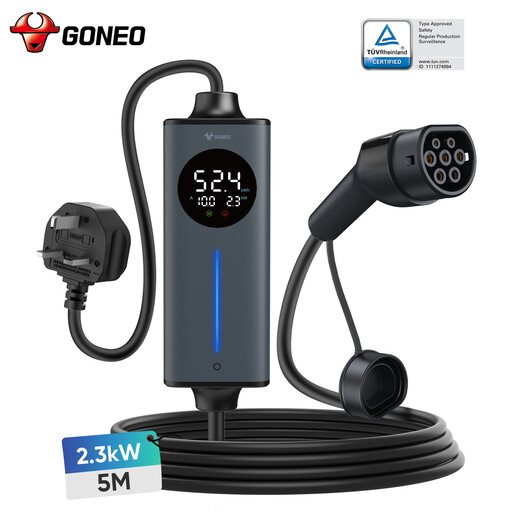
Why This Fits Their Persona: A 5m cable suits drivers who park close to a socket and want a more compact option for home or occasional travel.
It provides adjustable current, temperature monitoring and a display rather than relying on a basic fixed-output design.
Type 2 connector, UK 3-pin plug, adjustable 10A current and stated IP66 protection.
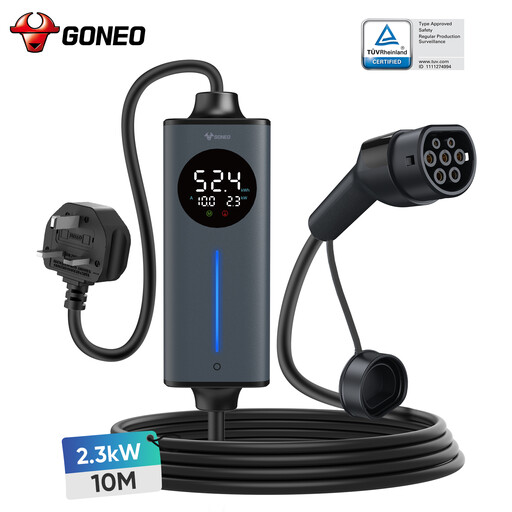
Why This Fits Their Persona: The 10m reach offers a practical balance for households that want flexibility without the storage demands of a very long cable.
The built-in display and dual leakage protection help address uncertainty around charging status and electrical safety.
10m cable, delay charging function, temperature readout and automatic power reduction or shutdown on overheating.
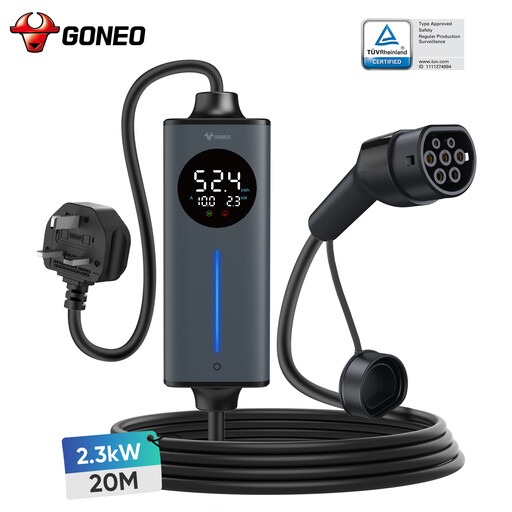
Why This Fits Their Persona: A 20m cable is suited to larger driveways, rural properties or temporary charging locations where the socket may be far from the vehicle.
Its long reach reduces the temptation to use an unsuitable extension cable, while current adjustment helps accommodate different domestic circuits.
20m cable, Type 2 connector, IP66-rated housing and protection against overvoltage, overcurrent and short circuits.
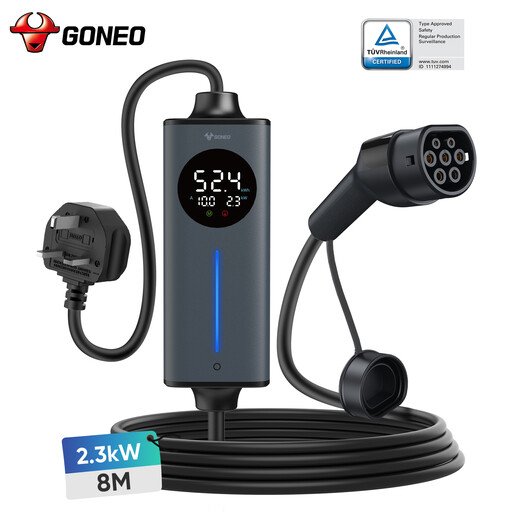
Why This Fits Their Persona: The 8m cable offers useful reach for travel stays and temporary charging without the bulk of the longest option.
It combines plug-and-play operation with an LED display and earth detection, helping travellers check the connection before charging.
8m reach, delayed charging, dual leakage protection and stated compatibility with most European EVs using Type 2.
We have compiled a complete, real-time list of products that fully satisfy these strict selection criteria and UK safety regulations.
A portable UK 3-pin EV charger is usually slower than a dedicated wallbox, so it suits overnight charging or topping up during a stay. To estimate electricity cost, multiply the energy used in kilowatt-hours by your electricity tariff. For example, adding 20kWh at 30p per kWh would cost approximately £6, before charging losses.
Use delay charging if your electricity tariff has cheaper off-peak periods, but confirm the schedule with your supplier. Keep the control unit ventilated, avoid coiling the cable tightly while charging and store it dry after use.
It can be suitable when connected directly to a correctly installed and appropriately rated socket, provided the charger and vehicle instructions are followed. Do not use a damaged socket, unsuitable extension cable or multiway adaptor. If the socket becomes hot, stop charging and arrange an electrical inspection.
Charging time varies according to battery capacity, starting charge level, vehicle limits and charging losses. As a simple guide, adding 10kWh at 2.3kW takes over four hours in ideal conditions. Real-world charging may take longer.
Measure the distance from the intended socket to the vehicle, then allow extra length for safe routing without tension. Choose 5m for close parking, 8m or 10m for general flexibility and 15m or 20m where the socket is substantially farther away. Longer cables require more careful storage and positioning.