
24/7 Customer Support

Free returns

Same-day & Next-day Delivery

Quality Guaranteed

Unlock Your Welcome Offers: FREE Delivery | Up to 80% OFF | Free 30-day JoyPlus trial
Download the APP
A portable EV charger UK 3 pin model can be useful for overnight charging at home, visiting family or dealing with limited access to public charge points. However, not every product described as “portable” is suitable for regular UK use. Some listings focus on headline power figures while overlooking cable reach, socket compatibility and the protection needed for outdoor charging.
Before buying, watch for three common pitfalls:
The right choice depends on how and where you charge, rather than the largest number shown in a product title.
For a UK household charging setup, look for a UK plug EV charger with a standard three-pin plug on one end and a Type 2 EV charger connector on the vehicle end. Type 2 is widely used by European electric vehicles and plug-in hybrids, but buyers should still check the vehicle handbook or charging-port specification.
A Type 2 charging cable is a different product category. For example, a 7.2kW cable or 11kW three-phase cable may be appropriate between a compatible charge point and a vehicle, but neither includes a UK three-pin mains plug or socket-level charging control.
A 2.3kW EV charger typically draws up to 10A from a 230V supply. This is considerably slower than a dedicated home wall box, but it can suit overnight top-ups or occasional charging when installation is not practical.
An adjustable current EV charger can be more flexible because the user may select a lower setting where the household circuit or socket requires it. Do not assume the vehicle will always accept the maximum output: charging speed is limited by the car, the supply and the charger’s own settings.
As a simple guide, a 2.3kW charger may add roughly 2.3kWh of energy per hour before normal charging losses. The usable range gained depends on the vehicle’s efficiency, battery size and conditions.
Length is especially important on UK driveways, where the socket may be indoors or positioned away from the vehicle. A 15m electric car charger offers more parking flexibility than a short lead, but it will also be heavier and needs careful storage to prevent kinks and trip hazards.
For outdoor or travel use, check for a stated enclosure rating such as IP66 waterproof EV charger. IP66 indicates a high level of protection against dust and powerful water jets for the rated enclosure; it does not mean the product should be submerged.
Useful safety features include:
Use a sound, correctly wired socket. Avoid daisy-chained adaptors and ordinary household extension leads unless the manufacturer specifically permits the arrangement. Keep connections away from standing water, and stop charging if the plug or socket becomes unusually hot.
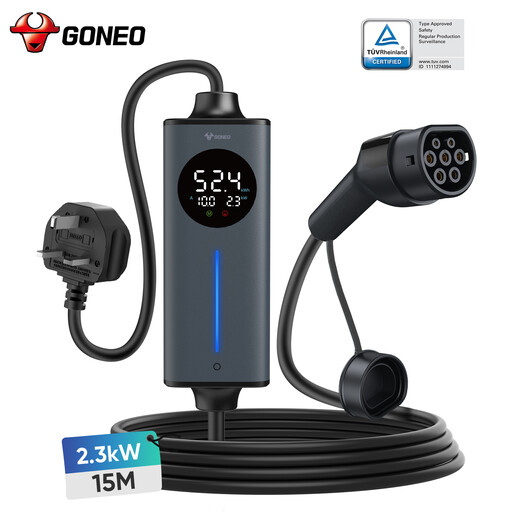
Why This Fits Their Persona: A practical option for EV or PHEV owners who want one home and travel EV charger without arranging a wall-box installation. The 15m lead can help with awkward driveway layouts.
It is a complete UK three-pin portable charger rather than a cable-only product, with stated earth detection, leakage protection and temperature monitoring.
Type 2 connector, listed maximum 10A/2.3kW output, LED display, delay charging and stated IP66 enclosure protection.
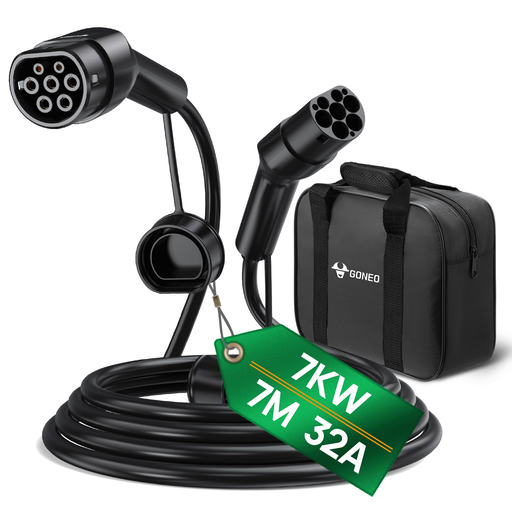
Why This Fits Their Persona: Suitable for drivers who already use public or wall-mounted Type 2 charge points and want a dedicated cable for regular connections.
The listing clearly identifies the cable as Type 2 to Type 2 and states exclusions including J1772, CCS1 and CHAdeMO, helping prevent connector mistakes.
7m reach, 32A single-phase specification, carry bag, TPU jacket, IP54 rating and stated TÜV Rheinland certification.
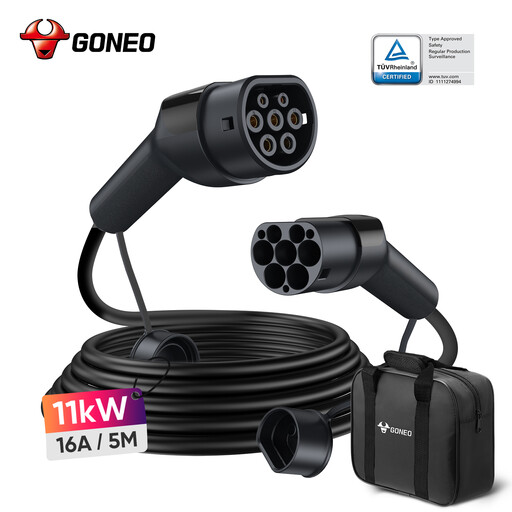
Why This Fits Their Persona: A match for EV owners whose vehicle and charge point support three-phase 11kW charging and who prefer a shorter cable for direct parking positions.
The stated 11kW, 16A three-phase format makes the intended use clearer, while the compatibility exclusions reduce the risk of buying for the wrong socket type.
5m cable length, Mode 3 design, carry bag, IP54 rating and stated compatibility with Type 2 and CCS2 vehicles.
We have compiled a complete, real-time list of products that fully satisfy these strict selection criteria and UK safety regulations.
Not automatically. The socket should be in good condition, correctly wired and capable of handling the charger’s stated current for the intended duration. A standard three-pin supply is generally slower than a dedicated wall charger. Check the vehicle and charger manuals, and avoid using unsuitable adaptors or extension leads.
The approximate cost depends on the electricity tariff and energy delivered. At 2.3kW, one hour uses about 2.3kWh before charging losses. Multiply the energy used by your unit rate to estimate the cost. A delay function may help users schedule charging during a cheaper tariff period, where their electricity plan offers one.
It can be convenient on a large or awkward driveway, but a longer lead adds weight and requires more careful storage. Keep it clear of walkways, do not leave it coiled tightly while charging unless the instructions permit this, and protect the connector from dirt and water. For a compact parking position, a 5m or 7m cable may be easier to handle.