
24/7 Customer Support

Free returns

Same-day & Next-day Delivery

Quality Guaranteed

Unlock Your Welcome Offers: FREE Delivery | Up to 80% OFF | Free 30-day JoyPlus trial
Download the APP
A portable EV charger UK search can produce plenty of similar-looking products, but the specifications are not interchangeable. A 3-pin charger, a Type 2 charging cable and a fixed wallbox solve different problems. Choosing by price or headline charging speed alone can leave you with a cable that does not match your vehicle, a lead that is too short for public bays or a domestic charger that is unsuitable for the socket you plan to use.
This guide explains the practical checks UK electric vehicle and plug-in hybrid owners should make before buying.
An 11kW EV charging cable does not make a vehicle charge at 11kW if its on-board charger (OBC) accepts less. Similarly, a 22kW EV charging cable only delivers its potential where the vehicle and charging point support the required three-phase supply.
Check your vehicle handbook or manufacturer specification first. The cable rating should meet the OBC requirement, but a higher-rated cable does not automatically increase the car’s charging speed.
A Type 2 EV charger may refer to a portable unit with a UK plug and Type 2 vehicle connector, while a Type 2 EV charging cable usually has Type 2 connectors at both ends for use with a compatible public or domestic charge point.
Before ordering, confirm:
Ingress protection ratings describe resistance under defined conditions; they do not remove the need for sensible handling. An IP66 waterproof EV charger should still be kept away from standing water, damaged sockets and submerged conditions. A Type 2 cable with an IP54 rating is designed for dust and water resistance, but connectors should be capped and stored dry after use.
A 2.3kW EV charger connected to a UK 3-pin plug is intended for slower charging. The actual charging time depends on battery size, starting charge level, vehicle limits and the selected current. It can be useful as a backup or travel charger, but it is not a substitute for a dedicated higher-power home installation when rapid overnight charging is required.
For detachable Type 2 cables, common configurations include:
A 16A EV cable and a 32A EV cable are not equivalent. Current rating affects the cable’s intended electrical load, while phase configuration affects how power is supplied. Always match both to the vehicle and charge point.
Five metres can work well where the charging point is directly beside the vehicle. Seven metres may provide more flexibility in public car parks, while 10 metres or longer can help when the socket position and parking layout do not align. Extra length adds weight and takes more storage space, so avoid buying an oversized lead without a genuine need.
A carry bag, protective cap, ergonomic handle and flexible outer jacket can make a noticeable difference for commuters who connect and disconnect regularly.
For a portable electric car charger, look for clearly stated protection features such as earth detection, leakage protection, overcurrent protection, overvoltage protection, short-circuit protection and temperature monitoring. A display showing voltage, current and temperature can also make operating conditions easier to understand.
Safety marks and standards should be treated as product information to verify rather than a reason to ignore correct installation. Use a suitable household socket, avoid extension leads unless the manufacturer explicitly permits them and stop using equipment showing heat damage, cracked housings or damaged pins.
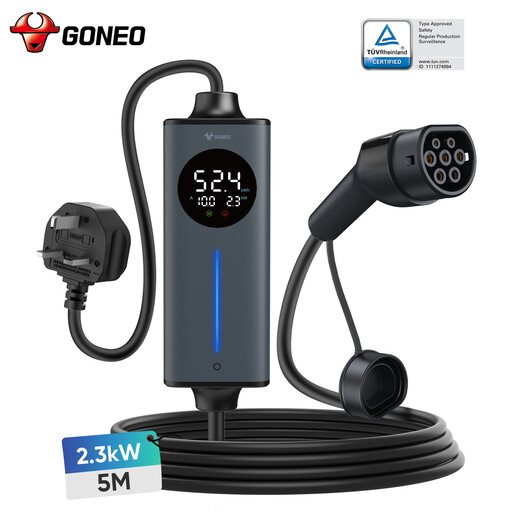
Why This Fits Their Persona: A straightforward option for owners seeking a backup charger for home use, occasional overnight charging or trips where a UK socket is available.
Its stated 2.3kW maximum makes the slower charging expectation clear, while adjustable current and temperature monitoring help users manage domestic charging more carefully.
UK 3-pin plug, Type 2 connector, adjustable 10A current, delay charging, LED display and stated IP66 rating.
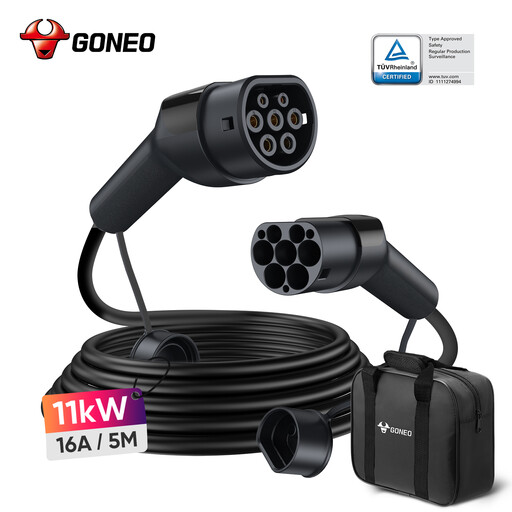
Why This Fits Their Persona: A compact cable for drivers who regularly use compatible 11kW public or domestic charge points and prefer easier storage.
The 16A, three-phase specification identifies the intended charging setup instead of implying universal 11kW performance for every vehicle.
5m length, carry bag, protective cap, TPU jacket, stated IP54 resistance and Type 2-to-Type 2 connection.
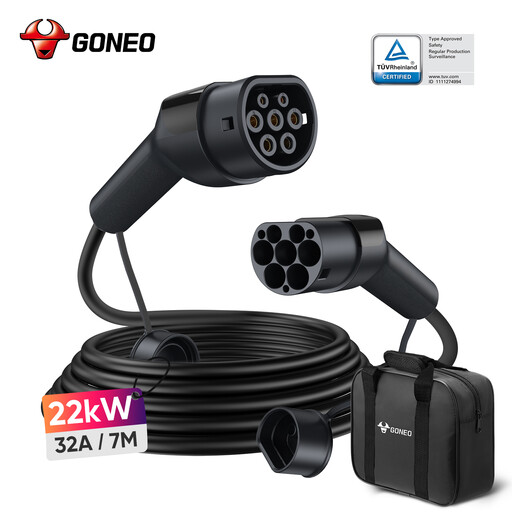
Why This Fits Their Persona: Suitable for drivers who need added reach at public charge points and own a vehicle with a compatible 22kW OBC and three-phase charging capability.
The stated 22kW, 32A, three-phase specification makes compatibility checks essential rather than suggesting that every EV will charge at the headline rate.
7m reach, 32A rating, carry bag, protective cap and TPU cable jacket with stated resistance to more than 20,000 bends.
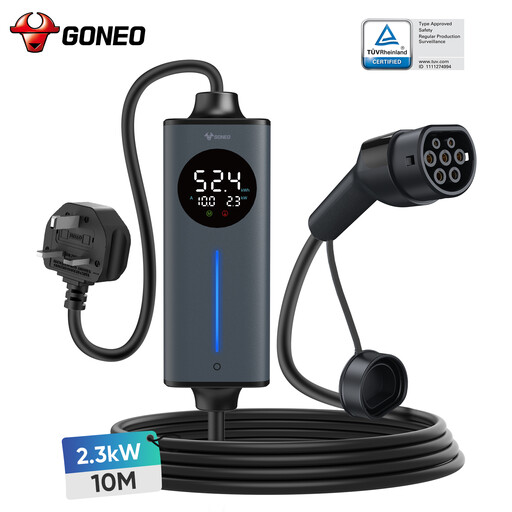
Why This Fits Their Persona: The 10m cable is practical where a driveway layout, parking position or holiday accommodation socket is further from the vehicle.
It combines a clearly stated 2.3kW limit with adjustable current and automatic temperature-related power reduction or shutdown features.
10m reach, UK 3-pin plug, Type 2 connector, delay charging, LED monitoring and stated IP66 protection.
We have compiled a complete, real-time list of products that fully satisfy these strict selection criteria and UK safety regulations.
Yes, a suitable 3-pin EV charger is designed for a UK household socket, but the socket and wiring must be appropriate and in good condition. Portable chargers are generally slower than dedicated home charge points, so follow the manufacturer’s current settings and safety instructions.
It may connect physically in some Type 2 systems, but the charging setup determines the actual output. The product specification should be checked carefully: some 11kW cables are intended for three-phase use and may not be the appropriate choice for a single-phase 7kW installation. Match the cable to the vehicle OBC and charge point requirements.
Service life depends on storage, weather exposure, bending, connector care and frequency of use. Look for stated bend resistance, robust cable materials, protective caps and a clear operating temperature range. Replace a cable if you notice exposed conductors, damaged insulation, overheating or loose connectors.