
24/7 全天候客户支持

免费退货

当日/次日达

品质保障

开启新人专享福利: 全场免邮 | 低至 2 折 | 免费试用 30 天 JoyPlus 会员
下载 Joybuy
A portable fan can make commuting, working, travelling and sleeping more comfortable, but the wrong model may become inconvenient after only a few uses. UK shoppers often focus on headline airflow figures while overlooking battery performance, charging requirements, mounting stability and cleaning access.
Before buying a handheld fan, USB fan or rechargeable portable fan, check how it will fit into your daily routine. A compact mini fan for a train journey has different requirements from a desk fan for a home office, car fan for long-distance driving or pram fan used under adult supervision.
Battery claims are normally measured at the lowest speed. A fan advertised with nearly 20 hours of operation may run for substantially less at maximum airflow. Look for the stated operating range, battery capacity, charging time and whether the fan can operate while connected to USB power.
A battery-operated fan using replaceable batteries may be convenient for festivals or travel, but rechargeable models can reduce the need to carry spare cells. USB-C charging is also useful because compatible cables, power banks and laptop ports are widely available.
A high wind-speed figure does not automatically make a fan suitable for every room or person. A handheld fan needs to direct air towards your face or upper body, while a desk fan should stand securely and distribute air without occupying too much workspace.
For a car fan, mounting stability and adjustment range matter as much as airflow. A pram fan needs careful positioning, secure attachment and constant adult supervision. Do not treat any fan as a toy, and keep fingers and loose objects away from moving blades or grilles.
Noise levels can vary by speed, surface and motor design. A fan that is comfortable at low speed may be more noticeable at maximum output. If you plan to use one beside a bed, in a shared office or during travel, prioritise low-noise operation, multiple speed settings and a stable base.
Battery capacity is usually shown in mAh, but capacity alone does not determine runtime. Power consumption, motor design and selected speed all affect performance. For example, the JISULIFE Life 7 lists a 5000mAh lithium-ion battery, 5W maximum power and an operating time of approximately 3.5 to 19 hours, depending on settings and use.
A larger battery generally adds weight, so consider whether you will carry the fan in a handbag, work bag or pocket. Also check charging time: a model that takes four to five hours to recharge may need to be connected overnight, whereas a smaller mini fan may recharge more quickly.
A useful portable fan should be easy to carry and stable when placed down. Foldable designs can work well for desks, luggage and bedside tables. A lanyard or wrist strap can help prevent accidental drops during commuting or outdoor activities.
For vehicle use, check whether the fan is USB powered or designed for a 12V/24V cigarette lighter socket. A suction-cup car fan should only be attached to a clean, suitable surface and positioned so it does not obstruct the driver’s view or controls.
Two or three speeds may be sufficient for occasional personal cooling, while five speeds offer finer adjustment. Check whether the product has a digital battery display, tilting head, oscillation or 360-degree adjustment.
For UK use, read the supplied instructions and check that the product includes appropriate information for safe operation. Look for clear details about charging, cleaning, battery disposal and electrical input. Keep rechargeable fans away from water, do not use damaged cables and do not disassemble lithium-ion batteries.
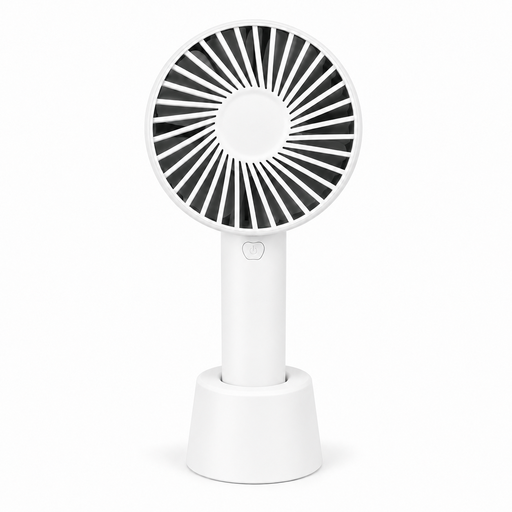
Why This Fits Their Persona: A straightforward choice for shoppers wanting everyday cooling at home, in the office or while commuting without extra mounting equipment.
The USB-rechargeable design avoids reliance on disposable batteries, while the included stand provides hands-free desk use rather than handheld operation only.
USB-rechargeable battery, lightweight format, desktop stand and wrist strap.
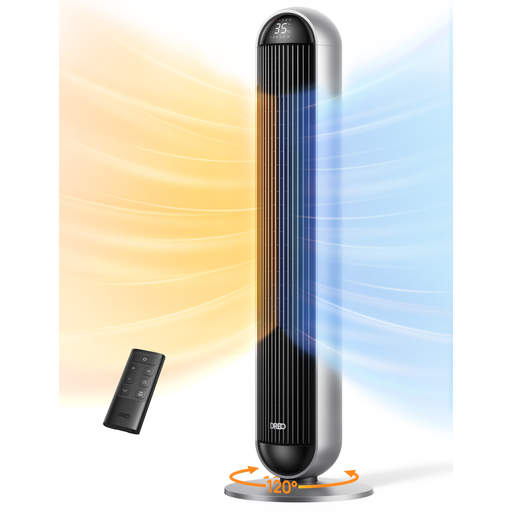
Why This Fits Their Persona: Suitable for indoor shoppers who want one portable appliance for air circulation in warmer weather and supplementary heating during colder periods.
Its function is not limited to a small handheld breeze: it has fan and heating modes, thermostat control, oscillation and a timer for room-based use.
Portable hot-and-cold operation, digital controls, remote control, oscillation and tip-over protection.

Why This Fits Their Persona: Designed for drivers and passengers who need adjustable airflow across a car, SUV, van or lorry during commuting and road trips.
The dual-head layout avoids concentrating airflow on one occupant, while the foldable body supports tidier storage when the vehicle is parked.
12V/24V vehicle compatibility, two fan heads, 360-degree adjustment, three speeds and two USB ports.
A fan moves air across the skin but does not reduce the room’s air temperature. This makes a handheld fan, quiet fan or desk fan suitable for personal cooling, desks, bedrooms and short-term summer use.
A portable air conditioner actively cools a room and normally needs an exhaust hose connected to a window kit. It is larger, heavier and typically uses more electricity than a small USB fan. Check the unit’s dimensions, hose arrangement, drainage requirements, noise information and available floor space before purchasing. A fan heater may be more suitable if you want one appliance for both heating and air circulation, but heating mode requires particular attention to clearances and safe electrical use.
We have compiled a complete, real-time list of products that fully satisfy these strict selection criteria and UK safety regulations.
Running cost depends on wattage, usage time and your electricity tariff. A small 5W fan uses far less electricity than a portable air conditioner, although the exact cost varies. Check the product’s rated power and multiply it by operating hours to compare models. Charging a rechargeable portable fan also depends on battery capacity and how often it is recharged.
Yes, provided the power supply and mounting method are suitable. USB car fans can connect to a vehicle USB port, power bank or car charger. Other models use a 12V or 24V socket. Install the fan where it cannot obstruct visibility, airbags, controls or safe access to the vehicle. Adjust the fan only when it is safe to do so.
The physical fan may last for several seasons with careful cleaning and safe storage, but rechargeable battery capacity gradually declines with use and age. Avoid exposing the fan to excessive heat or moisture, use a compatible charging cable and follow the manufacturer’s storage instructions. For occasional use, a battery-operated fan with replaceable AA batteries can be an alternative.