
24/7 全天候客户支持

免费退货

当日/次日达

品质保障

开启新人专享福利: 全场免邮 | 低至 2 折 | 免费试用 30 天 JoyPlus 会员
下载 Joybuy
A portable fan can make a bedroom, home office or small flat more comfortable without taking up the space of a conventional floor fan. However, attractive product pages can make it difficult to compare what really matters.
Before buying, look beyond airflow modes and modern styling. Battery capacity, charging compatibility, noise information and the fan’s intended coverage all affect whether it suits daily UK use.
A cordless fan still depends on its battery capacity and charging method. Some listings provide little information about expected operating time, charging duration or whether the fan can operate while connected to power.
For a rechargeable fan, check:
If the listing does not state battery runtime, avoid assuming it will last throughout the night or a full working day.
“Quiet fan” and “low-noise operation” are useful descriptions, but they do not always provide a measured decibel figure. Noise can also vary according to speed, surface and room acoustics.
For a bedroom fan or office fan, look for:
A fan with more airflow may also create more audible noise, so the highest speed is not necessarily the most suitable for sleeping or video calls.
A small USB fan is designed mainly for personal airflow. It may feel effective at a desk or beside a bed, but it is not automatically suitable for circulating air throughout a large room.
A portable tower fan can offer a taller airflow path and, in some models, oscillation. Before purchasing, consider the room size, the distance between the fan and the user, and whether you need directional or wider airflow.
A USB fan is convenient for desks, travel and flexible placement. A USB Type-C fan may be particularly practical if you already use Type-C chargers for phones, tablets or laptops. Confirm that the supplied cable and your chosen adaptor are compatible.
For cordless use, rechargeable models remove the need for a permanent cable connection. This is helpful in bedrooms, rented accommodation, caravans or outdoor seating areas, provided the fan is kept away from water and excessive moisture.
A bladeless desk fan can be easier to wipe clean because there are no exposed fan blades. Conventional enclosed-blade designs may also be compact, but the air outlet and intake should remain unobstructed.
Check the product dimensions and base design before ordering. A fan that fits a desk may still be too tall for a bedside shelf, while a portable tower fan should stand on a stable, level surface.
Multiple airflow modes make it easier to balance comfort, noise and battery use. An oscillating tower fan can distribute air across a wider area than a fixed-direction model.
For evening use, a timer can prevent the fan running unnecessarily. A remote control and LED display may also be useful for a floor-standing bedroom fan, although they may be less important for a compact office fan.
An energy-saving fan is generally more useful when its running requirements are clearly stated. DC motors are commonly described as offering lower energy consumption and more precise speed control than traditional AC motor designs, but actual running costs depend on the model, speed and electricity tariff.
For a simple comparison, look at the rated power, charging requirements and whether the fan is intended for continuous mains use or occasional battery operation.
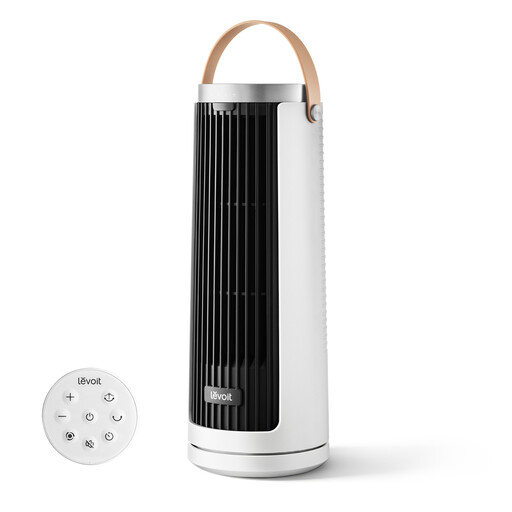
Why This Fits Their Persona: Its compact white tower format suits shoppers who want personal cooling for a desk, bedside table, study area or travel bag without committing to a larger floor fan.
The listing identifies a rechargeable battery, cordless use and USB Type-C charging, so buyers can assess portability rather than relying on the word “wireless” alone.
Multiple airflow modes, low-noise operation and a compact portable tower design.
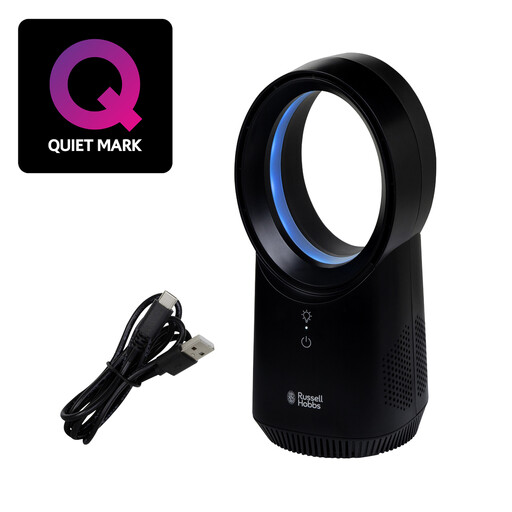
Why This Fits Their Persona: This rechargeable desk fan is designed for tidy home-office, bedroom and travel set-ups where straightforward cleaning and cable-free placement are priorities.
The product details specify USB-rechargeable cordless operation and three speed settings, making the power arrangement and control range clear.
Bladeless construction, USB charging, three speed settings and an approximate 0.8 kg weight.
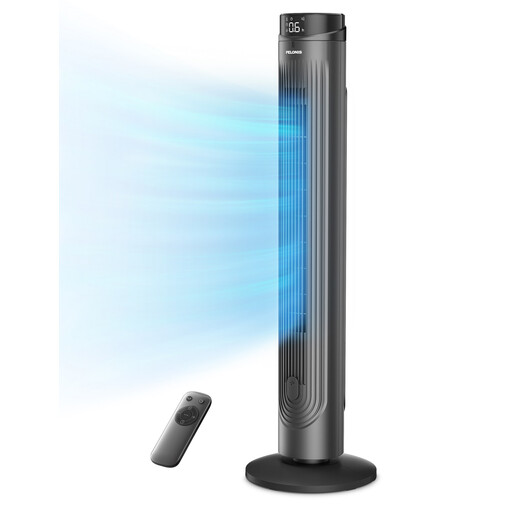
Why This Fits Their Persona: Its floor-standing format is more suitable for shoppers seeking wider airflow in a bedroom or living space rather than close-range desk cooling.
The listing specifies a DC motor, 12 speeds, oscillation and a 24-hour timer, giving more control than a small fixed USB fan.
Bladeless tower format, 12 speed levels, oscillation, remote control and a 24-hour timer.
We have compiled a complete, real-time list of products that fully satisfy these strict selection criteria and UK safety regulations.
Yes, a portable fan can suit a bedroom when it provides a low-speed setting, stable placement and suitable noise performance. A timer can be useful if you do not want it operating continuously. Review the manufacturer’s instructions and stated noise information rather than assuming every compact model is silent.
A rechargeable fan can avoid continuous mains operation when used in short periods, but running cost depends on its power demand, charging frequency and electricity tariff. A mains-powered DC fan may also use relatively little electricity. Compare the stated power requirements and intended usage rather than relying only on “energy-saving” wording.
Lifespan varies according to construction, battery condition, cleaning and frequency of use. Keep the fan dry, avoid blocking the airflow, use the recommended charging accessories and store it in a cool, dry place. For battery models, capacity may gradually reduce with repeated charging over time.