
24/7 Customer Support

Free returns

Same-day & Next-day Delivery

Quality Guaranteed

Unlock Your Welcome Offers: FREE Delivery | Up to 80% OFF | Free 30-day JoyPlus trial
Download the APP
Choosing portable football goals and basketball hoops can seem straightforward until a goal tips over in the garden or a basketball stand proves too large to move. Product photographs often emphasise bright colours, branded graphics or quick assembly, while important details such as anchoring, storage dimensions and base capacity receive less attention.
For UK families, the right choice depends on where the equipment will be used, who will use it and how often it must be moved. This guide explains the main buying pitfalls, the specifications worth checking and a selection of products suited to different households.
A portable football goal is designed to be transported before or after use, not moved while children are playing. Lightweight frames can tip if they are not secured with every supplied peg. This is particularly important on grass, uneven ground or in windy conditions.
Likewise, a portable basketball goal should not be moved once its base has been filled with sand or water. Moving a weighted stand can place stress on the wheels, frame or base.
A pop-up football goal may unfold quickly, but it still needs to be pegged down and checked before use. Folding models may also include locking tabs or frame sections that must be fully engaged.
Basketball stands require more preparation. The backboard, pole and base usually need assembly, and the base must be filled according to the instructions. A claimed assembly time is only useful if the buyer has enough space, tools and an extra adult available.
A small image can make a goal look suitable for a garden when its assembled footprint is much larger. Check the goal width, depth and height, as well as the folded size if it will be stored in a shed or cupboard.
For basketball, compare the backboard dimensions and height range. A larger backboard may provide a more familiar playing experience, but it also needs more clearance around the stand.
For younger children, compact kids football goals can be easier to use and store. The Kickmaster Quick Up goal measures 120 x 80 x 80 cm, while the Kickmaster folding one-on-one set measures 90 x 59 x 61 cm. These proportions are suited to short shooting distances and informal garden play.
A folding football goal is useful when storage space is limited. A pop-up football goal can be convenient for parks and spontaneous practice, but it must still be secured with the supplied pegs. Box-style goals, such as 4 x 6 ft or 5 x 8 ft designs, provide a wider target for training and casual matches.
Look for:
A portable football goal with target sheet adds marked shooting zones, which can make solo practice more structured. It is a practical feature, but it does not replace correct anchoring or adult supervision.
An adjustable basketball hoop should offer a height range that matches the players using it. The SPORTSOUL X Series models adjust from 7.5 to 10 feet, or approximately 2.3 to 3.05 metres. This makes them suitable for family use where children and adults may share the same outdoor basketball stand.
Check whether the mechanism uses fixed increments or continuous adjustment. The 44-inch model uses a spring-loaded mechanism with 6-inch increments, while the 50-inch and 54-inch versions offer tool-free adjustment across the stated range.
Backboard dimensions also matter:
The SPORTSOUL basketball stands combine polycarbonate backboards, steel support structures and HDPE bases. Their bases require filling with sand or water for stability; the 44-inch version holds up to 35 gallons, while the 50-inch and 54-inch versions hold up to 40 gallons. Sand is specified as the preferred filling material for maximum stability on those models.
For football equipment, inspect the net, frame and pegs before each session. Store folded goals dry where possible. For basketball stands, tighten hardware periodically, clean with mild soap and water and consider a protective cover when left outdoors.
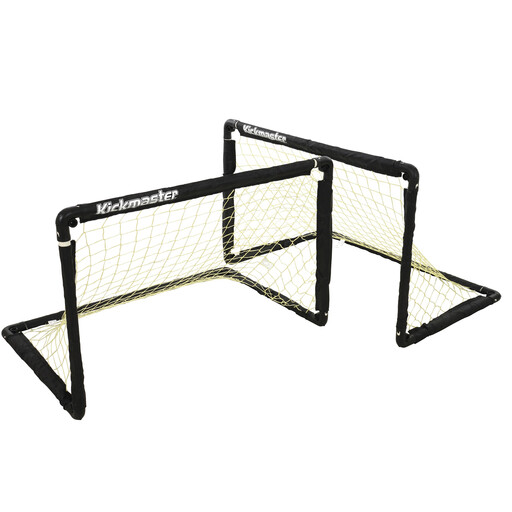
Why This Fits Their Persona: Its 90 x 59 x 61 cm assembled size suits younger players and households needing compact garden or park equipment.
The locking tab helps the frame stay rigid when opened, while anchor pegs address the common stability problem.
Folding design, UV-resistant frame, carry-friendly format and no batteries required.
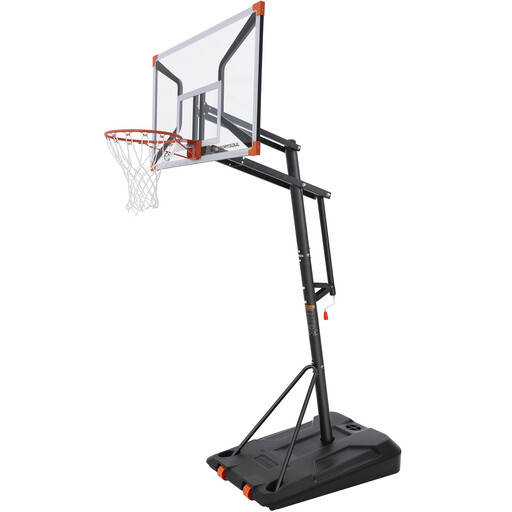
Why This Fits Their Persona: Families wanting a substantial outdoor basketball stand with a larger backboard and flexible height setting may prefer this format.
The stated 40-gallon base capacity and structured steel support make the stability requirements clear rather than leaving them implied.
Tool-free height adjustment from 7.5 to 10 feet, polycarbonate backboard and under-60-minute assembly specification.
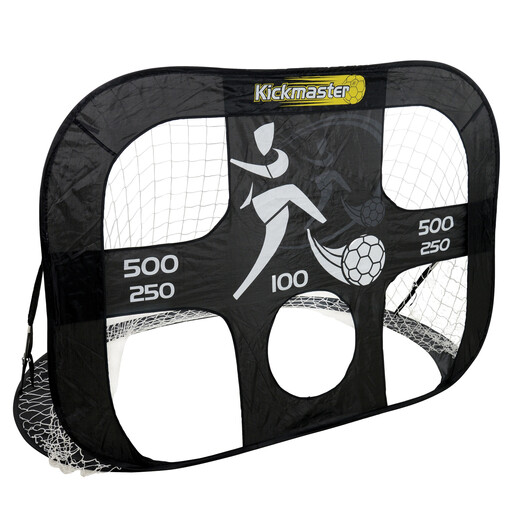
Why This Fits Their Persona: Players who want a wider training target for regular shooting practice can use its 213 x 152 x 152 cm assembled format.
It includes anchor pegs and a target sheet, addressing both the stability and unstructured-practice pitfalls.
Large assembled dimensions, built-in target shot, side storage pockets and carry bag.
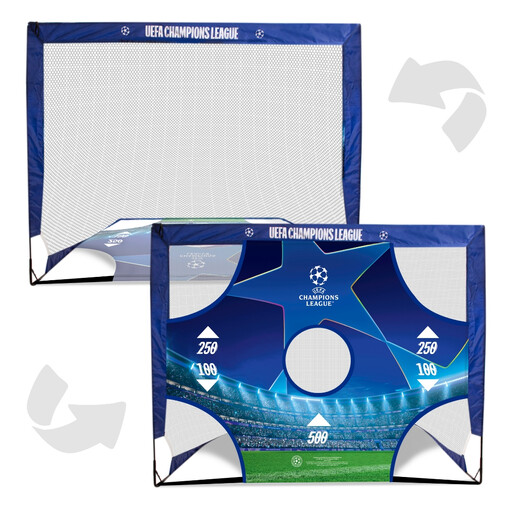
Why This Fits Their Persona: A young football fan may appreciate the officially licensed UEFA Champions League styling alongside a compact garden-training format.
The target sheet provides a defined practice feature, while the flexible frame and pegs support setup and storage when used correctly.
3 x 4 ft format, removable target sheet, flexible frame and weather-resistant target sheet.
We have compiled a complete, real-time list of products that fully satisfy these strict selection criteria and UK safety regulations.
Yes, provided the garden has enough clear space and the goal is secured with all supplied pegs. Check for slopes, hard surfaces, fences, windows and other obstacles before play. Goals should not be climbed on or left unsecured in strong weather.
The SPORTSOUL X Series listings specify assembly in under 60 minutes, but the actual time depends on the number of adults helping and how familiar they are with the instructions. The base must then be filled with sand or water before use.
Football goals and basketball hoops do not require electricity or batteries. Ongoing costs mainly involve storage, occasional cleaning, replacement nets or pegs and protective covers. Keeping equipment dry and checking fasteners regularly can help reduce avoidable replacement costs.