
24/7 Customer Support

Free returns

Same-day & Next-day Delivery

Quality Guaranteed

Unlock Your Welcome Offers: FREE Delivery | Up to 80% OFF | Free 30-day JoyPlus trial
Download the APP
A portable handheld fan can make crowded trains, warm offices and outdoor events more comfortable, but compact cooling products are not all designed in the same way. Some are convenient to carry yet difficult to position, while others advertise impressive speed figures without clearly explaining battery life, charging requirements or noise.
Before buying, look beyond appearance and headline claims. The right choice should match your routine, preferred cooling strength and need for handheld or hands-free use.
RPM figures can look impressive, but motor speed alone does not tell you how much air will reach your face. Blade design, air outlet size and the shape of the grille also affect the experience. A fan with several speed settings gives you more control, but the highest setting may use considerably more battery.
For everyday use, check whether the listing provides practical information such as air speed, operating time or speed levels, rather than relying only on a large RPM number.
A USB rechargeable fan is convenient only when its battery suits your schedule. A small battery may be adequate for a short commute but less suitable for a full day at a festival or outdoor event. Claimed operating times also usually vary by speed setting, so treat the longest figure as a low-speed estimate unless the listing explains otherwise.
Check whether the product uses USB-C charging, the approximate charging time and whether a suitable cable is included. A fan with USB-C charging can be easier to integrate with current phone and laptop cables, although the cable and power source should still be compatible.
Holding a fan continuously may become inconvenient at a desk, on public transport or while applying make-up. A handheld fan with stand, wrist strap, lanyard or hanging function can offer more flexibility. However, a stand is useful only if it provides stable placement on a reasonably flat surface.
Also check the weight. A lightweight handheld fan is easier to carry, but a larger battery may make a model heavier. Decide whether pocketability or longer runtime matters more for your routine.
Battery capacity is commonly shown in mAh. Higher capacity can support longer use, but runtime also depends on motor power and speed selection. For occasional use, a mini portable fan with a smaller battery may be easier to carry. For travel, camping or long outdoor events, a model with a 3,000mAh or 5,000mAh battery may be more suitable.
Do not charge a fan if its battery, casing or cable is damaged. Lithium-ion products should be kept away from excessive heat, water and open flames, and should be disposed of according to local requirements when no longer usable.
Three speeds are generally enough for basic personal cooling: gentle airflow for an office or bedside table, medium airflow for commuting and a stronger setting for outdoor use. Five speeds offer finer adjustment, which can be useful when moving between air-conditioned interiors and warmer outdoor areas.
Descriptions such as “strong airflow” should be assessed alongside measurable information, including maximum air speed, number of blades, power rating and stated operating modes.
A rechargeable pocket fan should fit comfortably into a bag without adding unnecessary bulk. Products weighing around 100–180g are generally easier to carry, though the ideal weight depends on the battery and casing.
For desk use, look for a compact desk fan that can stand securely. A wrist strap or lanyard is useful when walking, travelling or attending an event, while a foldable design can make storage easier.
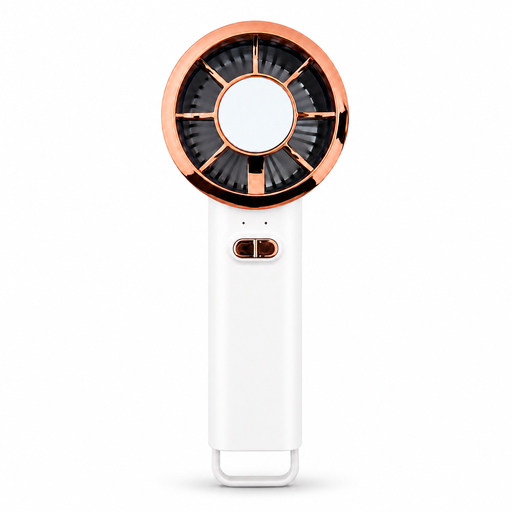
Why This Fits Their Persona: A practical choice for commuters, office workers and first-time buyers who want straightforward personal cooling with a useful extra feature.
Three adjustable speeds make the airflow easier to tailor than a single-mode fan, while the integrated phone stand addresses the problem of having to hold the product continuously.
USB rechargeable; three speed settings; integrated phone stand; suitable for handheld or desk use.
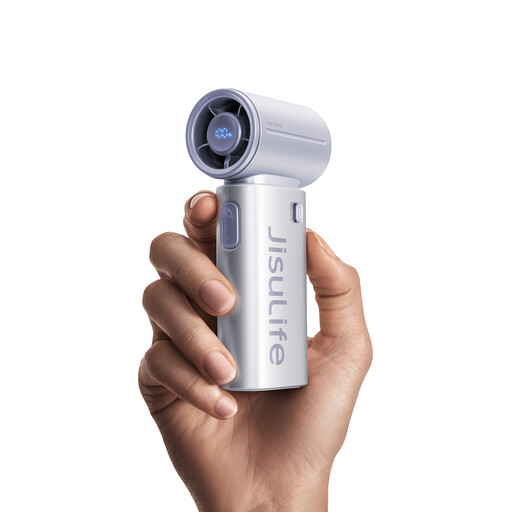
Why This Fits Their Persona: Its display-led controls and larger battery suit travellers, cruise passengers and event attendees who want clearer battery information and more adjustment.
The LED display shows the selected speed and battery level, helping reduce uncertainty about remaining charge. Its five speed levels also avoid relying on a basic low, medium and high arrangement.
5,000mAh battery; five speed settings; LED speed and battery display; stated operating time of 3–22 hours depending on use.
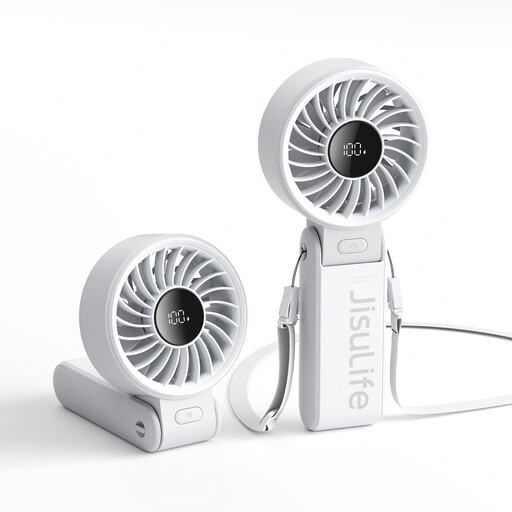
Why This Fits Their Persona: Designed for people who move between work, travel and outdoor activities and want handheld, desk or neck-worn operation.
The foldable 3-in-1 format provides alternatives to holding the fan, while five speed settings and a battery display make it easier to adapt to different environments.
5,000mAh battery; USB-C cable included; five speeds; handheld, desktop and neck-worn use; stated runtime of 3.5–19 hours depending on settings.
We have compiled a complete, real-time list of products that fully satisfy these strict selection criteria and UK safety regulations.
Choose a model with an integrated or supplied stand. A stable base can turn a handheld fan into a compact desk fan for an office, bedside table or dressing area. Place it on a flat, dry surface and keep the grille clear.
Runtime depends on battery capacity, motor power and speed. Product specifications may quote a range, such as several hours at high speed and considerably longer at low speed. For predictable use, select a capacity suited to your longest typical journey and carry a compatible power bank when travelling.
Their electricity use is generally modest because they use small rechargeable batteries. Running cost depends on the battery’s capacity, charging frequency and electricity tariff. To estimate energy per full charge, multiply the battery voltage by its amp-hour capacity, then convert watt-hours into kilowatt-hours. Chargers also draw a small amount of energy during charging, so the exact figure will vary.