
24/7 Customer Support

Free returns

Same-day & Next-day Delivery

Quality Guaranteed

Unlock Your Welcome Offers: FREE Delivery | Up to 80% OFF | Free 30-day JoyPlus trial
Download the APP
A portable handheld fan can be useful on a crowded train, during a warm commute, at a festival or beside your desk. However, choosing one based only on phrases such as “turbo power” or “long battery life” can lead to disappointment.
Some compact fans feel powerful for a few minutes but become inconvenient when the battery drains quickly. Others are difficult to position, noisy in quiet offices or awkward to recharge while travelling. The right choice depends on airflow control, battery capacity, charging options and how you plan to use it.
A high-speed fan can provide a concentrated breeze, but maximum airflow normally uses more power and may create more noise. Battery claims are also usually measured on the lowest setting. For example, a fan advertised with up to 18 or 22 hours of operation may provide considerably less time at its highest setting.
Look for a clear breakdown of runtime by speed level, rather than relying on one headline figure.
A handheld fan is convenient when you are walking or waiting outdoors, but holding it continuously is not practical at a desk. A rear stand, foldable body or included base can turn it into a handheld fan with stand or compact desk fan.
If hands-free use matters, check whether the stand is supplied and whether the fan can sit securely on a flat surface. A wrist strap or lanyard is also useful for commuters and festival visitors, but lanyards should be kept away from young children.
A slim mini portable fan may fit into a pocket, but its smaller battery can mean more frequent charging. A higher-capacity battery adds weight, so there is a trade-off between portability and long battery life.
For occasional personal cooling, a 2,000mAh battery may be sufficient. For camping, travel days or outdoor events, models with 5,000mAh batteries may offer more flexibility, provided the extra size and weight suit you.
Battery capacity is commonly shown in mAh, but runtime depends on motor power, speed setting and whether the fan is used while charging. Compare products using both capacity and stated operating time.
A USB rechargeable fan is particularly practical in the UK because it can usually be topped up from a laptop, power bank or USB adapter. Check the charging connector: USB-C is convenient when it matches the cables already in your bag. Also confirm whether a mains adapter is included, rather than assuming it is.
Three speed settings are adequate for straightforward personal cooling. Five settings or a variable control provide more adjustment between a gentle breeze and concentrated airflow. A high-speed fan may suit outdoor use, but a lower setting is generally more comfortable for an office, bedroom or quiet carriage.
Product descriptions may list motor speed in RPM or wind speed in metres per second. These figures describe motor or airflow characteristics, but they do not alone establish how comfortable or quiet the fan will feel in use.
For work, study or sleep, check for a stated low-noise design or noise figure where available. A brushless motor is an objective design feature, but noise can still vary by speed.
Before buying, read the safety information and look for:
A bladeless neck fan avoids exposed rotating blades around the front of the device, but it is not a reason to ignore charging, moisture or wearing instructions. Children should use personal fans under suitable adult supervision.
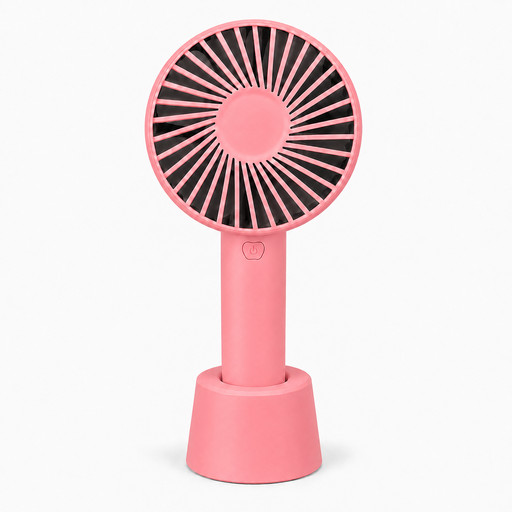
Why This Fits Their Persona: A simple option for home, office use, commuting and occasional travel, with a stand for hands-free cooling and a wrist strap for carrying.
It does not rely on handheld use alone: the supplied stand supports desktop placement, while USB charging works with laptops, power banks and compatible adapters.
Lightweight design; includes both a desktop stand and wrist strap.
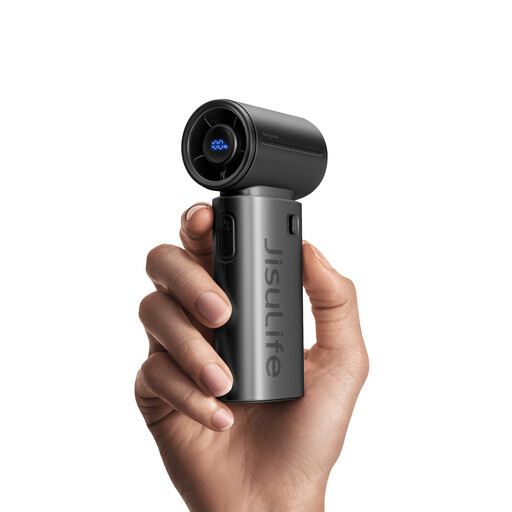
Why This Fits Their Persona: Suitable for commuters, travellers and concert visitors who want a compact fan with more speed adjustment and battery information.
The LED display shows the selected speed and battery level, making it easier to monitor charge instead of guessing from a single runtime claim.
5000mAh battery; five speed levels; stated operating time varies from 3 to 22 hours by setting.
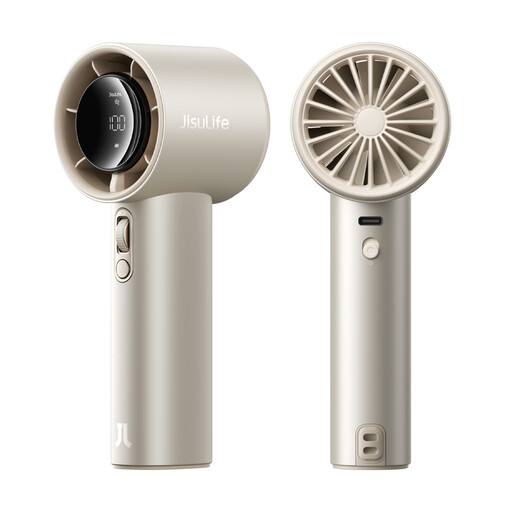
Why This Fits Their Persona: A high-output travel fan for outdoor events, long journeys and users who want fine control over airflow rather than only three fixed modes.
Its display shows battery and wind-speed information, while the scroll control offers 100 wind-speed levels. Higher settings will affect runtime and may produce more noise.
5000mAh battery; stated 1.5–2-hour charging time with compatible fast-charging equipment; 100 adjustment levels.
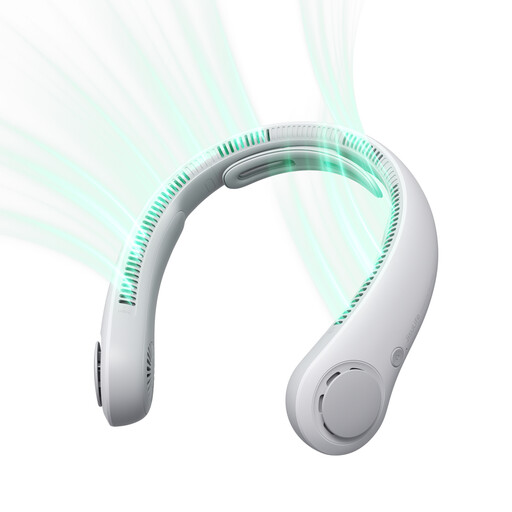
Why This Fits Their Persona: A portable neck fan for walking, gardening, gym sessions, outdoor work and events where holding a fan is inconvenient.
The hands-free format avoids continuous gripping, while five speeds and a stated 2.5–16.5-hour operating range provide adjustment for different activities.
Bladeless front design; USB-C charging; 5000mAh battery; approximately 282g weight.
We have compiled a complete, real-time list of products that fully satisfy these strict selection criteria and UK safety regulations.
Usually, their electricity use is modest because they operate from a small rechargeable battery. The cost depends on charging frequency, battery capacity and your electricity tariff. A simple estimate is:
Energy used per charge in kWh = battery watt-hours ÷ 1,000, with a small allowance for charging losses.
For example, a 5,000mAh battery listed at 3.7V is approximately 18.5Wh. Actual consumption varies according to the charging system and speed setting.
The operating time depends on speed, battery condition and usage. Product specifications may state several hours on high speed and substantially longer on low speed. Battery capacity gradually reduces with charge cycles, so avoid heat, punctures, moisture and unsuitable chargers to help preserve the built-in lithium-ion battery.
A neck fan should only be used by children with appropriate adult supervision. Check the manufacturer’s age guidance, keep lanyards away from young children and ensure the wearer does not use the fan while running, cycling or operating machinery. A conventional handheld fan may also require supervision because of rotating blades and charging cables.