
24/7 Customer Support

Free returns

Same-day & Next-day Delivery

Quality Guaranteed

Unlock Your Welcome Offers: FREE Delivery | Up to 80% OFF | Free 30-day JoyPlus trial
Download the APP
A portable handheld fan can make a noticeable difference on a crowded train, at a summer concert or during a warm night in a tent. However, compact cooling products vary considerably in battery capacity, airflow control, noise, charging and carrying options.
The specification that looks most impressive on a product page is not always the one that matters most in daily use. Before buying, check these common pitfalls and match the fan to how you actually plan to use it.
A high-speed turbo fan may produce a strong breeze, but maximum power usually uses more battery and can be louder. It may also feel excessive in an office, church, cinema or on public transport.
Look for adjustable control rather than focusing only on a headline wind-speed figure. A fan with three to five speed settings suits basic personal cooling, while models with 100 speed levels offer finer adjustment for different environments.
Battery claims normally refer to the lowest speed. A rechargeable handheld fan advertised with 18, 22 or 30 hours of use may run for considerably less at high power.
Check whether the listing states the operating range and charging time. A 5000mAh battery can be useful for travel and outdoor events, but capacity is only part of the decision. Charging access, the selected speed and the fan’s motor power all affect practical runtime.
A mini portable fan may fit in a handbag or pocket but still be uncomfortable to hold if the grip is awkward. Similarly, a fan without a stand or strap may be less useful at a desk or while walking.
For regular UK travel, consider weight, dimensions, a safety lock, a lanyard and USB charging. If you carry the fan in luggage, a lock can help prevent accidental activation. Keep fingers, loose hair and clothing away from moving blades or air intakes, and follow the manufacturer’s charging instructions.
Airflow may be listed in metres per second, RPM or simply as speed levels. These figures are not always directly comparable between brands, so use them alongside the fan’s design and intended use.
If you need a quiet portable fan for work or study, prioritise low-speed control and published noise information where available. One Life 9 listing gives a noise range of 55–76 dB at 30cm, demonstrating why high-speed operation may not suit every setting.
A USB rechargeable fan is convenient when you already carry a laptop, power bank or phone charger. Check the connector type, stated charging time and whether a cable is included.
A 2000mAh battery can keep a smaller, lightweight fan compact, while 4250mAh and 5000mAh batteries generally support longer stated operating ranges. Some larger models also offer power-bank functionality, although using that feature will reduce the charge available for cooling.
Do not expose a battery-operated fan to water, dismantle the battery or use an unsuitable high-voltage charger. For UK use, read the supplied instructions and check that the product includes appropriate manufacturer information, safety warnings and charging guidance.
For concerts, festivals, cruises and commuting, a fan weighing around 100–180g is easier to carry for extended periods. A wearable neck fan or lanyard can leave both hands free, while a foldable model can switch between handheld and desktop use.
A stand is valuable in an office or bedroom, but it adds little if your main priority is fitting the fan into a small pocket. Also consider whether the controls can be operated without accidentally changing speed inside a bag.
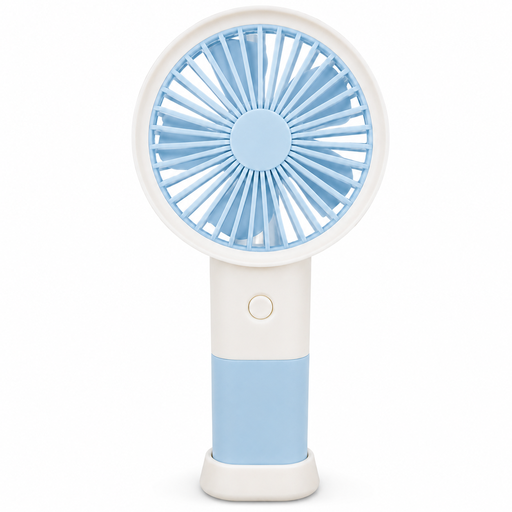
Why This Fits Their Persona: A straightforward choice for shoppers wanting everyday cooling without extra functions. The table stand also suits a home office or bedside table.
The three-speed control avoids relying on a single maximum setting, while Type-C charging makes everyday recharging simple.
Three adjustable speeds; integrated table stand; Type-C charging.
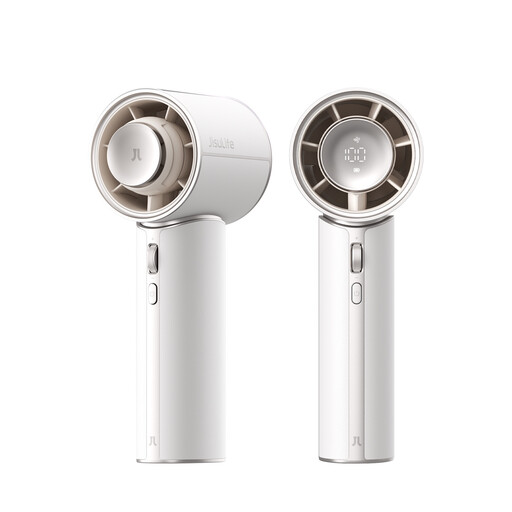
Why This Fits Their Persona: Its compact 180g format, storage pouch and retractable lanyard suit travel, events and gift shopping where appearance matters.
The stated 1–30 hour range makes the relationship between speed and runtime clearer than a single battery claim.
1–100 speed adjustment; LED display; aroma pod and five spare pads; 4250mAh battery.
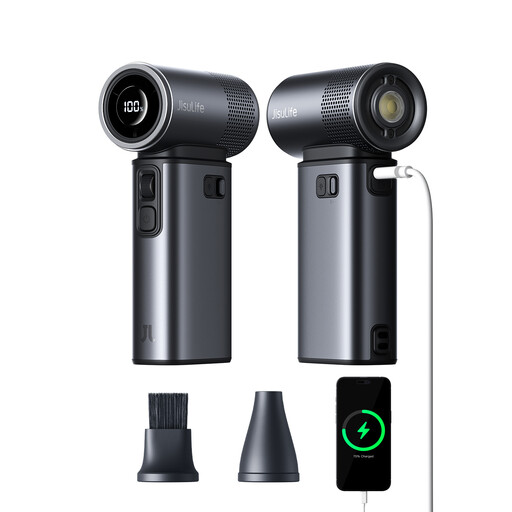
Why This Fits Their Persona: Designed for camping, beach trips, cruises and concerts where stronger airflow, a larger battery and added utility can be worthwhile.
The 9000mAh capacity and stated 3–25 hour range provide more context than quoting turbo power alone. Use storm mode away from eyes, faces and sensitive skin.
100 speed levels; 9000mAh battery; LED display; flashlight and power-bank function.
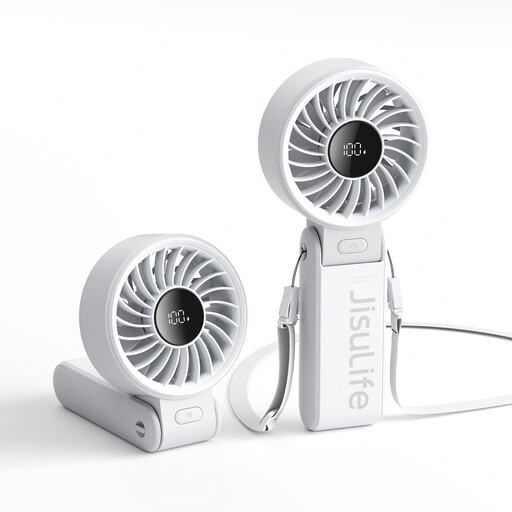
Why This Fits Their Persona: Foldable handheld, desktop and neck-worn use makes it practical for desk work, getting ready, shopping and outdoor activities.
Its stated 3.5–19 hour operating range and five speeds help set realistic expectations, while the display shows speed and remaining battery.
5000mAh battery; foldable 3-in-1 design; five speeds; LED display.
We have compiled a complete, real-time list of products that fully satisfy these strict selection criteria and UK safety regulations.
Most USB rechargeable fans use relatively little power compared with mains-powered room cooling appliances. The exact running cost depends on battery capacity, charging frequency, electricity tariff and speed setting. Charging from a laptop or power bank still transfers energy from that source, so it is sensible to recharge only when required.
The battery runtime varies by speed, battery condition and usage. Product listings may state ranges such as 3–19, 3–22 or 3–30 hours. Battery capacity gradually reduces over repeated charging cycles. Store the fan dry, avoid extreme heat and follow the supplied charging instructions to support normal service life.