
24/7 Customer Support

Free returns

Same-day & Next-day Delivery

Quality Guaranteed

Unlock Your Welcome Offers: FREE Delivery | Up to 80% OFF | Free 30-day JoyPlus trial
Download the APP
A portable handheld fan can make a noticeable difference on a crowded commute, warm office day, festival visit or holiday. However, compact fans vary considerably in battery capacity, airflow, charging convenience and stability. A low-priced model may appear attractive until it runs flat, becomes awkward to hold or offers only one impractical speed.
This guide explains the main buying traps and the specifications worth checking before choosing a rechargeable handheld fan, mini personal fan or portable desk fan.
A listing may highlight motor speed, blade count or a maximum wind figure. These numbers can be useful, but they do not show how comfortable the fan will be at arm’s length, how loud it may become or how quickly its battery will drain.
A high-power handheld fan can be suitable outdoors, but a lower setting may be more practical in a shared office, library or bedroom. Look for several speed settings rather than focusing only on the highest stated output.
“Cordless” does not necessarily mean long-lasting. Battery-operated fans using AA batteries can be convenient for immediate use, while a USB rechargeable fan is easier to maintain if you regularly carry a power bank or use a laptop.
Check:
A stated runtime is normally dependent on speed and usage conditions, so treat the maximum figure as a guide rather than a guarantee for every setting.
A fan that feels comfortable in the hand may not stand securely on a desk or bedside table. If you want hands-free cooling while working, studying or sleeping, choose a handheld fan with stand or a dedicated compact desk design.
Also consider the grille and blade construction. Keep fingers, hair and loose objects away from moving parts, and follow the supplied instructions. Fans should be kept away from water and excessive moisture. When buying in the UK, check that the product includes appropriate instructions, importer or manufacturer details and the relevant conformity marking for the product category.
For commuting or short trips, a small USB rechargeable fan may be sufficient. USB-C is particularly convenient because the same type of cable may already be used for a phone, tablet or power bank. Models with larger batteries can be more suitable for camping, festivals or long outdoor events, but they may also weigh more.
For example, the JISULIFE Life 7 lists a 5000mAh battery, five speeds and a stated operating range of 3.5 to 19 hours depending on settings. The JISULIFE Pro1S also lists a 5000mAh battery, with a stated 3 to 15-hour operating range depending on wind level and usage.
Weight and shape affect whether a fan stays in your bag or is left at home. A compact travel fan should be easy to grip and store without taking up much room. A wrist strap can help reduce accidental drops during walking or shopping.
If you mainly need cooling at a workstation, a stable base may be more valuable than an ultra-light body. Some models combine handheld and desktop use, while folding or neck-worn designs provide additional hands-free options.
A quiet portable fan is more suitable for offices, bedrooms and study areas, but “quiet” should be supported by clear product information rather than assumed from a small size. Brushless motors may be promoted for smoother or quieter operation, although actual sound levels depend on speed and design.
Multiple speed levels help you balance airflow and noise. For household safety, do not insert objects into the grille, avoid operating a damaged unit and disconnect the charger before cleaning. Lithium-ion battery models should not be disassembled, punctured or exposed to fire or extreme heat.
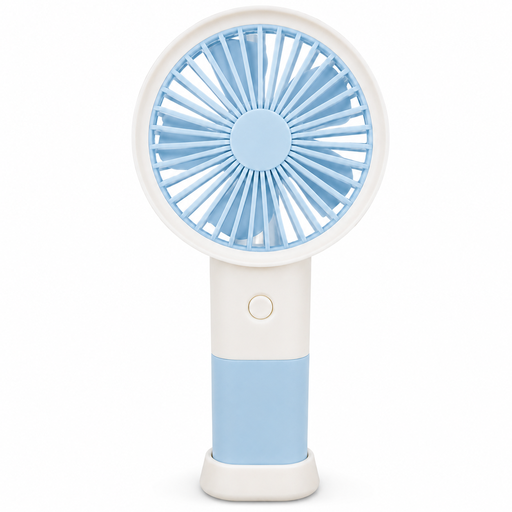
Why This Fits Their Persona: A practical option for commuters, students and office workers wanting one compact fan for handheld and desk use.
Three speed settings avoid reliance on one fixed airflow level, while the included table stand addresses the common desk-stability problem.
Type-C charging; three speeds; supplied table stand; compact format for bags and backpacks.
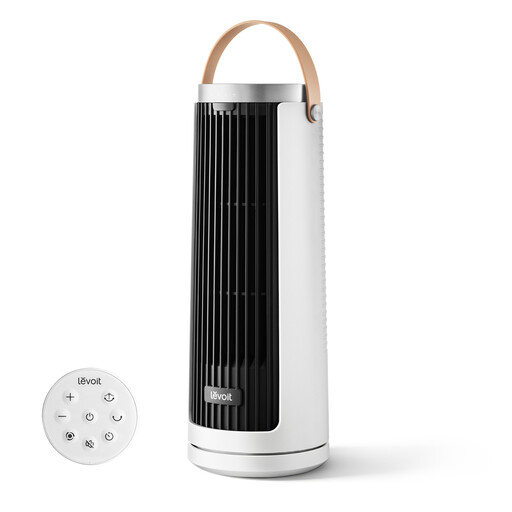
Why This Fits Their Persona: Its tower form suits buyers who prefer a dedicated, hands-free unit for an office, bedroom, study or bedside table.
The product information specifies cordless rechargeable operation, multiple airflow modes and low-noise operation instead of a single-speed design.
USB-C recharging; cordless use; multiple airflow modes; compact tower design.
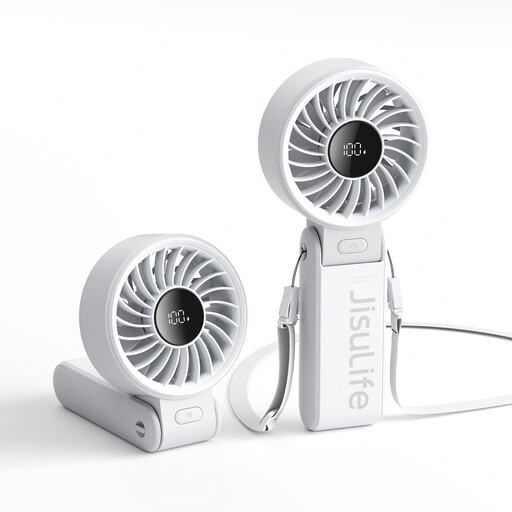
Why This Fits Their Persona: Suitable for long working days, outdoor events, camping and travel where battery information and flexible positioning matter.
The digital display shows wind speed and remaining battery power, helping reduce uncertainty about when recharging is needed.
5000mAh battery; five speed settings; stated 3.5–19-hour operating range; handheld, desktop and neck-worn use.
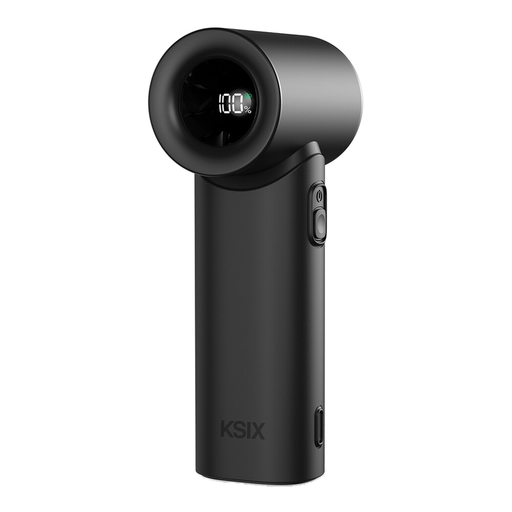
Why This Fits Their Persona: A compact choice for shoppers prioritising a stated maximum air speed for festivals, commuting and outdoor activities.
Its specifications state the maximum air speed, charging time and battery capacity, making the performance and power requirements easier to compare.
9.0m/s stated maximum air speed; 3000mAh battery; USB-C charging; 128g weight; handheld and desktop use.
We have compiled a complete, real-time list of products that fully satisfy these strict selection criteria and UK safety regulations.
Charging time depends on the battery capacity, input specification and charger used. The KSIX AirGo Turbo lists approximately three hours, while larger-capacity models may take longer. Always use a compatible cable and power source, and follow the product manual.
A rechargeable model avoids repeatedly buying disposable AA batteries and can be topped up from a laptop, adapter or power bank. Running cost still depends on electricity use, charging frequency and battery condition. A battery-operated fan may be useful when you need instant operation away from a socket.
Some can. Look for a supplied stand, foldable body or a product explicitly described for handheld and desktop use. Place the fan on a stable, flat surface, keep the air outlet clear and do not position it near water.