
24/7 全天候客户支持

免费退货

当日/次日达

品质保障

开启新人专享福利: 全场免邮 | 低至 2 折 | 免费试用 30 天 JoyPlus 会员
下载 Joybuy
A portable handheld fan can make a crowded train, warm office or outdoor event more comfortable, but choosing one based only on phrases such as “turbo power” or “long battery life” can lead to disappointment. A compact body may be awkward to hold, maximum runtime may apply only at the lowest speed, and a USB cable is not always included.
Before buying, focus on how the fan will fit into your daily routine. The right model should provide suitable airflow, practical battery performance and a charging method that works with the devices you already carry.
A rechargeable handheld fan may advertise 18, 22 or 30 hours of operation. These figures generally depend on the lowest speed setting and may not represent use at higher airflow levels. If you need a fan for a full day at a festival or while travelling, check whether the product lists different operating times by speed.
Battery capacity is useful but not the only factor. A 5000mAh battery may support a longer low-speed runtime, while a high-speed turbo fan can use considerably more power.
Products may list motor speed in RPM, wind speed in metres per second or simply use descriptions such as “high-power”. These figures are not interchangeable. A higher RPM number does not automatically mean that the fan will feel more effective at the distance you use it.
Look for practical controls, such as three to five speed settings, or a wider adjustment range. A personal cooling fan used in an office may need a gentle breeze, while outdoor use at a concert or sports event may call for a more concentrated airflow.
A mini portable fan that is too heavy can become tiring during a commute. Similarly, a pocket fan without a stand or lanyard may be less useful at a desk or while sightseeing. Check the dimensions, weight and included accessories before ordering.
For lithium-ion models, use the recommended charging cable and adapter, keep the fan away from water and do not place fingers or objects near the grille while it is running. A safety lock can also help prevent accidental activation inside a handbag or suitcase.
For regular travel, a USB rechargeable fan is usually convenient because it can be topped up from a laptop, power bank, car charger or USB adapter. USB-C is increasingly useful because it may match the cable used for other devices.
Pay attention to both operating time and charging time. Some compact models run for several hours at higher speeds but require longer charging, while others provide a shorter recharge period with a compatible adapter. A battery indicator or handheld fan with LED display makes it easier to see when charging is needed.
A fan with several speed levels gives you more flexibility in different settings. Lower speeds can be more suitable for an office, library or indoor event; higher levels may be more practical outdoors.
Noise information is helpful when it is provided, but check the stated measuring distance. One Life 9 model lists noise between 55dB and 76dB at 30cm, so the perceived sound may vary depending on the setting and how close the fan is to your face.
A lightweight design is useful for commuting and travel, while a stand can convert a handheld fan into a portable desk fan. Neck cords, wrist straps and retractable lanyards provide alternative carrying options, but any cord should be used responsibly and kept away from young children.
For luggage, also check whether the fan has a safety lock, storage pouch and a clearly stated lithium battery rating. These details can be more useful than decorative features when the fan is used frequently.
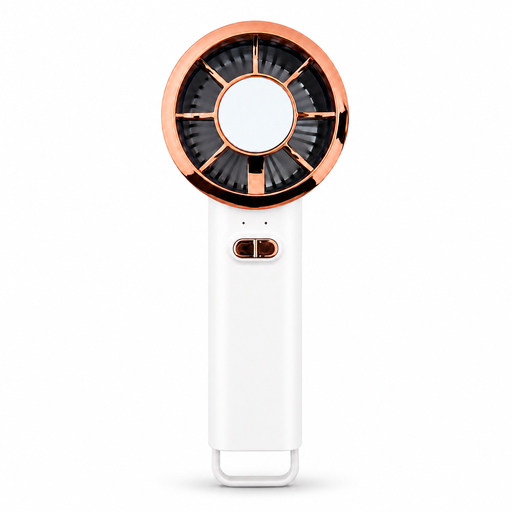
Why This Fits Their Persona: A practical starting point for commuters, students and office users who want simple personal cooling without a complex control system.
Three speed settings provide straightforward adjustment, while USB charging avoids reliance on replaceable batteries.
Includes an integrated phone stand and can be charged from a laptop, power bank or USB adapter.
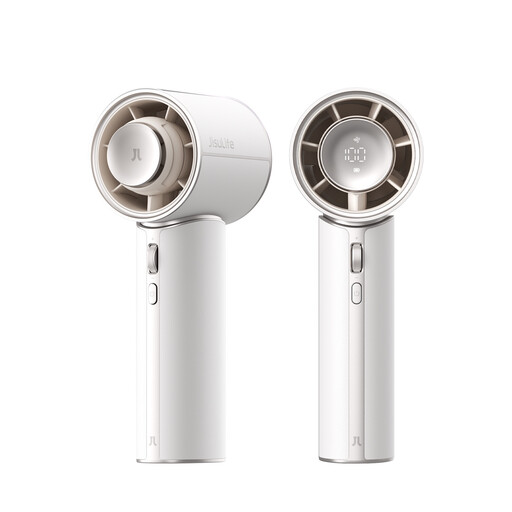
Why This Fits Their Persona: Suitable for shoppers who value a refined finish and fine control for offices, weddings, travel or outdoor events.
The LED display shows wind speed, while a battery check and safety lock help address uncertainty during travel.
Lists 1–100 wind levels, a 4250mAh battery and a stated 3–30-hour operating range depending on speed.
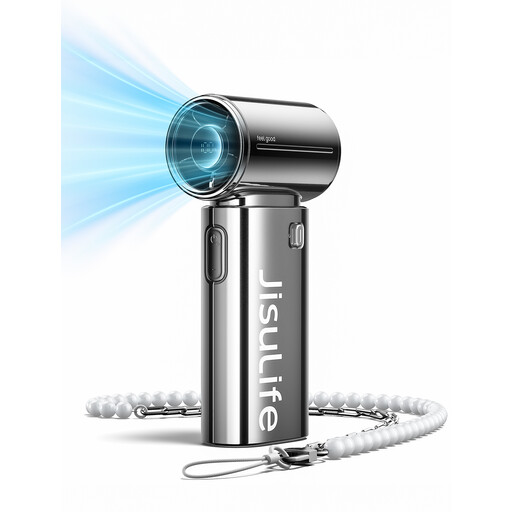
Why This Fits Their Persona: A suitable match for outdoor events, cruises, camping and long journeys where a larger battery and concentrated airflow are priorities.
The five-speed system and stated speed-dependent runtime make it easier to select a realistic setting rather than relying only on a headline figure.
Features a 9-blade design, listed wind speed of up to 10m/s, 5000mAh battery, LED display and carry lanyard.
They can be more convenient for regular use because you recharge the built-in battery rather than repeatedly buying AA batteries. Running cost depends on electricity tariffs, charging frequency and battery lifespan. A USB rechargeable fan can usually be topped up from equipment you already own.
Charging time varies by model, battery capacity and adapter. The listed products range from approximately two to five hours under their stated conditions. Check whether fast charging requires a compatible adapter, and avoid unsuitable high-voltage chargers.
Some models include a stand or foldable design for hands-free use. If this matters, confirm that a stand is supplied rather than assuming the fan can balance independently. A desktop mode is useful in an office, beside a bed or while applying make-up, while a lanyard is more practical for festivals and sightseeing.